
To define credibility is to understand the single most powerful force in modern public relations. In 2026, audiences face constant information overload.
They scroll past hundreds of messages every day.

Therefore, they do not simply choose what to believe; they filter out everything that does not feel real, honest, or backed by proof.
Visibility alone no longer wins attention. Credibility does. The global communications landscape is facing a trust crisis.
Multiple global surveys, including the Edelman Trust Barometer, consistently show declining confidence in institutions, media outlets, and corporate messaging.
As a result, brands and leaders that define credibility as a core strategic asset will rise above the noise. Those that do not will fade quickly.
This article breaks down exactly how to define credibility, why it matters in PR, and how leading firms like Spred Global Communications help organizations engineer it at scale.
Additionally, we cover the key pillars, common mistakes, and proven strategies you can use to build lasting credibility today.
What Does It Mean to Define Credibility?
Credibility, in the context of public relations and communications, refers to the perceived believability, reliability, and expertise of a source.
It is the immediate judgment audiences make when they receive a message. In other words, credibility is the filter through which every brand claim, press release, or leadership statement passes.
Importantly, credibility’s meaning goes beyond simply telling the truth.
A brand can be factually accurate yet still appear untrustworthy because of past actions or inconsistent messaging.
Therefore, credibility is largely perception-based. Audiences use mental shortcuts to evaluate whether a source is worth trusting.
How Audiences Define Credibility in Practice
Audiences typically ask three key questions when they define credibility for any source:
- Does this source know what they are talking about?
- Is this source being honest with me?
- Does this source behave consistently over time?
However, it is also important to distinguish credibility from related concepts. Reputation is the long-term aggregated perception built over years.
Authority is recognized expertise in a field. Credibility, on the other hand, operates at the moment of communication. It is the gateway through which reputation and authority are interpreted.
Read Also: Proven Executive Message Alignment Techniques to Master During Crises
Define Source Credibility: The Foundation of Influence
To define source credibility, we look at academic research in persuasion psychology.
Source credibility theory identifies two core elements: expertise and trustworthiness.
Audiences accept messages more readily when they believe the source knows the subject deeply and communicates honestly.
Furthermore, when you define credible source characteristics in a PR context, you look for three consistent traits.
First, the source consistently backs claims with data and evidence.
Second, the source speaks clearly and avoids vague or overpromising language.
Third, the source acknowledges mistakes and corrects them openly.
As a result, brands that build these traits over time develop a credibility advantage.
They influence narratives with less resistance and recover faster from mistakes.
Additionally, they also maintain audience loyalty even under heavy scrutiny.

Define Credibility Through Its Four Core Pillars
In order to fully understand the concept of credibility as a tool for PR, it is important to first understand the four pillars of credibility.
Each pillar has its own unique function and works together to form a platform that allows for trust and influence.
Expertise: Demonstrate What You Know
Expertise is the perception that a brand or leader has knowledge and skills.
Yet, claiming expertise without supporting this claim with facts and data does the exact opposite. Therefore, it is important for a PR practitioner to do the following:
- Conduct data-driven research and insights
- Write thought leadership articles for publications
- Contribute to industry panels and reports
- Speak at industry conferences
Trustworthiness: Build Honest Communication
Trustworthiness is the perception of honesty and ethical intent. It is a delicate concept. Once lost, it is extremely hard to regain.
In some cases, it is impossible. Yet, this pillar is vital for the success of a brand. Therefore, it is important for a brand to
Be honest and transparent
- Communicate transparently, even during difficult moments
- Acknowledge mistakes quickly and clearly
- Maintain ethical consistency across all decisions
Reliability: Do What You Say You Will Do
On the other hand, reliability entails being able to do what we promise to do. This instills a sense of predictability, which in turn instills a sense of confidence in our audience.
Furthermore, to understand what reliability entails in psychology, we can understand it as a function of behavior that remains constant across situations and time.
When we apply this to PR, a brand that is reliable has to demonstrate constant messaging, meet expectations as communicated, and demonstrate reliability as a function of time.
Authenticity: Align Words with Actions
Authenticity entails a state of being where there is a match between what we claim to do and what we end up doing.
Modern audiences are extremely sensitive to messaging that is merely performative in nature.
They can easily pick up on discrepancies between what a brand claims to do and what it ends up doing.
What Is the Credibility Gap and Why Does It Destroy Brands?
What is the credibility gap? Simply put, it is the space between what a brand claims and what audiences actually believe.
When this gap widens, trust collapses rapidly. Organizations lose influence. Leaders lose authority.
In addition, the credibility gap often forms silently, through small inconsistencies, delayed crisis responses, or messaging that feels polished but hollow.
Several common patterns create a credibility gap. Overpromising and underdelivering is the most frequent cause.
However, poor crisis handling, especially denial or delayed response, can widen the gap faster than almost anything else
Furthermore, inconsistent messaging across platforms confuses audiences and signals a lack of internal alignment.
The key warning signs of a credibility gap include:
- Declining audience engagement despite high visibility
- Increased skepticism in public comments and media coverage
- Low trust scores on brand perception surveys
- Slow recovery after negative press events
How Spred Engineers Credibility for High-Stakes Organizations
Spred Global Communications does not simply run PR campaigns.
Instead, they operate as a reputation intelligence partner for Fortune 500 companies, government agencies, and high-profile executives.
Their core mission is to protect and elevate institutional credibility through strategic communications, reputation architecture, and measurable influence.
The company approaches the challenge of how to define credibility as a structural problem, not a messaging problem.
Therefore, they build systems rather than campaigns. These systems compound trust over time and protect enterprise value. This approach delivers results that single campaigns simply cannot sustain.
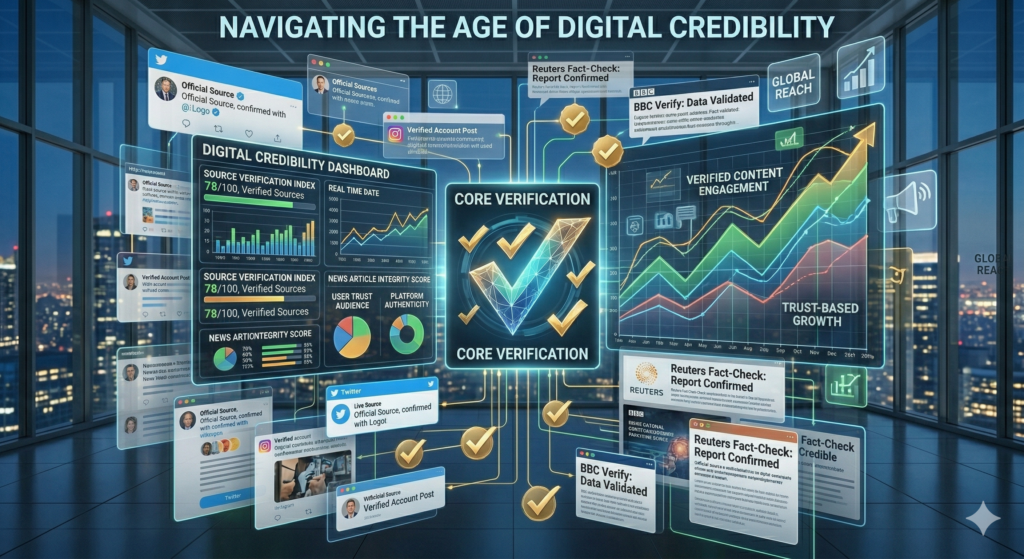
Spred’s Five Strategic Pillars for Credibility Architecture
This firm structures its advisory model around five pillars designed to define credibility at an institutional level:
- Narrative Control: Spred designs narrative architecture that prevents reputational drift before it escalates into public exposure.
- Reputation Infrastructure: The company builds durable credibility systems that compound trust over time rather than spiking attention through isolated campaigns.
- High-Stakes Crisis Intelligence: In addition, they deliverdelivers real-time response frameworks so organizations protect credibility in the critical first hour of any crisis.
- Elite Visibility Strategy: Spred engineers strategic visibility that strengthens authority without creating unnecessary reputational risk.
- Contrarian Industry Reframes: The company challenges PR illusions by reminding clients that visibility is not credibility and volume is not authority.
How to Define Credibility in a Digital Media Environment
Digital media has significantly changed how audiences define credibility. Social platforms allow direct communication.
However, they also expose brands to immediate public scrutiny. Credibility can build quickly in digital spaces, but it can collapse even faster.
Consequently, brands must pay as much attention to their digital presence as they do to traditional media.
Finally, there is the issue of misinformation, which affects the definition of credible source signals.
For example, it is hard for a user to distinguish credible sources from sources of misinformation.
Therefore, brands that make efforts towards building credible source signals will be at an advantage.
The key digital credibility signals are as follows:
1. Earned media from top-tier publications
2. Consistent, data-driven content across all touchpoints
3. Positive user reviews and authentic user testimonials
4. Transparent communications during times of crisis
5. Third-party validation from industry experts, analysts, and journalists
What Is a Credibility Statement and How Do You Build One?
A credibility statement is a statement that communicates your expertise, trust, and value proposition to a specific audience.
A credible statement, however, is more than a statement. It is a statement that must also be reflected in the performance of an organization.
Therefore, a credible statement is only effective if an organization’s performance is a reflection of the statement.
In order to develop an effective credibility statement, the following steps should be followed:
- Define your area of expertise based on hard facts and data
- Clearly define the problem that your audience needs help with
- Add hard facts and data as proof
- Align your statement with your public behavior and messages
- Test your statement with your stakeholders
Proven Strategies to Build and Define Credibility Over Time
Defining credibility as a tool for business requires building and sustaining it. One campaign does not establish credibility.
Therefore, it is important for public relations practitioners and business leaders to use the following strategies for all the campaigns they develop and implement:
Thought Leader Positioning
Share your knowledge based on hard facts and data. Also, contribute to the conversation by sharing your unique perspective.
In addition, publish articles in other media outlets. Thought leader positioning is one of the most effective tools for defining credibility.
Leverage Earned Media and Strategic Storytelling
It is much more credible than paid media. Therefore, it is much easier to build credibility through earned media than through paid media.
Additionally, the stories and experiences shared through earned media resonate much deeper with the audience than paid media.
Invest in Crisis Readiness
In most cases, credibility is most apparent in times of crisis. Therefore, organizations that invest in a crisis readiness framework build their credibility much better than those that do not.
Spred’s crisis intelligence model states that the first sixty minutes of a crisis response define the next six months of perception.
Therefore, it is the preparation and not the credibility that matters in times of crisis.
Align Actions Consistently with Values
Credibility is all about aligning actions with the organization’s values. In addition, actions and values must be aligned consistently.
In most cases, actions and values that are not aligned destroy an organization’s credibility much faster than any other factor.
Therefore, an organization must ensure that all the actions it takes align with the organization’s values.
How to Measure and Track Your Define Credibility Progress
It is impossible to measure credibility in a direct and quantifiable manner.
Nevertheless, there are certain parameters that PR professionals can monitor in order to evaluate the overall levels of credibility.
Moreover, it is also possible to get an overall view of the situation by considering a combination of these parameters.
Certain key tools for measuring credibility include the following:
- Trust Score – A method of calculating the beliefs of the audience for your brand through surveys.
- Sentiment Analysis – A method for analyzing the overall sentiment or perception of the audience for your brand.
- Media Quality Tracking – A method for analyzing the credibility of the media covering your brand.
- Audience Perception Surveys – A method for analyzing the believability and trustworthiness of your brand.
- Brand Trust Tracking – A method for tracking the overall parameters for building brand credibility in the long term.
It is also important to note that high engagement does not necessarily mean high credibility.
Common Credibility Killers You Must Avoid
Even the most well-resourced organizations can undermine their own credibility through preventable blunders.
Henceforth, PR practitioners must be aware of these credibility killers in the organization’s communication strategy and eliminate them as soon as possible:
- Inconsistent Messaging – This is the fastest way to undermine an organization’s credibility.
- Lack of Transparency – This is another surefire way to undermine an organization’s reputation.
- Overpromising and Underdelivering – This is the surefire way to undermine an organization’s reliability pillar of credibility.
- Poor Crisis Response – This is another surefire way to undermine an organization’s reputation.
- Performative Messaging – This is another surefire way to undermine an organization’s reputation.
The Future: Why Define Credibility Now More Than Ever
The need to define credibility as a key aspect in the organization’s strategy is going to become even more important in the future.
This is because there are several emerging trends that are going to affect how people perceive sources and brands in the next phase in the evolution of the communications landscape.
- AI Content Scrutiny: Audiences are increasing their skepticism of AI-generated content. As a result, human-backed authenticity signals carry greater weight.
- Demand for Transparency: Stakeholders expect more disclosure and accountability from organizations across all sectors.
- Verification Culture: Greater emphasis on fact-checking and source validation means that credibility signals must be verifiable, not just claimed.
Therefore, organizations that invest in building genuine credibility today will gain a significant competitive advantage in the future.
Authenticity is becoming a differentiator that no budget can simply buy.
Frequently Asked Questions: Define Credibility in PR
Q1: How do you define credibility in public relations? To define credibility in PR, we describe the perceived believability, expertise, and reliability of a brand or source.
It is the quality that causes audiences to accept a message rather than question it.
Furthermore, it operates at the moment of communication and directly influences trust and decision-making.
Q2: What is the meaning of “credibility” in a business context? Credibility, meaning in business, refers to the degree to which stakeholders, investors, customers, regulators, and the media believe that your brand is honest, competent, and consistent.
Additionally, credibility is the foundation on which all influence and trust is built.
Q3: How do you define a credible source in PR? To define credible source characteristics in PR, look for expertise backed by evidence, transparent communication, a track record of accurate information, and a consistent alignment between statements and actions.
When you define credible source standards clearly, you give your audience a reliable filter for evaluating information.
Conclusion: Define Credibility Before the Market Defines It for You
Credibility is not just a superficial quality. It is the underlying driver of trust, influence, and protection of enterprise value.
In a world of fragmented and dubious media attention, credibility is the litmus test for engagement or dismissal.
Organizations that succeed in defining credibility, building it with sustained effort, and defending it in adversity will achieve a sustainable competitive advantage.
Enterprises such as Spred Global Communications are proof that credibility is engineered as a system, not an initiative.
Their business model proves that by defining credibility as a foundation for the business, based on expertise, trustworthiness, reliability, and authenticity, an organization will not just survive the test of adversity but will flourish under it.
Start today. Audit your credibility gaps. Align your messaging with your actions. Build the systems that sustain long-term trust.
And remember: the organizations that define credibility on their own terms shape the narrative. The organizations that do not wait for others to define it for them.
