
Why High-Stakes Leaders Need Strategic Media Preparation
Executive media training prepares senior leaders for intense public scrutiny. Without proper executive media training, every interview becomes a reputation risk.
Today, CEOs face regulatory pressure from every direction. Founders navigate investor confidence challenges daily. Board members answer difficult questions under bright lights.

Your media visibility directly equals your reputation exposure. One poorly handled question can erase years of trust. A single misstatement can trigger stock price volatility overnight.
Here is the critical distinction most leaders miss. Media skills teach you how to speak clearly on camera. Executive risk management protects your enterprise from narrative collapse.
Generic media coaching fails C-suite leaders consistently. Those programs focus on body language and vocal tone. They ignore litigation sensitivity, regulatory frameworks, and board alignment.
That is precisely where strategic advisory stands apart. Spred Global Communications operates as a media training for leaders advisory firm. We do not teach presentation tricks or rehearse talking points.
Instead, we prepare leaders for the moments that define legacies. We build strategic defenses around your public narrative. Your reputation deserves more than a confidence workshop.
Executive Media Training for Exclusive High-Stakes Leaders: Table of Contents
- Why High-Stakes Leaders Need Strategic Media Preparation
- What Is Executive Media Training?
- What Are the Core Components of Executive Media Training?
- Executive Media Training vs Generic Media Coaching
- Benefits of Professional Media Coaching for C-Level Executives
- How to Choose an Executive Media Training Company
- How Much Does a Bespoke Media Relations Workshop Typically Cost?
- Executive Media Training Programs with Live Coaching Sessions
- Compare Virtual Media Training Platforms for Senior Leaders
- Top Executive Media Training Services for C-Suite Leaders
- Where to Find Executive Media Coaching Near Me
- Frequently Asked Questions About Executive Media Training
- Executive Media Training for Leaders Who Cannot Afford Mistakes
What Is Executive Media Training?
So, what is a media executive expected to handle today? The answer goes far beyond press conferences and interviews. Modern executives face adversarial journalists, activist investors, and regulatory bodies.
Executive media training operates within a governance context first. It protects leaders who carry fiduciary and reputational obligations. Every public statement carries legal, financial, and strategic weight.
Let us clarify three distinct categories that often get confused.
- Media training focuses on interview techniques and delivery skills
- Executive media services cover strategic communication across channels and stakeholders
- Reputation risk advisory builds protective frameworks around leadership visibility
What does a media executive do in a high-pressure environment? They represent the organization during earnings calls and regulatory inquiries. They speak to journalists who specialize in confrontational questioning.
CEOs carry the heaviest exposure burden in any organization. Founders face unique scrutiny during funding rounds and IPO roadshows. Board members must communicate with precision during governance challenges.
Each role demands a different communication strategy entirely. That is why one-size-fits-all coaching programs consistently fall short. The stakes differ, so the preparation must differ too.
Executive media training ties directly into reputation protection architecture. Your words become permanent records in regulatory filings and transcripts. Journalists quote you, analysts interpret you, and regulators scrutinize you.
Therefore, this training exists to protect enterprise value at every level. It prepares you for the worst scenarios before they arrive. Strategic leaders never wait for a crisis to start preparing.
What Are the Core Components of Executive Media Training?
Understanding what are the core components of executive media training are matters deeply. Four pillars form the foundation of any credible program. Each pillar addresses a distinct risk vector that leaders face.
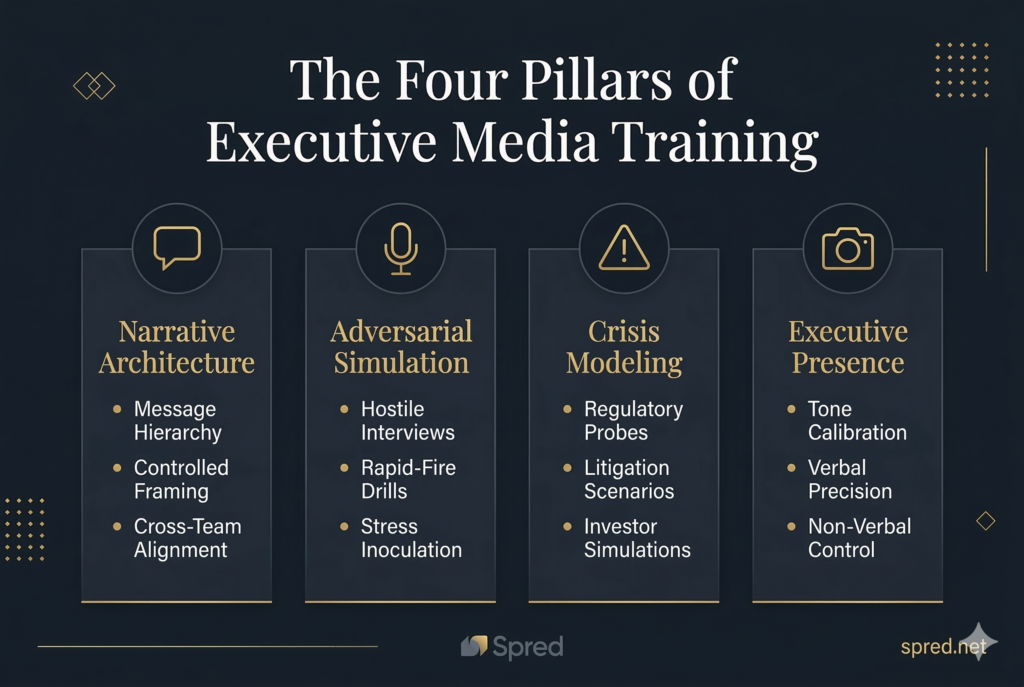
Here are media training examples drawn from real advisory engagements. These media training exercises reflect the intensity senior leaders encounter. Let us walk through each component in detail.
Narrative Architecture and Message Discipline
Message discipline starts with building a clear hierarchy of ideas. You identify your primary narrative and protect it fiercely. Every response you give reinforces that central narrative.
Controlled framing means you shape the conversation proactively. You do not react to the interviewer’s framing passively. Instead, you redirect toward your strategic messaging consistently.
Alignment across legal, communications, and board teams is critical. Your messaging must satisfy all three audiences simultaneously. Misalignment between these groups creates exploitable gaps for journalists.
Adversarial Media Training Exercises
Hostile interview simulation replicates real confrontational environments. Trained journalists challenge you with aggressive questioning patterns. You practice maintaining composure under deliberate pressure.
Rapid-fire questioning tests your ability to think quickly. These drills compress decision-making into fractions of a second. You learn to respond with precision rather than impulse.
Stress inoculation builds your resistance to high-pressure moments. Through repeated exposure, you develop calm authority naturally. The goal is to make pressure feel familiar, not threatening.
Crisis Scenario Modeling
Regulatory probes require extremely careful language from leaders. One misstatement during a regulatory inquiry can trigger formal investigations. Simulation prepares you for these precise, high-consequence moments.
Litigation exposure scenarios test your ability to protect legal positions. You practice speaking publicly without compromising active legal strategies. This balance demands specific training that generic programs ignore.
Investor call simulations prepare you for skeptical financial audiences. Analysts ask pointed questions designed to reveal weaknesses. You learn to address concerns while reinforcing market confidence.
On-Camera Authority and Executive Presence
Tone calibration ensures your delivery matches your message intent. A serious message requires a serious tone, without exception. Mismatched tone undermines credibility faster than incorrect facts.
Verbal precision eliminates filler words and ambiguous phrasing. Every word you speak must carry a strategic purpose. Audiences lose confidence when leaders speak vaguely or ramble.
Non-verbal control covers posture, eye contact, and gestures. Your body communicates as loudly as your words do. Trained leaders project authority through both channels simultaneously.
Related: High-Stakes Media Interview Preparation: Complete Executive Guide
Executive Media Training vs Generic Media Coaching
Why do senior leaders need something fundamentally different? The answer lies in the consequences of getting it wrong. Generic coaching prepares you for friendly interviews and conferences.
Executive media training prepares you for hostile, high-stakes encounters. The gap between these two approaches is enormous.
Consider the difference between founder coaching and public CEO exposure. A founder speaking at a tech conference faces moderate risk. A public company CEO addressing an earnings miss faces litigation risk.
Political-level questioning intensity defines executive media encounters today. Journalists treat senior business leaders like elected officials now. They probe for contradictions, inconsistencies, and hidden agendas.
Litigation-sensitive environments demand legally aware communication strategies. Every word a CEO speaks can appear in court filings. Generic coaches do not understand this reality at all.
The reputation consequences of misstatements compound over time dramatically. A poorly worded response lives online permanently. Search engines surface your worst moments for years afterward.
That is why senior leaders require bespoke executive media services specifically. Cookie-cutter programs create cookie-cutter leaders who stumble under pressure. Your exposure profile demands preparation that matches your risk level.
Spred builds programs around your specific vulnerability profile. We study your regulatory environment, investor base, and media landscape. Then we design training that addresses your actual risks directly.
Benefits of Professional Media Coaching for C-Level Executives
What are the benefits of professional media coaching for C-level executives? The returns extend far beyond better interview performance. Strategic executive media training protects and enhances enterprise value measurably.
Here are the core benefits you should expect from proper preparation:
- Protect enterprise valuation by preventing public statements that trigger sell-offs or downgrades
- Control narrative during volatility so your message reaches stakeholders before speculation fills the void
- Prevent regulatory misinterpretation by using precise language that satisfies compliance requirements
- Strengthen investor confidence through consistent, credible communication during earnings cycles and roadshows
- Increase strategic authority by demonstrating command of complex topics under public pressure
Each benefit compounds over time as your public track record builds. Investors watch how you handle tough questions across multiple appearances. Regulators notice when leaders communicate responsibly and precisely.
Executive media services create cumulative value for your personal brand. Consistent performance builds trust that protects you during difficult periods. Leaders with strong media records recover from crises faster.
How to Choose an Executive Media Training Company
Choosing the right partner determines your level of preparedness entirely. Not all firms deliver the rigor that senior leaders actually need. Here is what you should evaluate when choosing an executive media training company.
You want to find top-rated media training firms specializing in crisis communication. Crisis capability separates serious advisory firms from presentation coaches. Ask every prospective partner these critical questions.
Crisis Communication Expertise
Does the firm specialize in crisis scenarios specifically? Or do they primarily offer generic presentation and speaking coaching? This distinction matters more than any other evaluation factor.
Ask them to describe their crisis simulation methodology in detail. Request references from clients who faced actual public crises. A firm without crisis expertise cannot prepare you for real exposure.
Regulatory and Legal Alignment
Does the firm understand disclosure frameworks and compliance requirements? Can they train you to communicate without triggering regulatory scrutiny? Leaders in regulated industries need this capability urgently.
Your media training must align with your legal counsel’s guidance. The best firms collaborate with your legal team directly. They build messaging that satisfies both public and regulatory audiences.
Real Simulation Capability
Does the firm run hostile drills with trained adversarial interviewers? Or do they conduct soft, supportive interview practice sessions? The difference determines whether you are actually prepared for real encounters.
Ask to observe a simulation session before you commit. Watch how their trainers create pressure and challenge participants. Effective simulation should feel uncomfortable and revealing.
Governance Alignment
Can the firm align your messaging with board-level expectations? Do they understand how public statements affect governance dynamics? Board confidence requires communication consistency from leadership.
Spred integrates governance awareness into every training engagement naturally. Our approach connects your public communication to your board strategy. This alignment protects both your reputation and your organizational authority.
Related: Executive Public Relations: CEO Reputation & Thought Leadership
How Much Does a Bespoke Media Relations Workshop Typically Cost?
Also, how much does a bespoke media relations workshop typically cost? Pricing varies dramatically based on scope, intensity, and customization. Understanding the tiers helps you budget appropriately for proper preparation.
Here is a realistic breakdown of market pricing today:
- Entry-level coaching ranges from $2,000 to $5,000 per session and covers basic interview preparation and delivery improvement
- Mid-tier executive programs range from $10,000 to $30,000 and include scenario simulation, message development, and on-camera training
- Bespoke high-stakes executive media training starts at $50,000 and above for comprehensive programs with crisis modeling, legal alignment, and ongoing advisory
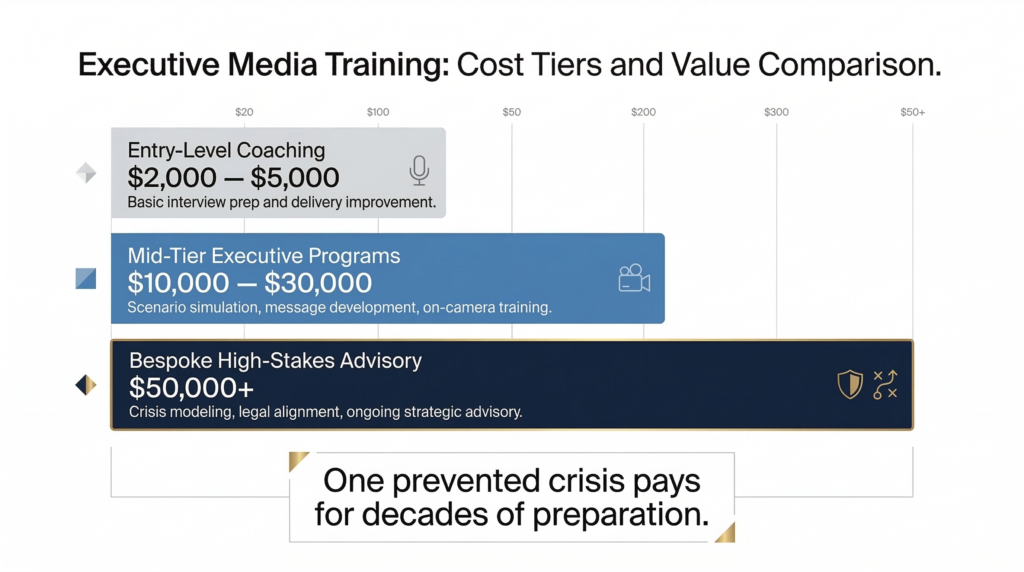
Frame this investment correctly in your mind right now. This is reputation insurance, not a discretionary expense. One prevented crisis pays for decades of preparation instantly.
A single mishandled interview can erase billions in market value. Training that prevents that outcome represents an extraordinary return on investment. The cost of unpreparedness always exceeds the cost of preparation.
Executive Media Training Programs with Live Coaching Sessions
Executive media training programs with live coaching sessions deliver results that recorded modules cannot match. Real-time environments create authentic pressure that builds genuine capability. Here is why live training outperforms every alternative.
Real-time correction happens in the moment during live sessions. A coach identifies your weaknesses as they appear naturally. You adjust immediately rather than reviewing footage days later.
Live programs typically include these high-value components:
- Mock press conferences with trained journalists asking adversarial questions
- Earnings call simulation with analysts challenging your financial narrative
- Regulatory inquiry drills that test your compliance-aware communication
- Investor roadshow preparation with skeptical audience role-play
Recorded modules lack the pressure that triggers authentic stress responses. You need to practice under conditions that mirror real encounters. Your muscle memory only develops through repeated live repetition.
Live coaching also allows trainers to adapt to your specific patterns. Everyone has different verbal habits and non-verbal tendencies. Personalized correction in real time accelerates your development dramatically.
Related: Crisis Communications Planning: Frameworks on How to Prevent Disasters
Compare Virtual Media Training Platforms for Senior Leaders
When you compare virtual media training platforms for senior leaders, clear differences emerge quickly. Not all platforms deliver the same value or rigor. Three distinct categories exist in the market today.
| Feature | Generic Platform | Boutique Firm | Strategic Advisory (Spred Model) |
|---|---|---|---|
| Approach | Presentation tips | Interview practice | Crisis and governance preparation |
| Questioning Style | Soft questioning | Media coaching | Adversarial stress testing |
| Legal Awareness | No legal lens | Limited scope | Reputation risk modeling |
| Customization | Template-based | Moderate | Fully bespoke |
| Outcome | Better delivery | Better interviews | Strategic reputation protection |
Virtual-only platforms lack executive-level realism in most cases. They work well for mid-level managers and spokespeople. Senior leaders face pressures that virtual platforms cannot replicate fully.
The best approach combines virtual accessibility with live intensity. Strategic advisory firms offer hybrid models that serve global leaders. You get the convenience of virtual with the rigor of live.
Top Executive Media Training Services for C-Suite Leaders
What defines top executive media training services for C-suite leaders? The answer goes beyond client lists and testimonial pages. Genuine top-tier executive media services meet five specific criteria consistently.
Here is what qualifies a firm as truly top-tier:
- Crisis readiness demonstrated through real engagement history with actual crises
- Regulatory literacy across multiple industries and jurisdictional frameworks
- Investor-aware messaging that strengthens market confidence during communication
- Reputation architecture that connects public communication to long-term brand equity
- Confidential advisory framework that protects client privacy at the highest level
Most firms satisfy one or two of these criteria partially. Very few deliver all five with genuine depth and credibility. Your selection process should evaluate each criterion independently.
Spred has built its advisory practice around all five pillars specifically. Our team brings decades of experience across crisis, regulatory, and governance environments. We serve leaders who face the highest possible public scrutiny levels.
Where to Find Executive Media Coaching Near Me
Searching for executive media coaching near me produces mixed results typically. Location-based searches surface local presentation coaches and speaking trainers. True executive advisory firms operate differently from local coaches.
Here is what you should consider about format and geography:
- In-person intensives deliver the strongest simulation realism for senior leaders
- Global virtual advisory serves leaders across time zones with flexible scheduling
- Board-level private sessions maintain confidentiality for sensitive preparation needs
- International deployment capability supports multinational leaders across multiple markets
Whether you search for executive media training in New York, London, or Singapore matters less than capability. The right firm reaches you wherever you operate globally.
Spred delivers in-person intensives and virtual advisory worldwide. Our team deploys to client locations for maximum confidentiality. We also maintain secure virtual environments for remote preparation sessions.
Geography should never limit your access to proper preparation. The quality of your training matters more than the proximity of your trainer. Choose capability over convenience every single time.
Frequently Asked Questions About Executive Media Training
What is executive media training?
Executive media training prepares senior leaders for high-stakes media encounters. It covers crisis communication, regulatory sensitivity, and adversarial interview preparation specifically.
How long does executive media training take?
Programs range from single-day intensives to multi-week advisory engagements. The duration depends on your exposure level and preparation needs.
Is executive media training necessary before an IPO?
Absolutely, IPO roadshows expose founders and CEOs to intense analyst scrutiny. Proper preparation protects both your personal credibility and offering valuation.
How much does executive media training cost?
Costs range from $2,000 for basic sessions to $50,000 or more. Bespoke high-stakes programs command premium pricing for comprehensive preparation.
What industries require executive media training most?
Financial services, healthcare, technology, energy, and any regulated industry benefit most. Public-facing leaders in these sectors face the highest scrutiny levels.
Can executive media training prevent crisis missteps?
Proper training significantly reduces the likelihood of damaging public statements. It builds reflexive communication discipline that activates under genuine pressure.
What makes executive media training different from public speaking coaching?
Public speaking coaching improves delivery and confidence on stage. Executive media training protects your reputation, legal position, and enterprise value simultaneously.
Executive Media Training for Leaders Who Cannot Afford Mistakes
Your next public appearance carries permanent consequences for your reputation. Every interview, earnings call, and press conference creates a lasting record. The stakes you face demand preparation that matches your exposure level.
Public scrutiny intensifies every year for senior business leaders. Journalists, regulators, analysts, and activists all watch your words closely. One unguarded moment can define your legacy negatively for decades.
Reputation permanence means your words outlive every news cycle completely. Search engines preserve your statements indefinitely for anyone to find. Strategic narrative control is not optional for leaders at your level.
Executive media training gives you the discipline, composure, and strategy you need. It transforms media encounters from risk events into authority-building opportunities. Leaders who prepare properly perform under pressure with visible command.
Spred partners with senior leaders who face the highest stakes globally. Our advisory approach protects your reputation, your organization, and your legacy. We prepare you for the moments that matter most.
