
Estimated reading time: 13 minutes
Executive public relations shapes how the world sees your company’s top leaders. Your CEO’s reputation directly impacts business success, investor confidence, and stakeholder trust.
CEO reputation management has become a board-level priority in today’s media environment. Every executive statement now carries weight. Every public appearance matters. Social media amplifies both praise and criticism within minutes.
Executive thought leadership PR builds lasting authority for senior leaders. It positions them as trusted voices in their industries. This approach creates value that extends far beyond traditional marketing.
Executive public relations is the strategic management of how senior leaders are perceived. It covers relationships with stakeholders, media, investors, regulators, and the public. Unlike traditional PR, executive PR focuses on authority, credibility, and risk containment at the leadership level.
Why does this matter now more than ever? Leaders face constant scrutiny from multiple directions. A single misstep can erase years of goodwill. The stakes have never been higher.
This guide explains what top organizations actually do. You will learn how to protect leadership’s reputation. You will discover how to build genuine authority. Most importantly, you will understand when to take action.
Executive Public Relations: CEO Reputation & Thought Leadership Table of Contents
- What Executive Public Relations Really Means at the Leadership Level
- CEO Reputation Management as a Strategic Risk Function
- Executive Thought Leadership PR: Authority Without Overexposure
- How Top Organizations Measure ROI in Executive Public Relations
- Tools and Platforms That Support Executive Public Relations Without Replacing Strategy
- Choosing the Right Executive Public Relations Firm: What CEOs Should Look For
- Is Executive Public Relations Only for Large Enterprises?
- Executive Public Relations in High-Stakes Moments: IPO, Regulation, and Crisis
- When to Engage an Executive Public Relations Partner
- FAQ
What Executive Public Relations Really Means at the Leadership Level
Many people confuse executive PR with corporate communications. They are not the same thing. Understanding the difference changes everything.
Corporate PR focuses on brand messaging and company announcements. It handles product launches, quarterly earnings, and general media relations. The company itself takes center stage.
Executive public relations works differently. It places the leader at the center of reputation strategy. The focus shifts to personal credibility and individual authority.
Your CEO is both an asset and a potential liability. A strong leader’s reputation drives company valuation upward. Poor leader perception drags everything down.
Consider what happens when a respected CEO speaks. Markets listen. Investors pay attention. Employees feel confident. Customers trust the brand more.
Now consider the opposite scenario. A CEO stumbles in a public forum. Stock prices can drop immediately. Talent starts looking elsewhere. Business partners grow nervous.
Executive public relations protects against these risks. It also creates opportunities for positive influence. The goal is strategic reputation management at the highest level.
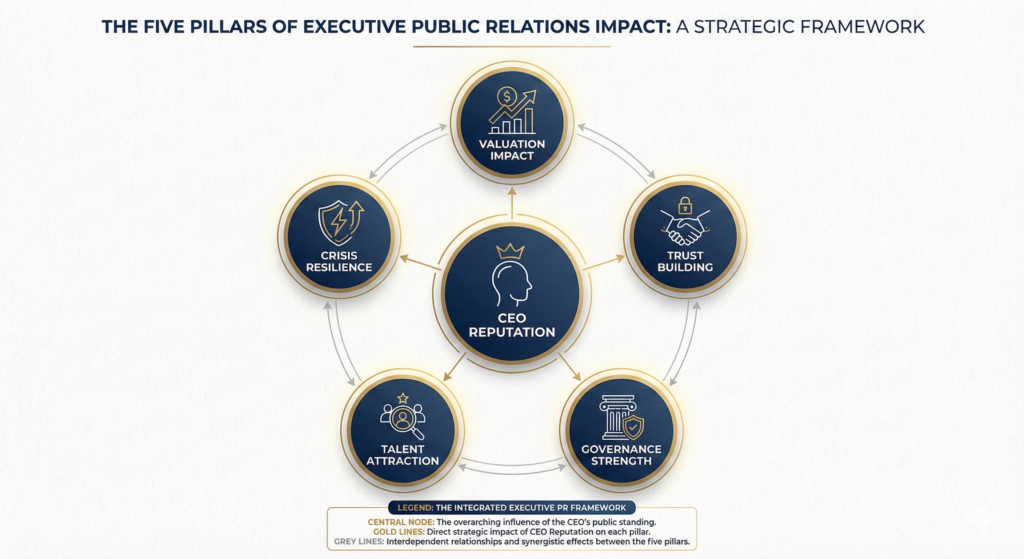
Here is how executive PR influences key business outcomes:
- Valuation Impact: Strong CEO reputation adds measurable enterprise value
- Trust Building: Stakeholders believe in companies led by credible leaders
- Governance Strength: Boards rely on executive reputation for stability
- Talent Attraction: Top performers want to work for respected leaders
- Crisis Resilience: A good reputation protects during difficult times
The connection between the leader and the company’s reputation is permanent. You cannot separate them. Smart organizations manage both together.

CEO Reputation Management as a Strategic Risk Function
Leadership reputation is not a vanity project. It serves as a critical risk management function. Boards increasingly recognize this reality.
Why CEO Reputation Equals Corporate Stability
Your CEO represents the company in every interaction. This representation happens whether planned or not. The connection is automatic and unavoidable.
Investors make decisions based on leadership confidence. They assess management quality before committing capital. The CEO’s reputation directly affects investment decisions.
Employees watch their leaders constantly. They judge company direction through executive behavior. A strong leader’s reputation improves retention and engagement.
Customers also form opinions about leadership. These opinions influence purchasing decisions. Trust in leadership transfers to trust in products.
Regulators pay attention to executive conduct as well. They factor leadership reputation into their assessments. Poor reputation invites additional scrutiny.
Executive Visibility Risks
Visibility creates opportunity and exposure simultaneously. Every public appearance carries some level of risk. Leaders must understand this trade-off.
Social media has changed the visibility equation dramatically. Executives now face constant potential scrutiny. Any statement can become headline news.
Here are common visibility risks that leaders face:
- Media Misinterpretation: Statements taken out of context cause damage
- Social Media Amplification: Small issues become major problems quickly
- Competitor Attacks: Rivals may target the leadership’s reputation deliberately
- Past Issues Resurfacing: Old matters can return at inconvenient times
- Personal Behavior Scrutiny: Private actions affect professional standing
Managing these risks requires a proactive strategy. Reactive approaches rarely work well. The best defense is careful preparation.

Crisis Preparedness for Leadership Teams
A crisis will find every organization eventually. The question is not if but when. Prepared leadership teams survive better.
Executive public relations includes crisis preparation work. This means developing response protocols in advance. It means training leaders for difficult situations.
Key elements of crisis preparedness include:
- Message Development: Pre-approved statements for likely scenarios
- Spokesperson Training: Media skills for high-pressure situations
- Channel Strategy: Knowing which platforms to use when
- Stakeholder Mapping: Understanding who needs what information
- Decision Trees: Clear protocols for rapid response
Preparation makes the difference between crisis and catastrophe. Leaders who practice handling pressure better. Those who wait often fail publicly.
The investment in preparation pays returns during calm periods too. Trained executives communicate more effectively. Their confidence shows in every interaction.
When Executive PR Becomes Crisis PR
Sometimes, reputation management transitions into crisis management. The shift happens faster than most expect. Recognition of this transition matters.
Warning signs often appear before a full crisis develops. Media inquiries have increased suddenly. Social media sentiment shifts negative. Internal concerns surface more frequently.
Smart organizations watch for these signals actively. They respond to early warnings with appropriate action. Early intervention prevents many crises.
Executive public relations consulting firms specializing in crisis management provide essential support. They bring experience from similar situations. They offer objective perspective during emotional moments.
Here is what changes during crisis mode:
- Speed Priority: Response time becomes critical
- Message Control: Every word matters more than usual
- Stakeholder Outreach: Proactive communication prevents speculation
- Media Management: Professional guidance becomes essential
- Legal Coordination: PR and legal must work together
The transition from normal to crisis mode should be seamless. This requires planning and practice. It requires having the right partners ready.
Crisis rarely announces its arrival politely. Organizations must stay ready constantly. Executive public relations builds this readiness into daily operations.
Recovery from a crisis depends heavily on pre-crisis reputation strength. Leaders with strong reputations recover faster. They have earned goodwill that sustains them.
This is why ongoing reputation investment matters so much. It serves as insurance for difficult times. The premium is worth paying.
Related: What Enterprise Reputation Management Really Means
Executive Thought Leadership PR: Authority Without Overexposure
Building executive authority requires a careful balance. Too little visibility limits influence. Too much visibility creates fatigue and risk.
Narrative architecture forms the foundation of thought leadership. This means developing clear themes for each leader. It means knowing what story you want to tell.
Effective narrative architecture includes several components:
- Core Message: The central idea the executive represents
- Supporting Points: Evidence and examples that reinforce the message
- Audience Relevance: Why this matters to specific stakeholders
- Differentiation: What separates this leader from others
- Consistency: Themes that hold steady over time
Controlled thought leadership outperforms constant visibility every time. Quality matters more than quantity. Strategic appearances beat frequent random ones.
Media cadence for CEOs should be deliberate and planned. The right pace varies by situation and industry. Some moments call for more visibility.
During stable periods, quarterly media touchpoints often work well. Also, during significant events, more frequent engagement makes sense. During sensitive times, less may be more.
Examples of successful executive public relations case studies show common patterns. Leaders who build authority gradually tend to sustain it longer. Those who seek constant spotlight often burn out their welcome.
The goal is to become a trusted source rather than a frequent commentator. Journalists should call for insight, not just quotes. This status takes time to develop.
How Top Organizations Measure ROI in Executive Public Relations
Measuring public relations results challenges many organizations. Traditional marketing metrics do not apply well. Executive PR requires different measurement approaches.
First, understand what not to measure. Clicks and page views miss the point entirely. Impressions alone tell you almost nothing useful.
Reputation indicators provide much better insight. These include sentiment analysis across media coverage. They include share of voice in industry conversations.
Key metrics for executive public relations success include:
- Sentiment Trends: Is coverage becoming more positive over time
- Message Pull-Through: Are key themes appearing in coverage
- Share of Voice: How often does your leader get cited
- Stakeholder Feedback: What do investors and partners say
- Media Quality: Are appearances in respected outlets increasing
Executive credibility metrics deserve special attention. These measures how influential audiences perceive the leader. Survey research can capture this data.
Board-level reporting should focus on business impact connections. Show how reputation strength affects recruiting success. Demonstrate links to investor confidence and valuation.
The best measurement approaches combine multiple data sources. They track trends over time rather than single points. They connect reputation data to business outcomes.
Tools and Platforms That Support Executive Public Relations Without Replacing Strategy
Technology supports executive public relations work effectively. It cannot replace human judgment and strategy. Understanding this distinction matters greatly.
Media monitoring tools track coverage across platforms continuously. They alert teams to emerging issues quickly. They help identify opportunities for engagement.
Stakeholder mapping tools organize relationship data systematically. They show connection patterns and influence networks. They support targeted outreach decisions.
Sentiment analysis tools measure tone in coverage automatically. They identify trends that humans might miss. They provide data for strategic decisions.
Crisis alert systems watch for warning signs constantly. They notify teams when issues emerge. They enable faster response when needed.
Here are categories of tools that support executive PR:
- Media Monitoring: Track coverage across traditional and digital media
- Sentiment Analysis: Measure tone and emotional content of coverage
- Stakeholder Management: Organize relationship data and interactions
- Crisis Detection: Identify emerging issues before they escalate
- Reporting Dashboards: Visualize data for leadership consumption
Tools support decision-making but do not make decisions. Strategy must come from experienced professionals. Technology serves as input, not a replacement.
The best tools integrate with existing workflow systems. They provide actionable data without creating overhead. They enhance human capability rather than complicate it.
Related: Reputation Strategy for Leaders Who Cannot Afford to Be Misunderstood
Choosing the Right Executive Public Relations Firm: What CEOs Should Look For
Selecting the right PR partner affects outcomes significantly. Not all firms serve executives well. Understanding decision criteria helps avoid costly mistakes.
CEOs should evaluate potential partners on several dimensions. Experience with similar situations matters most. Track record of success provides reassurance.
Here are the criteria that matter when choosing executive PR partners:
- Senior Oversight: Who will actually manage your account
- Confidentiality Standards: How is sensitive information protected
- Access Level: Can you reach decision-makers when needed
- Industry Knowledge: Do they understand your specific context
- Crisis Capability: Are they prepared for high-pressure situations
Many executives eventually outgrow large global PR firms. These organizations often assign junior staff to accounts. Relationship continuity becomes a problem.
Boutique advisory models offer different advantages. They provide senior attention consistently. They offer flexibility that large firms cannot match.
The choice between boutique and enterprise models depends on needs. Global companies with multiple markets may need large firm reach. Leaders seeking personal attention often prefer boutique approaches.
Confidentiality deserves special emphasis in selection decisions. Executive matters require absolute discretion. Any breach of confidence ends relationships permanently.
The best partners function as trusted advisors, not vendors. They offer counsel even when it is difficult to hear. They prioritize client interests over their own.
Is Executive Public Relations Only for Large Enterprises?
Many assume executive PR serves only Fortune 500 companies. This assumption misses the point entirely. Risk exposure determines need, not company size.
Founders face reputation risks from the earliest stages. Their personal brands often equal company brands. Poor reputation management can kill promising ventures.
Startups should consider executive PR investment in certain situations:
- Fundraising Campaigns: Investor confidence depends on founder credibility
- Market Entry: New brands need leadership authority behind them
- Talent Competition: Great candidates research founders thoroughly
- Partnership Development: Partners assess leadership before committing
- Media Attention: Coverage creates both opportunity and exposure
The question is not whether you can afford executive PR. It is whether you can afford the consequences of not having it.
Cheap executive public relations services often backfire badly. They lack sophistication for high-stakes situations. They may cause more harm than benefit.
Investment should scale with risk exposure and opportunity. Early-stage companies need foundational work. Growing companies need more comprehensive programs.
The best approach starts with risk assessment. Identify where exposure exists. Build protection for the highest priority areas first.
Executive Public Relations in High-Stakes Moments: IPO, Regulation, and Crisis
Certain moments demand intensive executive PR focus. These high-stakes situations require different approaches. Preparation must happen before they arrive.
IPO processes create unique visibility requirements. Executives face regulatory constraints on communication. They also need to build investor confidence simultaneously.
Key stakeholder groups during significant transitions include:
- Investors: Require confidence in leadership capability
- Regulators: Need assurance of compliance and transparency
- Employees: Seek clarity about future direction
- Partners: Want stability and continued commitment
- Media: Expect access and clear information
Stakeholder influence differs from influencer marketing completely. This is not about social media celebrities. It is about reaching people who affect outcomes.
Policy makers and regulators respond to executive credibility. They form opinions about companies through leadership impressions. This affects regulatory treatment significantly.
During sensitive transitions, executive visibility requires careful calibration. Sometimes, more visibility builds confidence. Sometimes, restraint protects process integrity.
The key is matching the communication approach to the situation requirements. Cookie-cutter strategies fail in high-stakes moments. Custom approaches based on specific circumstances work better.
When to Engage an Executive Public Relations Partner
Timing matters enormously in executive public relations. Acting too late limits options. Recognizing trigger points enables better decisions.
Signs that indicate the need for external advisory include:
- Increasing Media Scrutiny: More inquiries about leadership matters
- Stakeholder Concerns: Investors or partners raising questions
- Competitive Attacks: Rivals targeting leadership reputation
- Internal Uncertainty: Staff expressing concerns about visibility
- Growth Acceleration: Rapid expansion creating new exposure
- Transaction Preparation: M&A, IPO, or capital raise approaching
Internal communications teams provide valuable support always. They often lack specialized executive PR capabilities. External counsel brings different expertise.
The difference between internal and external counsel matters. Internal teams know the organization deeply. External partners bring fresh perspectives and specialized skills.
Timing decisions should favor earlier rather than later action. Building a reputation takes time and consistent effort. Rushing rarely produces good results.
Volume of activity matters less than strategic focus. Doing fewer things well beats doing many things poorly. Quality execution on priorities drives success.
The best time to build relationships with PR advisors is before need becomes urgent. This allows for thoughtful selection. It enables relationship development before a crisis.
FAQ
What is executive public relations?
Executive public relations is the strategic management of a senior leader’s public profile. It covers reputation, authority, and credibility management. The goal is to support trust, influence, and organizational stability.
How is executive PR different from corporate PR?
Executive PR focuses on leadership credibility and personal risk exposure. Corporate PR focuses on brand and organizational messaging. Both matter, but they require different approaches and expertise.
How do CEOs measure success in executive public relations?
Success is measured through reputation strength and sentiment trends. Media quality matters more than quantity. Stakeholder trust and credibility assessments provide the best indicators. Clicks and impressions tell you very little.
When should a CEO invest in executive public relations?
CEOs typically invest during growth periods or increased scrutiny. Regulatory exposure creates a need for reputation management. Any moment of reputational risk warrants attention. The best time is before problems emerge.
