
In the hyper-connected digital world of today, the executive’s online reputation has become one of the most valuable yet vulnerable assets an executive can own.
Whether you are the CEO, founder, or board member of an organization, the information that comes up when someone enters your name into the search engine has the potential to make or break business deals.
Online reputation management for executives is not only necessary, it is an imperative.

This guide will show executives how to take control of their digital presence, manage reputation risk, and use their online reputation to drive business success.
As you continue reading this article, we will delve into the ways in which traditional PR expertise meets modern digital know-how to provide executives with the tools necessary for success.
What Is Online Reputation Management (ORM) for Executives?
Online reputation management is the systematic practice of influencing, shaping, and defending the way an individual appears online.
When it comes to executives, this includes all facets of the digital world, including search engine results, social media presence, news articles, and more. Online
In addition, the process of executive online reputation management must be ongoing rather than episodic.
This is because the online environment is constantly changing, with the positive publicity an individual or firm receives yesterday potentially being forgotten or buried by new content.
How Executive ORM Differs from Brand Reputation Management
While brand reputation management is concerned with the general perception of the firm or brand, executive online reputation management is concerned with the individual.
Interestingly, the two are connected, however, in different ways.
For executive online reputation management, the difference between the two is that the former requires a more personalized content approach, including thought leadership, professional achievements, and authenticity.
Additionally, the executive or individual faces specific challenges that the brand or firm does not.
In online reputation management, the individual’s social media activities, work history, or even personal connections may be subject to scrutiny.
Read also: Executive Public Relations: CEO Reputation & Thought Leadership
Executive Online Reputation: A Powerful PR Guide for Founders: Table of contents
- What Is Online Reputation Management (ORM) for Executives?
- How Executive ORM Differs from Brand Reputation Management
- Why Online Reputation Management Is Critical for Executives
- Common Online Reputation Risks Executives Face
- How Search Engines Impact Executive Reputation
- Key Principles of Online Reputation Management for Executives
- Online Reputation Management Strategies For Executives
- Why Executive Online Reputation Matters
- Measuring Executive Online Reputation Success
- Best Practices for Long-Term Executive Reputation Management
Why Online Reputation Management Is Critical for Executives
1. Reputation Risks in the Digital Age
The digital era has fundamentally transformed how quickly reputational damage can occur.
Previously, negative stories took days or weeks to circulate; now, a single social media post can go viral within hours.
Therefore, executive reputation management serves as both shield and sword—protecting against attacks while proactively building positive narratives.
Misinformation spreads particularly fast in digital environments where verification often lags behind distribution.
Subsequently, executives without robust executive online reputation strategies find themselves constantly reacting to crises rather than preventing them.

2. Search Engines, AI Summaries, and First-Impression Bias
When someone searches an executive’s name, the first page of results creates an immediate impression that’s difficult to reverse.
Remarkably, research shows that most people never scroll beyond the first three search results. This means executive online reputation is largely defined by what appears in those critical top positions.
Additionally, AI-powered search summaries and knowledge panels increasingly synthesize information from multiple sources, making executive reputation management more complex.
These automated systems pull from various databases, potentially highlighting outdated or negative content without proper context.
Common Online Reputation Risks Executives Face
1. Negative Press and Media Coverage
Good executives may find themselves victims of negative journalism or commentary. In some instances, a journalist may expose legitimate concerns regarding an executive’s actions.
In other situations, a journalist may sensationalize a story to attract readers. Whatever the situation, a well-managed online reputation is essential to deal with negative press.
The permanent nature of online archives means that stories published years ago continue to come up in search engine results years after they were originally published.
In this regard, executive online reputation requires a response that covers both contemporary issues and historical issues through positive reputation building.
2. Outdated or Misleading Search Results
Digital platforms don’t automatically update information, which means outdated content about executives can persist indefinitely.
Former positions, old controversies, or inaccurate biographical details frequently dominate search results simply because they haven’t been actively displaced.
Consequently, executive reputation management suffers from neglect as much as from active attacks.
Furthermore, online reputation management must combat the search engine tendency to prioritize older, more established content over newer materials.
This requires strategic SEO efforts combined with consistent content production.
4. Social Media Controversies and Misinformation
Social media networks highlight both genuine communication and potential risk for executives.
A wrongly phrased tweet or a misinterpreted LinkedIn post can ignite controversy that quickly spreads across social media networks in minutes.
Moreover, deepfakes, impersonator accounts, and manipulated content can produce completely false information that negatively impacts executive online reputation, despite it being entirely fake.
Executive reputation management involves monitoring social media networks, rapid response strategies, and verification processes that can identify genuine executive communication and distinguish it from deceptive content.
How Search Engines Impact Executive Reputation
What Appears When Someone Searches an Executive Online
The first page of Google search results represents a digital first impression that is almost irreparable.
Usually, these results consist of LinkedIn profiles, news articles, company biographies, social media pages, and even Wikipedia pages.
Nevertheless, in the absence of proper executive reputation management, negative and irrelevant information can fill these prominent spots.
Search engine algorithms rank content based on recency, authority, and relevance.
Hence, executive reputation management is greatly aided by the regular publication of authoritative content that search engines can identify as authentic and up-to-date.
Key Principles of Online Reputation Management for Executives
1. Search Visibility and SERP Management
The management of search engine result pages (SERPs) is the most important aspect for the successful implementation of executive online reputation management.
This is done by adding content that ensures the first page of the search engine result is filled with positive and relevant information.
However, along with the addition of such content, the maintenance of the SERP is also necessary.
This is due to the fact that the search engine rankings are constantly changing as new content is being added.
It is also necessary for the executives to keep their details up to date on high-authority sites such as LinkedIn, trade bodies, and company websites.
This is because such sites are generally high-ranking sites, allowing the executives to add the necessary content for the successful implementation of executive reputation management.
2. Thought Leadership and Authoritative Content
The generation of insightful and unique content is necessary for the successful implementation of executive online reputation management, as it helps the executives become thought leaders in the field.
This also helps the executives improve their search engine rankings for the successful implementation of executive reputation management.
Regular media engagement ensures that when journalists need expert commentary, they turn to prepared executives who can shape narratives favorably.
This positions leaders as go-to sources rather than reactive commentators, enhancing online reputation management effectiveness.
3. Consistency Across Digital Platforms
However, this information may vary on different platforms. It negatively impacts their online reputation.
It is therefore essential for executives to use executive reputation management strategies that will be useful to them in maintaining similar information on different online platforms.
This will help them to manage their reputation easily online.
Online Reputation Management Strategies For Executives
1. Building a Proactive Media Narrative
Executives with good online reputation management skills not only use media inquiries about their companies to build their reputation.
Instead, they use these inquiries as an opportunity to build their reputation through media relations.
Executives use this as an opportunity to build their online reputation through building a proactive media narrative.
This will be useful to them when they are exposed to negative publicity through executive reputation management.
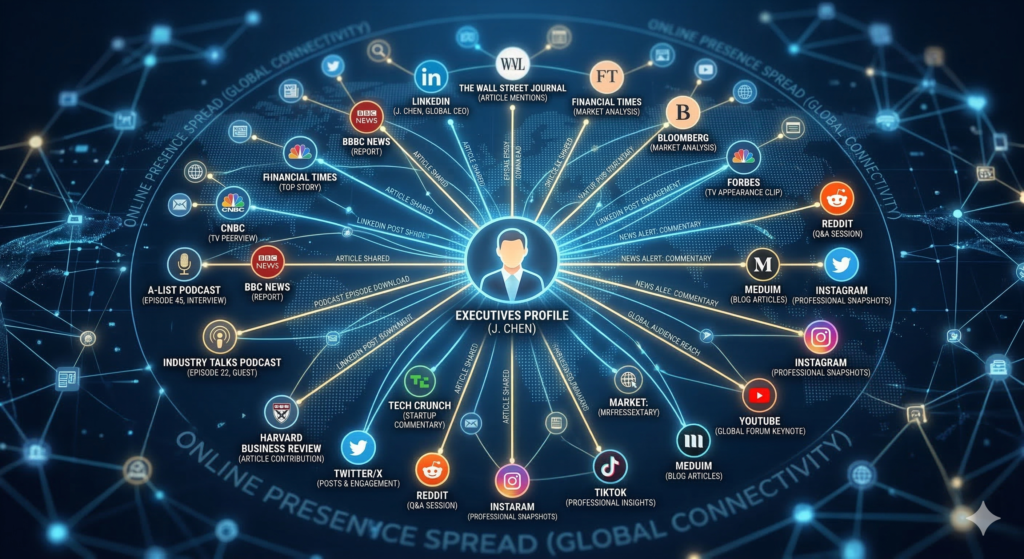
2. Executive Thought Leadership through Bylined Articles
Executives use online reputation management strategies such as writing articles for prominent publications.
The articles are used to build their reputation through executive reputation management by using bylined articles.
The articles have good chances of appearing on search engines and have the reputation of prominent publications.
Furthermore, op-eds allow executives to engage in issues affecting their industries and show their thought leadership capabilities in a manner that corporate communications are not able to replicate.
This helps in building the online reputation of executives.
3. Strategic Interviews and Media Placements
Participating in interviews strategically helps executives in managing their online reputation by leveraging other people’s credibility.
Podcasts, interviews, and other media placements create multimedia content that helps in building the online reputation of executives.
However, executives should prepare well for their interviews in order to avoid any potential miscommunications.
Strategic online reputation management requires training for executives in handling different interview situations.
4. Crisis Prevention vs Crisis Response
The best online reputation management for executives is one that prevents crises rather than waiting for them to happen.
This requires monitoring potential issues that may arise in the future.
Despite this, there are situations that are unforeseen for executives. Having crisis response strategies in place ensures that there are prompt actions taken in response to unforeseen issues that affect their online reputation.
Why Executive Online Reputation Matters
Online reputation management for executives involves monitoring, influencing, and controlling their online presence across various search engines, social media sites, news sites, and industry sites.
The first page of Google search engine results creates a first impression that is hard to change. In addition, most users only scan the first three search engine results page listings.
Therefore, executive online reputation is defined by what is found in these critical search engine page listings.
Good executive reputation management has a direct relationship with business outcomes. Companies with executives that have a positive online reputation have higher investor confidence, better recruitment outcomes, and higher customer loyalty.
On the other hand, companies with executives that have a poor reputation suffer from stock market losses and broken partnerships.
Measuring Executive Online Reputation Success
Key ORM and PR Metrics to Track
To ensure online reputation management is effective, measurement systems are required to monitor brand narrative control and emerging trends.
Positioning on search engine result pages, share of voice, sentiment analysis, and quality of media are some of the factors for measuring an executive’s online reputation management.
By tracking these factors regularly, executives and their teams can easily understand trends and how their campaigns are working, thus making informed decisions for their executive reputation management strategies rather than making assumptions.
Share of Voice and Sentiment Analysis
Share of voice analysis focuses on how many times an executive is mentioned in industry circles compared to others or their competitors.
The more share of voice an executive receives, the more they are likely to be influential in their online reputation management campaigns.
Sentiment analysis, on the other hand, focuses on whether an executive is portrayed positively, negatively, or neutrally in online reputation management campaigns.
3. Search Visibility and Branded Search Results
The content appearing for branded searches directly reflects the executive’s online reputation status. Monitoring which pages rank for these searches and whether positive or negative content dominates provides clear indicators for online reputation management effectiveness.
Additionally, tracking search volume for executive names can signal growing interest or emerging crises. Sudden spikes in search activity often precede reputation challenges and provide early warning opportunities for executive reputation management teams.
Best Practices for Long-Term Executive Reputation Management
Proactive vs Reactive ORM
- The most successful executive online reputation strategies emphasize prevention and preparation rather than crisis response
- Building positive content reserves, maintaining media relationships, and monitoring early warning signals all prevent small issues from becoming major crises
- While reactive capabilities remain necessary, organizations should invest primarily in proactive online reputation management that builds resilience and reduces crisis frequency for sustainable executive reputation management
Creating a Personal Reputation Roadmap
- Strategic executive reputation management requires clear objectives, defined audiences, and measurable milestones
- A personal reputation roadmap outlines content themes, target platforms, and engagement strategies aligned with career goals and organizational needs
- This planning transforms ad-hoc activities into coordinated campaigns that systematically enhance executive online reputation over time rather than through scattered, inconsistent efforts
Future-Proofing Executive Reputation
- Digital platforms, search algorithms, and communication channels evolve constantly, requiring online reputation management strategies that adapt to changing conditions
- Future-proofing involves staying informed about emerging platforms, understanding algorithm updates, and maintaining flexible approaches
- Building diverse content ecosystems across multiple platforms prevents over-reliance on any single channel, strengthening overall executive online reputation resilience
The Future of Online Reputation Management for Executives
AI, Search Evolution, and Executive Visibility
Artificial intelligence increasingly mediates how information about executives reaches stakeholders.
AI-powered search, automated news aggregation, and algorithmic content recommendations all shape executive online reputation in ways that traditional SEO cannot fully address.
Understanding how AI systems evaluate credibility, synthesize information, and present results becomes essential for effective executive reputation management in the coming years.

Conclusion: Taking Control of Your Executive Reputation
Online reputation management has evolved from an optional luxury to an essential leadership responsibility.
In an era where digital presence fundamentally shapes stakeholder perceptions, executives cannot afford passive approaches to their online narratives.
Strategic, proactive executive online reputation management creates competitive advantages that benefit both leaders and their organizations.
The strategies outlined throughout this guide provide frameworks for building, protecting, and leveraging reputation as a strategic asset.
From search visibility and thought leadership to crisis prevention and stakeholder engagement, comprehensive brand protection requires sustained commitment and professional execution.
Ultimately, executive reputation management succeeds when leaders recognize that their digital presence reflects not just past achievements but ongoing value creation and authentic leadership.
By investing in strategic online reputation management now, executives build foundations for long-term credibility, influence, and success.