
In this climate, public relations strategies are no longer a nice-to-have. They are how brands stay credible, stay relevant, and stay in business.
Audiences do not trust brands; they check them. Every message is questioned. Claims are tested. Every silence is read as a signal.
Smart brands use PR to shape how people see them, manage difficult situations, and build real relationships with the people who matter most.

What Is Public Relations? A Clear Definition
PR goes far beyond press releases.
It is the practice of managing how your brand is perceived, building strong relationships with stakeholders, and earning credibility through honest and consistent communication.
PR and advertising work differently. Advertising puts out paid messages.
Public relations, on the other hand, earns trust over time through authentic action and real stories.
PR and marketing also serve different roles. Marketing creates demand.
However, public relations shapes the environment in which that demand either grows or falls apart.
Without trust, even the best marketing campaigns do not convert.
Studies consistently show that earned media is seen as far more trustworthy than paid advertising. That gap in credibility is exactly where public relations does its best work.
According to the Edelman Trust Barometer, trust is now one of the top factors consumers use when deciding which brands to buy from, recommend, or defend publicly.
That makes public relations not just a communications tool; it makes it a direct driver of business growth.
Visibility without credibility is reputational risk.
The 7 Smart Public Relations Strategies That Build Trust
Narrative Control: Define the Story First
Silence creates risk. Therefore, smart brands take control of their story before someone else does.
When a brand stays quiet, others fill the gap. Rumors spread. Competitors frame the story. Journalists speculate.
That silence becomes expensive very quickly.
Framing is not the same as spinning. Framing means presenting facts clearly and in the right order. Spinning means twisting the truth.
Good PR professionals know the difference, and they build messaging that holds up under pressure.
The order in which you share information matters too.
For this reason, smart PR teams plan this sequence carefully so that audiences receive the right message at the right time.
Read Also : Public Sector PR Firms: The Best Top Agencies for Government
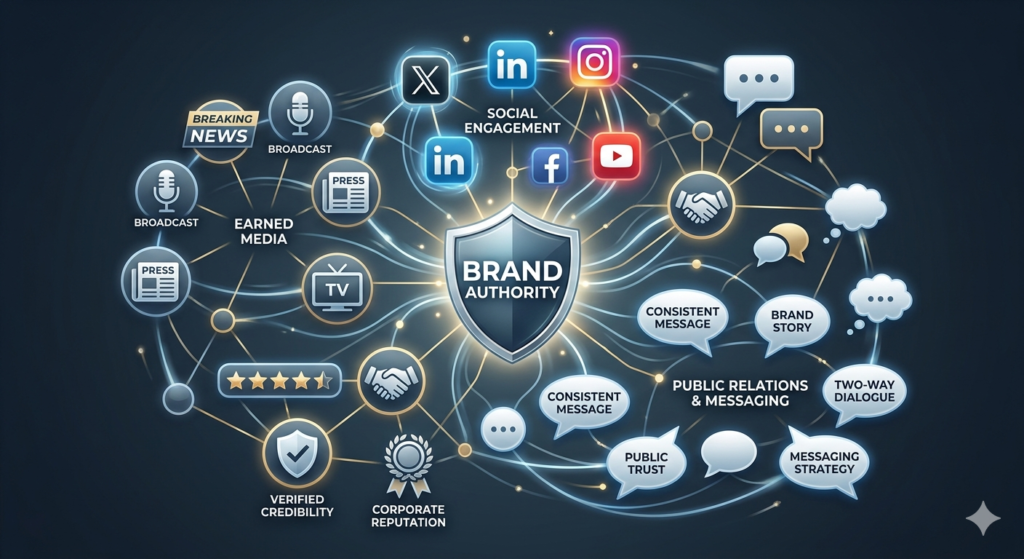
Reputation Infrastructure: Build Systems, Not Campaigns
Campaigns give you a short spike in attention. However, systems build lasting influence.
The strongest brands do not rely on individual campaigns to protect their reputation.
Instead, they build what some experts call a “reputation moat”, a layer of credibility that holds firm even when things go wrong.
This means aligning the way a CEO speaks publicly, how the brand appears online, how it handles media, and how it talks to investors, all at the same time.
As a result, authority becomes something the brand owns permanently, not something it borrows for a season.
Crisis Communication: Speed With Structure
The first sixty minutes of a crisis shape the next six months of your reputation.
Therefore, smart brands prepare their crisis response long before a crisis ever happens.
Slow responses signal that you do not care. Defensive responses make things worse.
However, a clear, honest statement delivered quickly, even if you do not have all the answers yet, builds confidence and keeps audiences on your side.
PR firms help leadership teams prepare for difficult situations in advance.
They run practice scenarios, sharpen key messages, and make sure that when something goes wrong, the response is calm and structured.
Case Study: Crisis Communication in Action
A mid-sized fintech company faced sudden regulatory scrutiny after a data error affected thousands of customers. Media inquiries came in within hours.
The PR team activated a pre-built crisis plan. The CEO released a transparent statement within 45 minutes.
It acknowledged the error, explained what steps were being taken, and committed to an independent audit.
Negative coverage peaked within 24 hours and then dropped sharply. Customer churn was well below what similar companies experienced in comparable situations.
Regulators noted the company’s openness as a positive factor.
Preparation is the crisis strategy. Brands that rehearse their response own the story. Brands that guess their way through it get defined by the incident.
Thought Leadership: Earn Authority Through Insight
Thought leadership builds the kind of authority that no advertising budget can create.
Additionally, it places your leaders at the center of the conversations that matter most in your industry.
Publishing real research, honest commentary, and useful analysis builds substance. Audiences recognize shallow content quickly.
Therefore, thought leadership only works when the ideas are genuinely valuable, not just visible.
PR specialists help executives find their unique point of view, develop articles and keynote talks, and identify the right media platforms to reach the right people.
Case Study: From Unknown to Industry Voice
The CEO of a healthcare tech company had great ideas but lacked a personal brand. She was operating in a crowded space with many well-funded competitors and large PR teams.
Realizing this, a Public relations agency discovered her key insight: that the actual problem with patient care was not that innovation was lacking but that systems did not communicate with each other.
The Public relations agency wrote a research-based article, secured publication in a leading industry magazine, and arranged for her to speak at a leading industry conference as a keynote speaker.
Within six months, her company was earning name-checks across leading industry and business publications.
Additionally, the volume of partnership opportunities had increased significantly. In fact, the company began receiving nominations for industry awards it had never previously been considered for.
A genuine idea, published in the right outlet, gives authority that cannot be bought.
Media Relations: Earn Coverage That Matters
Earned media gives your brand something paid media never can, third-party credibility.
When a trusted publication writes about your brand, that carries far more weight than anything you say about yourself.
Smart brands do not chase every media opportunity. Instead, they focus on the publications and platforms that their key audiences actually read and trust.
Good PR professionals build real relationships with journalists over time.
They understand what makes a story newsworthy, and they pitch ideas that serve the journalist’s audience, not just the brand’s agenda.

Digital Public Relations: Visibility With Purpose
In 2026, digital Public relations is where reputations are shaped every single day. Smart brands manage three key areas of their online presence:
- Search Visibility : How your brand appears in Google results, featured snippets, and AI-generated summaries.
A single negative article ranking near the top of your search results can do lasting damage to how new audiences see you.
- Online Reputation Management: Actively monitoring and responding to reviews, social comments, and online discussions. Ignoring public feedback sends its own message, and audiences notice the silence.
- Content Authority: Building a steady library of quality articles, useful data, and well-researched resources.
Additionally , this sinals expertise to both readers and search engines, and it generates the kind of backlinks that improve your long-term visibility.
Being seen is not enough. The question is whether what people see when they look you up builds trust or raises doubt.
One thing most brands miss is that digital PR and traditional PR feed each other. A strong media placement earns backlinks.
Those backlinks improve search rankings. Better search rankings put your brand in front of new audiences.
Those audiences then encounter your earned media, and trust builds from there. The two channels are not separate. They work as one loop.
Community Engagement and Authentic CSR
Smart brands demonstrate what they stand for through actions, not through PR releases.
The PR industry has learned this hard way. Purpose washing, or doing this, has backfired consistently.
CSR activities can create trust only when they reflect what a business genuinely believes in and how it genuinely operates.
Moreover, engaging with communities creates not just emotional engagement but also brand loyalty that cannot be achieved through advertising campaigns.
Internal communication is as important as external communication. Employees represent the brand in all conversations they have outside the office.
When what a company says outside does not align with how it treats people inside, that is a story waiting to happen
Case Study: When CSR Backfires
A financial services company launched a prominent youth employment campaign.
Meanwhile, behind closed doors, employees were complaining about their working conditions as well as opportunities for development within the company.
The situation came to a head when journalists started connecting two seemingly unrelated dots.
A social post by a former employee went viral, juxtaposing the campaign’s message with internal job cuts announced by the company in the same quarter.
In doing so, the campaign produced more negative coverage than positive. Brand trust scores dropped over the following months. Rebuilding credibility took significant time and resources.
Authentic community engagement starts inside. If employees do not believe in the brand’s values, the public will find out.
Public Relations Examples: What Smart Brands Do Differently
Patagonia is one of the clearest examples of Public relations done well over the long term.
The company has spent decades being openly honest about the challenges in its supply chain, rather than hiding them or using polished language to avoid the topic.
That consistency has built a level of trust that competitors simply cannot copy.
Trust earned through honest behavior, year after year, becomes one of the most valuable assets a brand can own.
Smart brands also understand that trust has two sides. Rational trust comes from being competent and consistent.
Emotional trust comes from showing real values and genuine empathy. Both need to be built at the same time.
Public Relations vs Marketing: Understanding the Real Difference
This is one of the most misunderstood areas in communications.
Marketing creates demand. Public relations, however, creates the conditions in which that demand can grow.
Unfortunately, a brand that people do not trust will struggle to convert even the most creative marketing campaign.
Public relations builds earned credibility, while marketing drives paid reach. Additionally, these two work well together, but only when teams understand and manage each one properly.
However, mixing them up leads to wasted budget and confused messaging.
How to Choose the Right Public Relations Partner
Choosing the right PR firm is a serious decision. Agencies vary widely in their focus, their experience, and their approach.
When evaluating a Public relations partner, look at:
- Their track record in your specific industry
- Their experience handling crisis situations
- The quality of their media relationships
- How clearly they report results
- If their values align with yours
Some firms focus on crisis management. Others specialize in executive visibility, financial communications, or building presence in specific markets.
.Firms like Spred Global Communications actively operate at the intersection of strategic storytelling and institutional credibility, supporting organizations that cannot afford to leave their reputation to chance.
The right partner acts as a strategic advisor. Not a vendor. Not a visibility machine.
Measuring Public Relations Success: What Smart Brands Track
Counting media mentions only tells part of the story. Smart brands track a fuller set of signals:
- Sentiment across all channels: are people saying positive, neutral, or negative things?
- Share of voice: how much of the industry conversation does your brand own?
- Trust survey results among key stakeholder groups
- How quickly and effectively your team responds in a crisis
- Whether your key messages are landing consistently across platforms
- Your search reputation: what comes up when people search your brand name
No single number captures trust fully.
Therefore, the best PR teams combine data with direct research to get a complete and honest picture of where the brand stands.
Frequently Asked Questions About Public Relations Strategies
1. What do public relations strategies do for a business? They shape how your business is seen by the people who matter, investors, customers, employees, and media.
More importantly, they build the foundation of trust that makes everything else the business does more effective.
2. How are public relations and advertising different? Advertising buys attention.
PR earns trust. Earned coverage from a credible outlet carries far more weight than a paid placement, though it takes more time and consistency to build.
3. What causes a public relations strategy to fail? The three most common reasons are brands react instead of plan, internal behavior does not match external messaging, and teams chase visibility instead of credibility.
However, the last one is the most common and the most damaging.
4. Which industries benefit most from PR? Financial services, technology, healthcare, government, and consumer brands all benefit significantly.
However, any organization that relies on the trust of others, which is every organization, needs a structured PR approach.
5. How long does it take to see PR results? Some results, like media coverage, can come within weeks. However, real reputation equity builds over months and years. Brands that treat PR as a one-off campaign rarely see lasting impact.

Conclusion: Public Relations Strategies Build the Trust That Drives Everything
Public relations is not a support function.
In fact, it is a core business strategy that determines whether your brand is believed or ignored.
The seven strategies in this guide give you a complete framework:
- Narrative Control: Own your story before others tell it
- Reputation Infrastructure: build systems, not just campaigns
- Crisis Communication: prepare long before you need it
- Thought Leadership: earn authority with real ideas
- Media Relations: focus on coverage that actually matters
- Digital PR: manage your online presence with purpose
- Community Engagement: show your values through consistent action
Therefore, PR and marketing work best when they work together. And the right PR partner acts as a true advisor, not just a team that generates press releases.
The brands building trust right now are the ones that will lead their industries in the years ahead.
Invest in systems. Prioritize credibility. And start building your public relations strategy today, not when you need it most.
