
Litigation PR is the practice of managing public communication during active legal disputes and has become one of the most critical disciplines for any organization that cannot afford to lose control of its story while simultaneously fighting in court.
When a lawsuit goes public, the reputational damage rarely waits for the legal process to catch up.
This article breaks down how litigation PR works, why legal crisis communications can make or break an organization’s standing, and what needs to happen when legal battles spill into the public eye.
What Litigation PR Actually Means/
A lot of people confuse litigation PR with crisis communications or general corporate PR.
They are related, but they are not the same thing.
Litigation PR lives in its own lane because it operates under legal constraints that most PR work never has to worry about.
In standard corporate PR, you shape messaging around brand goals. In a crisis, you move fast and try to contain the damage.
Litigation PR has to do something harder: align with the active legal strategy.
Every public statement you make during a lawsuit carries the risk of being used against you in court, picked up by opposing counsel, or misinterpreted by regulators.
That reality is why every word in a litigation communications strategy has to be worked out in close coordination between lawyers and communications professionals.
At its core, litigation PR is about protecting an organization’s credibility during legal proceedings without saying anything that could blow up the case. In practice, that means:
- Developing messaging that is legally safe but still clear enough to mean something publicly
- Monitoring what the media and social platforms are saying in real time
- Managing communications across multiple stakeholder groups who each need something different
- Having holding statements ready before the press calls
- Correcting misinformation without accidentally giving it more oxygen
Lawsuit reputation management is not something you figure out after a story breaks. By that point, the narrative is often already halfway out of your hands.

Litigation PR: Why Legal Disputes Become Reputation Crises
Here is the uncomfortable reality: court filings are public records. Regulatory subpoenas generate press coverage.
Internal documents, once they enter evidence, become fair game for journalists.
The moment litigation begins, the reputational exposure begins right alongside it, whether you are ready or not.
Social media makes all of this significantly worse. Allegations spread in hours. Clips get shared without context.
Speculation fills the gaps faster than any communications team can respond.
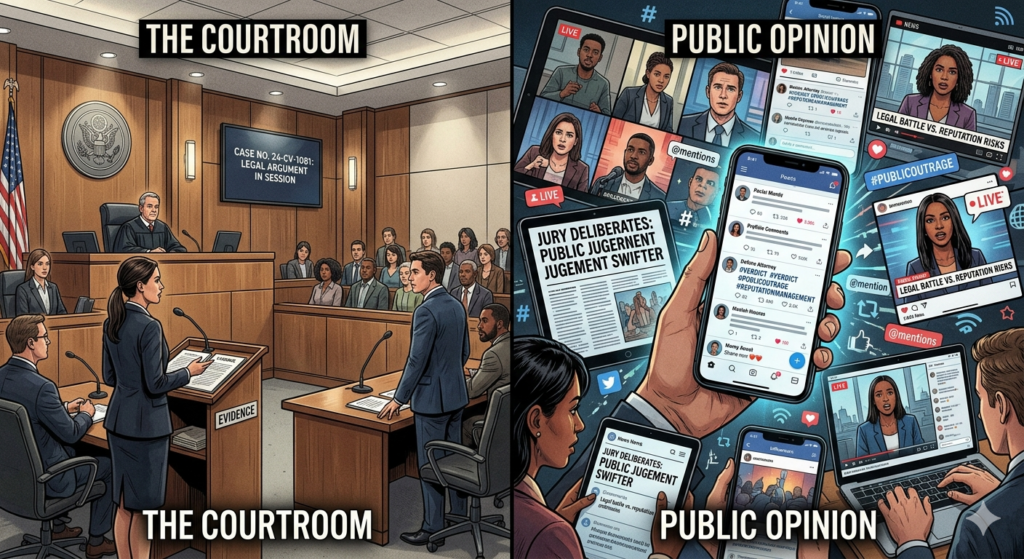
And unlike an actual courtroom, the court of public opinion has no evidentiary standards.
An organization can win its case and still spend years rebuilding its reputation because the public made up its mind long before the verdict came down.
This is the core problem that the legal-battle PR is trying to solve. When organizations go quiet for too long, other voices step in.
Competitors, former employees, activist groups, and media commentators build the narrative in the absence of an official one.
The longer that silence goes on, the more entrenched those external narratives become.
The reputational risks during litigation are real and often underestimated:
- Investor confidence drops, and market value becomes volatile
- Customer trust erodes in ways that outlast the legal dispute itself
- Employees grow uncertain, and talent retention becomes harder
- Regulatory bodies take note of public sentiment, sometimes adjusting their scrutiny accordingly
- Brand equity takes hits that a favorable verdict cannot automatically undo
The Litigation PR Lifecycle
Litigation PR does not operate as a single response; it moves through three distinct phases, each requiring a different communication approach.
Pre-Litigation: Risk Monitoring and Preparedness
The organizations that handle litigation PR best typically start preparing before anything has actually been filed.
Conducting periodic reputation risk audits, scanning for media vulnerabilities, running scenario planning for disputes that could realistically arise- these are not overcautious measures.
They are what separates organizations that respond well from those that scramble.
This phase is also where legal and communications teams need to build their working relationship.
Without pre-established protocols between those two functions, organizations tend to swing between over-disclosure and complete silence when things heat up.
Neither extreme serves them well.
Active Litigation: Controlled Communication
Once proceedings are active, trial publicity management demands real discipline.
Most organizations in this phase designate a small number of trained spokespeople, tightly control who is authorized to speak publicly, and build tiered responses for the different audiences they manage.
A functional litigation communications strategy during active proceedings covers:
- Issuing controlled statements that do not contradict legal positioning
- Handling press inquiries through consistent, pre-approved holding responses
- Monitoring digital channels around the clock for misinformation and sentiment shifts
- Keeping employees informed enough that internal uncertainty does not become its own problem
- Communicating differently with investors, regulators, and customers, because what each group needs to hear is genuinely different
Investors want to understand financial risk and whether the business is stable. Regulators need to see compliance-oriented communication that signals accountability.
Customers want to know that their relationship with the organization is not in jeopardy.
Sending one generic message to all three groups is one of the most common mistakes organizations make in this phase.
Post-Litigation: Reputation Repair
Winning a case does not mean the reputational work is done.
The post-litigation phase requires deliberate effort to reframe the narrative around the outcome, rebuild trust with stakeholders who pulled back during proceedings, and address any long-term brand damage that accumulated during the dispute.
Many organizations treat this phase as optional. It is not. A legal win with no follow-through communications often leaves the negative narrative in place by default.
Litigation PR: Message Control in High-Stakes Legal Environments
Getting messaging right during active litigation is harder than it sounds. Communications teams often have limited visibility into legal strategy because of attorney-client privilege protections.
They need enough context to manage external narratives credibly, but full access to the case strategy could compromise the proceedings.
That tension is real, and it does not resolve itself without structured coordination between the legal and communications functions.
The practical solution is a defined information-sharing protocol, one where the PR team gets what it needs to do its job without crossing into privileged territory.
This arrangement only works if both sides trust each other and have clear roles.
In terms of what to avoid, statements during active litigation should steer well clear of:
- Assigning blame or speculating on who is liable before the facts are established
- Any comment that could be read as an admission
- Speculation about legal outcomes or what regulators might find
- Responding to unverified allegations in ways that extend their reach rather than contain them
And silence is not a safe default. Refusing to comment entirely often hands the narrative to opposing counsel, media speculation, and whatever is trending on social media that day.
A well-constructed holding statement, one that acknowledges the situation without giving away anything legally sensitive, is almost always better than nothing.
Common Mistakes in Litigation PR
Many organizations make the same mistakes when managing public communications during a legal dispute. Here are the most common ones:
1. Speaking Too Soon Before the Facts Are Clear: Making public statements before all the facts are verified can backfire.
If the information turns out to be inaccurate, correcting it later can create even more negative publicity.
2. Remaining Silent for Too Long: Waiting too long to respond allows the media, stakeholders, and the public to create their own narratives.
In litigation PR, the first 48 hours are often crucial for establishing a clear and credible message.
3. Poor Coordination Between Legal and PR Teams: When lawyers and communications teams deliver conflicting messages, it creates confusion and damages credibility.
All public statements should be aligned and consistent across every channel.
4. Ignoring Social Media Conversations: Social media cannot be ignored during a legal crisis. False or misleading claims can spread quickly, and if they are not addressed promptly, they may become widely accepted as the truth.
5. Using Defensive or Aggressive Language: Responding with hostility, blaming others, or appearing overly defensive can worsen public perception and make the organization seem untrustworthy.
6. Failing to Monitor Public Sentiment: Organizations that do not track media coverage, online discussions, and stakeholder reactions may miss early warning signs of reputational damage and lose opportunities to correct misinformation quickly.
Successful litigation PR requires a balanced approach: communicate early, verify facts, align legal and PR strategies, monitor public sentiment, and maintain transparency throughout the legal process.
Litigation PR: Digital Reputation Management During Lawsuits
Search engine visibility is a dimension of lawsuit reputation management that organizations consistently underestimate.
When a lawsuit goes public, the top search results for an organization’s name are often dominated by case filings, media coverage of allegations, and social commentary.
That is frequently the first thing a potential investor, partner, or customer sees. Without active management, those results set the frame for every subsequent interaction.
Organizations navigating active litigation need to monitor branded keywords and legal case terms on an ongoing basis, understand which narratives are gaining search visibility, and ensure that accurate official information is accessible rather than buried.
On social media, real-time monitoring frameworks should be able to catch sentiment shifts and flag viral claims early.
When misinformation spreads, the organization faces a genuine judgment call: directly correct it, stay strategically silent, or pursue a legal takedown where the claim meets that threshold.
None of those options is universally right; the right choice depends on the nature of the claim and who is amplifying it.
The Role of Specialized Litigation PR Firms
Not every PR firm can operate effectively under the constraints posed by active litigation.
Specialized litigation communications firms bring something specific to the table: experience managing public narratives within legal boundaries, under genuine public scrutiny, with real consequences if they get it wrong.
They typically bring media strategy for active proceedings, executive communications coaching, and stakeholder messaging frameworks tailored to legally sensitive environments.
Some firms go further than managing press cycles. They build what might be called reputation infrastructure, systems and protocols designed to protect an organization’s credibility over time, not just during a single dispute.
Spred Global Communications operates along these lines, focusing on narrative control, prebuilt crisis intelligence, and what they describe as an institutional credibility architecture.
For organizations with recurring legal exposure or those operating in heavily scrutinized industries, that kind of structural approach to legal crisis communications reflects where the discipline has genuinely moved, away from reactive media management and toward something closer to long-term reputation engineering.
That distinction matters at the enterprise level. One misstep in litigation PR can hit market value, regulatory relationships, and investor confidence simultaneously.
Building a Litigation PR-Ready Reputation Framework
Organizations that treat litigation PR as a governance priority, rather than something to figure out when a problem lands, are consistently better positioned when disputes go public.
A litigation-ready framework looks something like this:
- Pre-crisis scenario planning that identifies the legal vulnerabilities most likely to surface
- Documented protocols for how legal and communications teams coordinate under pressure
- Trained spokespeople who know exactly what they are authorized to say and what they are not
- Real-time digital monitoring tools with clear escalation processes
- Tiered stakeholder communication plans built for different audiences, not a one-size-fits-all approach
- Post-litigation reputation repair plans are drafted before they are ever needed
Periodic reputation risk audits help surface public disclosure vulnerabilities, leadership communication risks, and digital exposure before they become active problems.
This kind of forward orientation is what genuinely separates organizations that handle legal-battle PR well from those that are perpetually caught off guard.
Litigation PR Is Now a Governance Priority
Litigation PR has moved from a specialized niche to a boardroom agenda item because the intersection of legal proceedings and public perception now directly affects financial performance, brand equity, and stakeholder trust in inseparable ways.
Legal and reputational outcomes are not the same, and organizations that treat them as equivalent keep learning that lesson the hard way.
Effective legal crisis communications require coordination across functions, real message discipline, audience-specific strategy, and a genuine commitment to reputation repair that does not stop the moment a favorable verdict comes in.
The organizations that do this well not only survive litigation; they come out of it with their credibility intact, sometimes even stronger than before.
If your organization carries recurring legal exposure or operates in an industry where scrutiny is part of the landscape, getting your litigation communications strategy in order before a dispute goes public is not a nice-to-have.
It is considerably more effective than trying to build one while the story is already running.
