
Founder reputation architecture is one of the most underestimated strategic assets in modern business.
When a founder’s identity becomes inseparable from a company’s brand, every personal misstep carries institutional consequences.
Executive reputation building, therefore, cannot be left to chance or managed reactively.
This article examines how organizations can design reputation systems that withstand scandal, leadership transitions, and public scrutiny, drawing on documented corporate cases and established communications frameworks.
Why Founder Reputation Architecture Defines Company Stability
According to research by the Edelman Trust Barometer, the credibility of leaders directly affects brand equity, investor confidence, and market valuation.
This effect becomes stronger in founder-owned companies, where the founder represents all three components of the organization at once, the brand image, strategy, and culture.
In such a situation, there emerges structural vulnerability.
The founder’s reputation infrastructure resolves such vulnerability through the transition from the person-based approach to a system-based approach.
As far as executive reputation building is concerned, the term implies the creation of organizational infrastructure rather than PR management.
The examples of Travis Kalanick of Uber, Adam Neumann of WeWork, and Elizabeth Holmes of Theranos demonstrate the consequences of having no reputation resilience.
In each case, lack of any reputation system made the negative impact on the company much worse than originally anticipated.
The Most Common Triggers That Destroy Executive Reputation
It is important to understand trigger patterns in relation to founder reputation architecture. Crisis triggers do not occur out of the blue.
In general, crisis triggers fall into three categories. Personal misconduct continues to be the most common type of trigger.
Cultural violations, harassment allegations, and unethical behavior require the board to intervene promptly.
Travis Kalanick’s resignation from Uber in 2017 was due to long-term cultural and ethical scandals.
Crisis events associated with financial or legal violations occur the quickest.
Elizabeth Holmes’ fraud conviction illustrated how false statements to investors could lead to organizational collapse.
The founder reputation architecture should include governance structures that protect against financial narrative manipulation.
Misstatement events become even more dangerous in the digital world where social media plays a significant role.
The 2018 Elon Musk tweet regarding taking Tesla private ended up in a lawsuit from the SEC.
One statement made publicly without proper vetting can trigger several crises concurrently.
Thus, founder reputation architecture should involve understanding these categories and creating response plans.

How a Reputation Collapse Actually Unfolds
Founder reputation architecture must account for the sequential nature of reputational collapse. The pattern is well-documented across corporate crisis literature:
- A trigger event emerges: scandal, controversy, or legal action
- Media and social platforms amplify the initial event rapidly
- Stakeholders—investors, employees, customers, begin reacting publicly
- Board and governance pressure escalates
- Leadership outcomes follow: resignation, removal, or diminished authority
This sequence rarely compresses or skips stages.
However, organizations with pre-built executive reputation-building systems can interrupt the amplification phase before stakeholder reaction escalates.
Reputation resilience, in practical terms, means having the infrastructure to act within the first 24 to 48 hours, before the narrative calcifies.
Building Founder Reputation Architecture Before a Crisis Emerges
The best founder reputation architecture is built when things are stable, not reactionary.
There are several elements here that aren’t negotiable.
Codified values mean less reliance on the founder’s actions.
If an organization’s values have been codified, then when one person falls, the organization won’t go down with him/her.
Values codification is fundamental to executive reputation management.
Narrative controls include pre-cleared messaging systems, media training policies, and clear guidelines for founders’ communications.
The result is that when the founder speaks, she/he will speak in accordance with what the law says, the investors want, and the brand demands.
Key stakeholder identification means mapping out the organization’s stakeholders, reporters, investors, government agencies, and internal influencers.
This layer of intelligence ensures that during a crisis, companies can quickly reach out to their network for assistance.
Companies like Spred Global Communications, which specializes in building what they call “defensive credibility” infrastructure, work specifically in this area, closing the information vacuum that leaves room for speculation.
Crisis response playbooks lay out who is communicating in the event of a reputational crisis, which channel, and what kind of messaging.
Succession plans fall into this category of crisis response planning as well.
Separating Founder Identity from Company Brand
Strategic Brand Separation is one of the crucial aspects of founder reputation architecture.
If the company’s image is completely based on the founder’s image, then every move made by the founder will be an organizational move.
Building executive reputation effectively means:
- Improving the corporate brand image without considering the founder’s individuality
- Promoting other executives as legitimate brand ambassadors
- Decreasing the founder’s visibility in terms of brand marketing
- Formalizing the organizational story such that it is independent
The above separation does not mean that the founder’s importance is reduced in any way.
The idea here is to reduce organizational risk. One reason why Tesla continues to exist as a brand across the globe is that the organizational brand is no longer based on a single representative.
On the other hand, WeWork did not do this, and restructuring the organization became essential when Adam Neumann left.
Stakeholder Trust Recovery After a Founder Scandal
Even with a strong founder-reputation architecture in place, crises can still occur.
CEO scandal recovery requires a differentiated approach for each stakeholder group.
Customers respond to transparent communication and demonstrable corrective action. Vague apologies without behavioral change deepen distrust rather than resolve it.
Investors require governance reforms and clear operational continuity plans.
Executive brand longevity in investor-facing contexts depends on evidence that the organization has restructured its oversight mechanisms, not simply replaced a headline.
Employees need internal communication clarity and reinforcement of company culture. Internal trust collapses faster than external trust and recovers more slowly.
Succession-reputation planning must address internal audiences specifically, not only external media.
Additionally, independent audits and third-party credibility validation accelerate recovery across all stakeholder groups.
Organizations that demonstrate accountability structurally, not just rhetorically, rebuild trust more efficiently.
The Role of Governance in Founder Reputation Architecture
Independent governance is consistently linked to crisis resilience in corporate research.
Strong founder reputation architecture integrates governance as a structural component, not an afterthought.
Key governance elements include the following:
- Independent board members with authority to act
- Separation of CEO and Chair roles
- Formal oversight committees with defined escalation protocols
The failures at WeWork and Theranos shared a common structural deficit: governance systems were too weak to challenge founder authority before crises became irreversible.
Reputation resilience, therefore, is partly a governance design problem.
Executive reputation building that ignores board structure and oversight mechanisms is incomplete.
Founder reputation architecture without governance integration creates the illusion of preparedness without the substance.
Succession Planning as a Reputation Asset
Succession reputation planning is among the most neglected dimensions of founder reputation architecture.
Organizations frequently treat succession as a contingency rather than a strategic investment.
Planned leadership transitions preserve institutional stability and investor confidence.
Forced exits, which dominate the documented cases of founder crises, consistently signal organizational instability and trigger valuation consequences.
Effective succession-reputation planning includes the following:
- Identifying and developing credible interim leadership candidates in advance
- Maintaining operational continuity documentation independent of the founder
- Communicating transition timelines transparently to all stakeholder groups
CEO scandal recovery is significantly more manageable when succession infrastructure already exists.
Uber’s recovery following Travis Kalanick’s departure was smoother partly because the board moved decisively toward structured governance reform.
Theranos had no comparable recovery pathway; the institutional identity was too fused with the founder’s personal credibility claims.
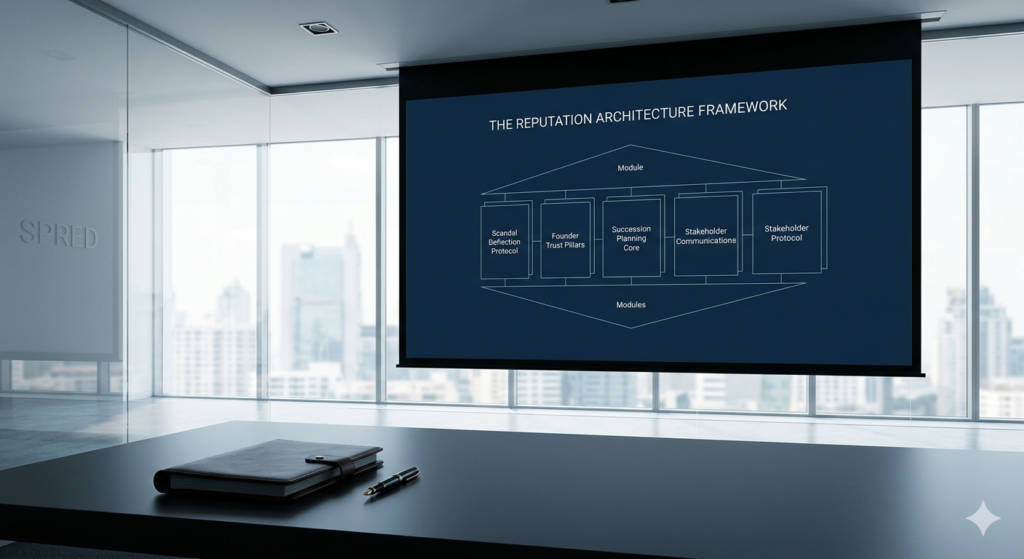
From Personality-Driven to System-Driven Trust
Founder reputation architecture ultimately represents a structural shift in how organizations generate and protect credibility.
Executive reputation building that relies exclusively on founder personality creates a single point of failure.
System-driven trust, by contrast, distributes credibility across governance structures, institutional narratives, and multiple leadership voices.
The organizations that survive founder scandals and leadership transitions share one consistent characteristic: they had already begun separating institutional trust from individual personality before the crisis emerged.
Reputation resilience is not rebuilt after a collapse; it is engineered before one.
Executive brand longevity depends on the same principle.
Founders who invest in formal reputation infrastructure, narrative systems, governance integration, crisis protocols, and succession planning create organizations that can survive their own worst moments.
Those who do not leave their companies structurally exposed to the full weight of personal reputational risk.
Founder reputation architecture is not a luxury for large organizations. It is the structural foundation on which sustainable executive leadership is built.
