
Diplomatic communications is the mechanism through which nations either win or lose the global battle for credibility, alliance, and influence.
This is before a single military asset is deployed or a single trade deal is signed.
State actors like China, Russia, and Iran invest billions of dollars into shaping foreign public opinion.
In this highly competitive landscape, the nations that communicate strategically and consistently hold a decisive advantage.
Those that communicate reactively, inconsistently, or not at all cede that advantage, often permanently.
The 2025 Comprehensive Annual Report on Public Diplomacy, published by the U.S. Advisory Commission on Public Diplomacy, framed this reality directly.
It argued that public diplomacy “yields concrete strategic benefits, from shaping global narratives to cultivating long-term allies”.
IIt urged the White House, Congress, and State Department leadership to treat it.
“Not as a soft accessory but as a core capability vital to American security, prosperity, and global leadership.”
That reframing, from diplomatic communications as a courtesy to diplomatic communications as a strategic weapon.
Is the foundation of every modern State Department that shapes world opinion rather than reacts to it.
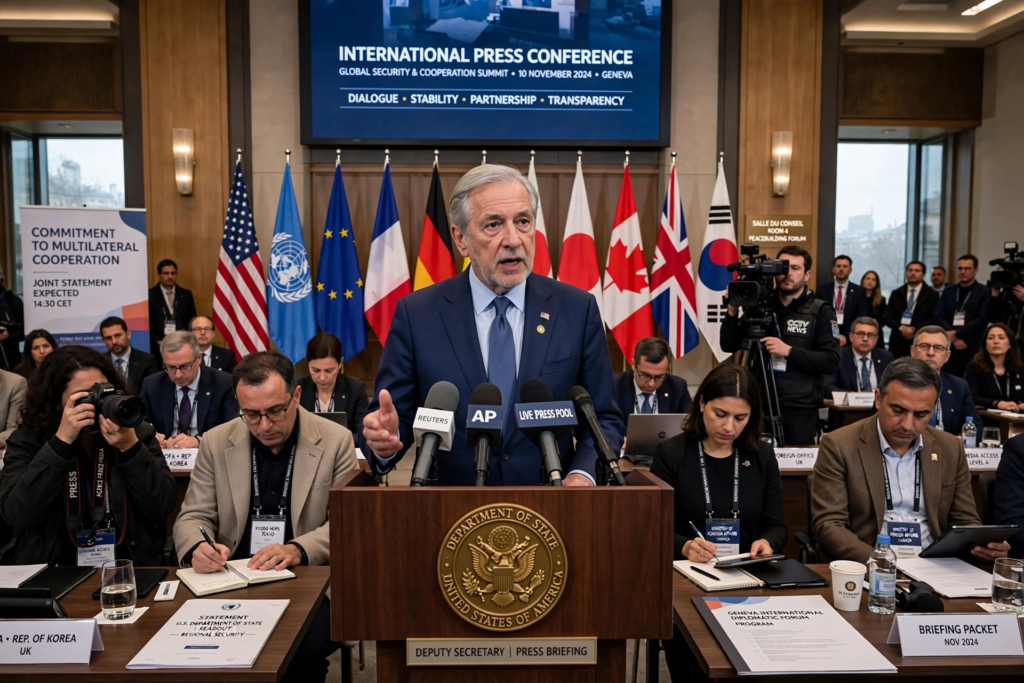
Why Diplomatic Communications Determines Foreign Policy Outcomes
Foreign policy is not made only in negotiating rooms.
It is made in the information space, through the narratives that foreign publics believe about your nation, your intentions, and your reliability as a partner. China’s approach makes the stakes clear.
For China, winning the narrative is not about reputation management. It is “about accumulating invaluable currency with which to weaken rivals, win friends and allies and shore up power at home.”
Russia operates similarly.
In 2025, a U.S. diplomatic cable warned that Russia had sharply expanded its Spanish-language disinformation campaign across Latin America.
Most aggressively in Mexico, using state-run outlets to erode trust in the United States.
RT’s audience in Mexico had reportedly grown from thousands to hundreds of millions of views, amplified through the Kremlin’s relationships with local media groups and sympathetic political figures.
Furthermore, the dissolution of the U.S. Global Engagement Center in 2025, the State Department’s primary counter-disinformation unit – left a significant gap in America’s ability to respond to these information operations in real time.
Diplomatic communications is not a peripheral function that operates alongside foreign policy.
It is the terrain on which foreign policy is won or lost, and the nations that understand this invest accordingly.
The 3 Dimensions of Strategic Diplomatic Communications
Expert State Departments do not treat diplomatic communications as a single discipline.
They operate across three distinct dimensions simultaneously, and the strength of their overall communications strategy depends on how well they integrate all three:
1. Government-to-government communications
This is the traditional diplomatic channel, formal statements, bilateral communiqués, multilateral negotiations, and the messaging that flows between foreign ministries and heads of state. It is essential, but it is no longer sufficient.
Government-to-government communications shapes the positions of foreign governments. It does not shape the opinions of foreign publics, and in democratic societies, foreign public opinion increasingly constrains what governments can agree to, regardless of their own preferences.
2. Public diplomacy – reaching foreign citizens directly
Public diplomacy is defined by the U.S. Advisory Commission on Public Diplomacy as “government activity intended to understand, inform, and influence foreign audiences.” It operates through cultural exchanges, international broadcasting, educational programmes, digital engagement, and the kind of people-to-people connections that shape how foreign citizens view your nation over decades, not news cycles.
The Under Secretary for Public Diplomacy’s mission is to “inform and influence foreign publics by expanding and strengthening the relationship between the people and government of the United States and citizens of the rest of the world.”
This long-term, relationship-based dimension of diplomatic communications is the most durable, and the most neglected. Nations that invest in it consistently hold stronger global credibility than those that communicate only in response to immediate foreign policy crises.
3. Counter-disinformation communications
This is the newest and fastest-growing dimension of diplomatic communications. State actors, primarily China and Russia, now deploy sophisticated, sustained information operations designed to erode trust in democratic institutions, amplify social divisions, and undermine confidence in the United States and its allies.
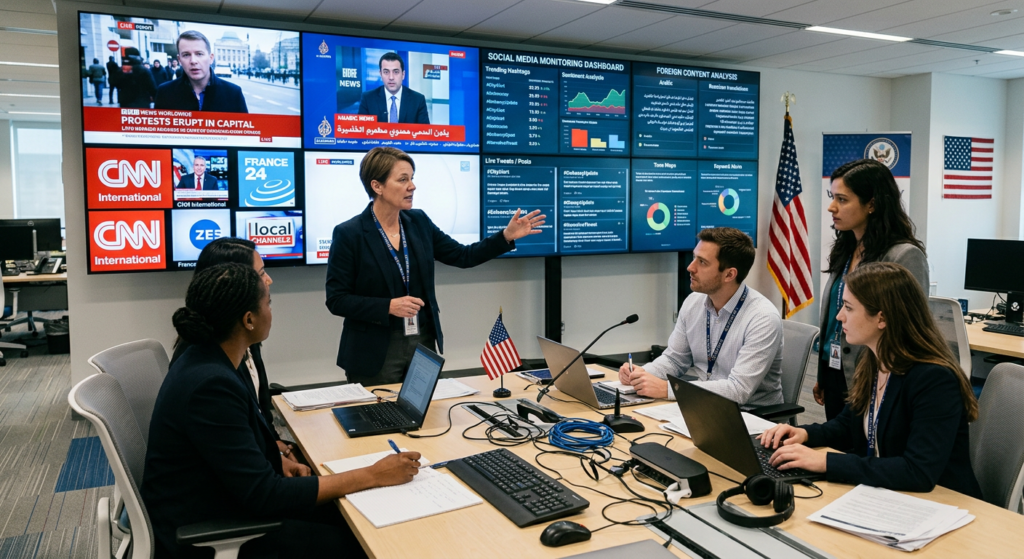
Counter-disinformation diplomatic communications requires real-time monitoring of foreign information environments, rapid response capability, and the kind of proactive narrative-setting that takes contested topics off the table before adversarial messaging can define them.
How Expert State Departments Shape World Opinion
The diplomatic communications strategies that consistently shape world opinion share five characteristics. Here is what they look like in practice:
1. Clear, positive value propositions – not just negative narratives about adversaries
The U.S. Advisory Commission on Public Diplomacy’s January 2025 meeting on China’s public diplomacy was explicit: “Negative narratives about China will not sway audiences.” Foreign publics respond to compelling positive arguments for your nation’s partnership – not to criticism of rivals.
Expert diplomatic communications leads with a clear answer to the question every foreign audience asks: why is a relationship with your country better for my community, my economy, and my future? Nations that answer this question specifically, consistently, and in culturally resonant ways build the durable alliances that geopolitical competition requires.
2. High-level engagement with underserved markets
The 2025 Advisory Commission meeting recommended that “high-level U.S. officials should more frequently visit countries which may not traditionally receive attention from the United States but which have very active Chinese diplomatic and business engagement.”
This principle reflects a fundamental reality of diplomatic communications: presence signals priority. Nations that receive regular, senior-level attention from foreign governments feel valued – and nations that feel valued are more likely to trust and align with those governments when competition for their partnership intensifies.
3. People-to-people exchange programmes at scale
The U.S. National Strategy for Public Diplomacy identifies exchange programmes as “perhaps the single most effective public diplomacy tool of the last fifty years.” Foreign nationals who study, work, or live in your country return home with direct experience of your values, your institutions, and your people, experience that no government broadcast or press release can replicate.
Exchange programmes operate on long timelines. Their impact compounds over decades as participants rise into positions of influence in their home countries. They are the most durable investment any State Department can make in long-term diplomatic communications effectiveness.
4. Technology as a strategic diplomatic communications tool
In 2025, the Trump administration approved exports of Nvidia chips to Armenia -described by the USC Center on Public Diplomacy as “chip power as statecraft.” Access to advanced technology is increasingly a tool of diplomatic influence -one that carries its own communications obligations and narrative-management requirements.
Additionally, the CSIS analysis of U.S. public diplomacy in a multipolar world noted that “the United States and its private sector already outcompete both China and Russia in technology development” – a strategic asset in diplomatic communications that requires deliberate leveraging, not passive possession.
5. Listening before speaking
The CSIS analysis of U.S. public diplomacy identified a fundamental failure pattern: strategic communications that advocates for U.S. values while “neglecting the divergent values held by foreign audiences.” This is why the United States “continuously struggles to improve its image and reputation in the Middle East,” despite significant diplomatic communications investment.
Expert diplomatic communications begins with genuine audience understanding – not just message delivery. Nations and foreign ministries that research foreign public opinion, identify culturally resonant concerns, and build their messaging around those concerns consistently outperform those that broadcast their own narratives regardless of local relevance
The Counter-Disinformation Communications Imperative
The dissolution of the U.S. Global Engagement Center in 2025 created a diplomatic communications gap at precisely the moment when state-sponsored disinformation operations were expanding fastest.
Russia’s expansion into Latin American Spanish-language media. China’s integration of state media, economic relationships, and direct diplomatic pressure to suppress critical reporting across Africa, Asia, and South America.
Iran’s use of proxy media networks across the Middle East.
Each of these represents a sustained, well-resourced effort to shape foreign public opinion against U.S. interests, and each requires a sustained, equally resourced response.
Effective counter-disinformation diplomatic communications includes:
- Real-time foreign information monitoring — tracking the narratives adversarial state actors are amplifying in specific markets before they reach mass circulation
- Proactive narrative setting — establishing accurate, compelling counter-narratives before disinformation takes hold, rather than correcting false beliefs after they are established
- Independent media support — investing in local journalism, fact-checking organisations, and digital infrastructure that gives foreign publics access to credible information sources beyond state-controlled or adversary-influenced media
- Rapid response capability — the ability to issue authoritative, evidence-based counter-statements within hours of a significant disinformation event, in the local language, through locally trusted channels
Moreover, counter-disinformation is most effective when it is not recognisable as government propaganda.
Independent media credibility, built and sustained over time, delivers counter-disinformation outcomes that official State Department communications cannot achieve alone.
When Diplomatic Communications Requires External Specialist Support
State Department and foreign ministry communications teams operate at extraordinary scale.
They manage thousands of diplomatic missions, dozens of language markets, and a global information environment that shifts daily.
Specialist external expertise adds specific value in several scenarios:
You need a specialist diplomatic communications partner when:
- A major foreign policy announcement requires coordinated global narrative management across multiple markets and languages simultaneously
- An information operation by a state adversary has generated significant false narrative traction in a strategically important market
- A bilateral or multilateral negotiation requires public communications support that protects the negotiating position without damaging the relationship
- Your State Department’s public diplomacy function needs independent strategic communications analysis and recommendation
- High-profile diplomatic events – summits, multilateral forums, peace negotiations, require sophisticated real-time media management beyond standard public affairs capacity
Spred Communications provides diplomatic communications strategy for State Departments, foreign ministries, and international institutions.
We combine elite media placement, real-time international monitoring, and multi-market narrative management to shape the global opinion that foreign policy outcomes depend on.
Closing Thoughts
Diplomatic communications is the discipline through which nations turn foreign policy positions into global trust, and global trust into lasting alliance, cooperation, and influence.
The State Departments that shape world opinion are not the loudest. They are the ones that invest in people-to-people relationships before they need political leverage.
They communicate compelling positive value to foreign audiences rather than simply criticising rivals.
Build your three-dimensional communications strategy.
- Invest in your exchange programmes.
- Counter disinformation actively and early.
- Treat diplomatic communications not as the soft side of foreign policy, but as the terrain on which every other foreign policy objective is ultimately won or lost.
Because in a world where information is the currency of geopolitical competition, the nations that communicate best are the nations that lead.
