
A military PR strategy is built for the moment when everything happens at once, when a crisis breaks, cameras arrive, and legislators demand answers.
Armed forces public affairs teams operate in one of the most complex communications environments in the world.
Your audience includes active-duty service members, their families, Congress, allied nations, domestic media, foreign press, veterans’ organizations, and the general public.
These are all of whom are simultaneously present and often hold conflicting expectations.
Your communications must be accurate, timely, and operationally secure.
They must uphold institutional values under political pressure. And they must hold up under the kind of scrutiny that few civilian organizations ever face.
The armed forces that manage this well do not improvise.
They build their military PR strategy long before the crisis arrives, and they test it, train for it, and update it continuously.
This article shows you exactly how they do it.
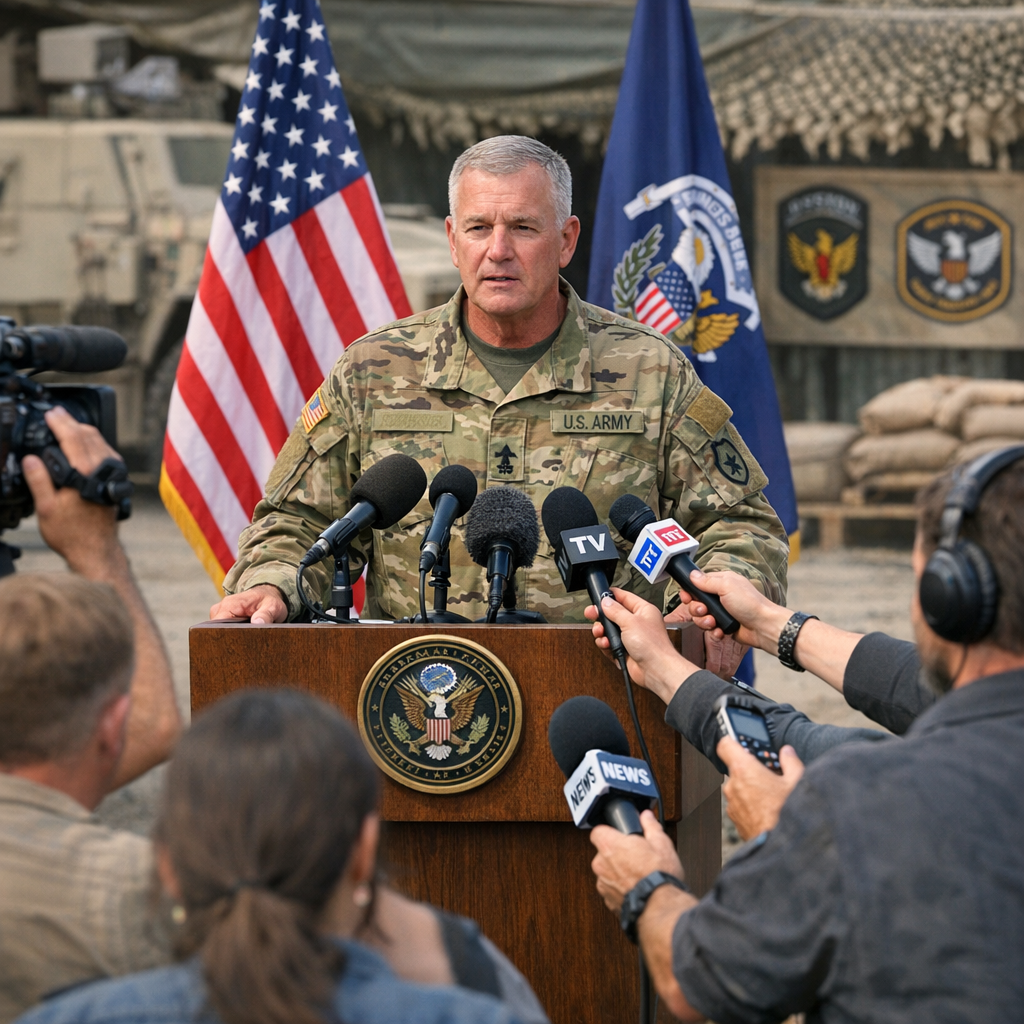
Why Military PR Strategy Is Unlike Any Other
The U.S. military’s public affairs enterprise comprises 4,000 professionals deployed across duty stations worldwide.
It is one of the largest government communications operations in existence, and one of the most constrained.
Every public statement must be approved for release.
Every media engagement is governed by doctrine. And every crisis unfolds in a global information environment where adversaries actively monitor what is said, how fast it is said, and where the inconsistencies appear.
In January 2026, Public Affairs was formally established as a basic branch of the U.S. Army, a structural recognition that communications is now a core military function rather than a support role.
The Army restructured its entire public affairs enterprise in 2025 under the Continuous Transformation initiative.
It established the Army Communications and Outreach Office to unify strategic communication, media relations, and public affairs integration across all Army components.
Furthermore, U.S. Marine Corps Communication Strategy and Operations, known as CommStrat, treats communications not as a separate plan but as part of the organization’s plan.
As Marine Corps Brig. Gen. Sean Salene explained at a PRSA conference: “There isn’t a separate communications plan, there is an organization plan.
As communications professionals, we understand the what, but more importantly, the why.”
That integration of communications into operational planning, not alongside it, is the foundation of effective military PR strategy.
It is also the standard against which every crisis response is ultimately measured.
The 4 Pillars of an Effective Military PR Strategy
Military crisis communications do not begin when the crisis hits.
It begins months, sometimes years, before, in the planning and preparation that make a rapid, credible response possible under pressure.
These four pillars define what that preparation looks like:
1. Proactive public affairs as standard operating procedure
The U.S. Army’s public affairs doctrine states that “the proactive release of accurate information puts U.S. military operations in context.”
According to the doctrine, this approach facilitates informed perceptions, counters misinformation and disinformation, and helps achieve national, strategic, operational, and tactical objectives.
This is not a communications aspiration; it is a doctrinal requirement.
Armed forces that release information proactively, consistently, and accurately build a credibility reserve that pays dividends when a crisis requires the public to trust their account of events.
Accordingly, proactive public affairs means more than press releases.
It means commander-driven communications, regular media briefings on non-crisis topics, community engagement, and a sustained relationship with the defense media that exists long before any crisis creates the need for it.
2. Unified spokesperson authority
Joint Publication 3-61, the foundational doctrine for U.S. military public affairs, establishes that a single, coordinated public voice is essential during both routine operations and crises.
Contradictory statements from multiple spokespersons are among the most damaging outcomes of a military crisis and are almost entirely preventable through prebuilt spokesperson authority structures.
Every major military unit needs a designated public affairs officer with clear authority to speak and a chain of communication that routes all external media inquiries through a single point of coordination.
3. Media relationship infrastructure built before a crisis
Navy Capt. Brook DeWalt, speaking at a national public affairs conference, described the military’s approach to misinformation during operational crises.
That kind of rapid, credible counter-messaging is only possible when media relationships exist in advance.
Journalists who already know your spokesperson and already have a baseline of institutional trust are far more likely to seek your response before publishing than those who have no prior relationship.
Build those relationships. Make your spokesperson available for background conversations on non-sensitive topics.
The credibility you build in quiet periods is the credibility you spend in a crisis.
4. Crisis scenario preparation and rehearsal
Research from San José State University’s communication studies program documents the synthesis model for military crisis communications.
Within that model, scenario identification and preparation represent the second critical step, immediately after ongoing public affairs efforts.
Armed forces PR teams must map their most likely crisis scenarios.
These include aircraft incidents, operational security breaches, personnel misconduct, strategic communications failures, and adversarial information operations.
Then they must rehearse those frameworks under realistic pressure before they need to execute them.
The Military Crisis Communications Playbook: Step by Step
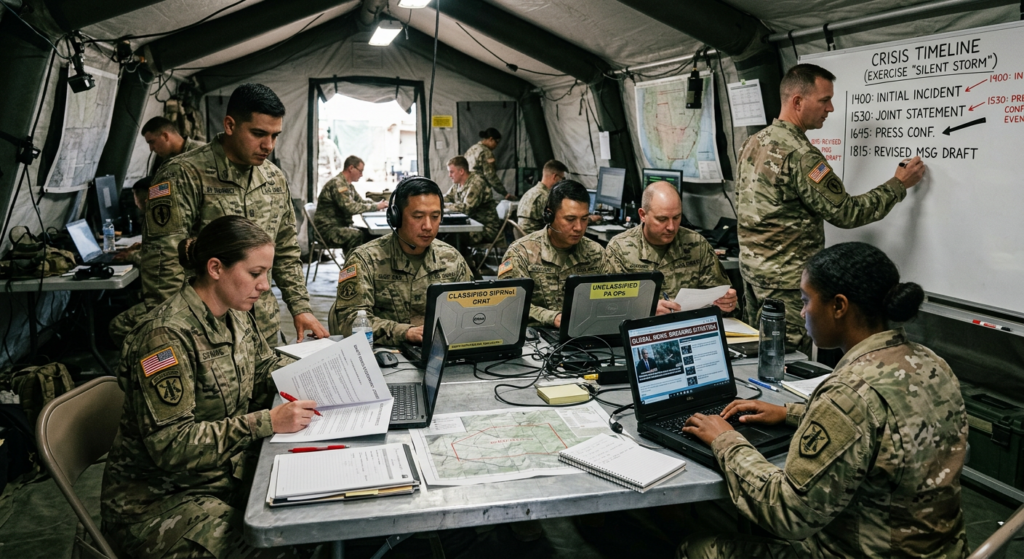
When a crisis breaks, the first 30 minutes determine whether your military PR strategy holds or collapses.
Below is the practical playbook that armed forces PR teams must be able to execute immediately.
0–10 Minute: Activate and assess
The public affairs officer contacts the commanding officer immediately. Assess what is known, what is suspected, and what cannot yet be confirmed.
Identify whether the incident involves classified information, ongoing operations, personnel casualties, or potential legal exposure; each category triggers different response constraints.
Do not wait for complete information before preparing communications. Begin drafting a holding statement immediately.
The holding statement acknowledges the situation, confirms that you are gathering information, and commits to a specific timeline for the next update.
10–30 minutes: Issue the holding statement
A credible holding statement, issued within 30 minutes, prevents the narrative vacuum that adversaries, critics, and uninformed media will otherwise fill.
The holding statement does not require complete information.
It requires accuracy, a human tone, and a specific commitment to updates.
Joint Publication 3-61 is clear on this principle: “Denying unfavorable information or failing to acknowledge it can lead to media speculation, the perception of cover-up, and degradation of public trust.”
Hour 1–3: Coordinate across the chain of command
All statements being released by subordinate units must be coordinated through the designated lead public affairs authority.
Contradictory statements from different levels of the organization are among the most damaging crisis outcomes and are almost entirely due to a coordination failure.
During this phase, brief key legislative contacts, allied nation communications liaisons, and senior command simultaneously.
Internal communications must keep service members and families informed, not just the external media.
Service members who receive accurate information through official channels are less likely to share speculation through personal social media accounts.
3–24 Hour: Sustain the update cadence
Issue regular updates on a committed schedule, even when new confirmed information is limited.
Each update reinforces that your institution is managing the situation, not hiding from it.
Updates can be brief. They cannot be absent.
Post-crisis: Counter misinformation actively
Military PR strategy does not end when the immediate crisis resolves.
Adversarial actors, domestic critics, and viral misinformation continue shaping public perception long after the operational incident concludes.
Track and counter false narratives with verified facts. Use official channels, service websites, verified social media accounts, and direct media briefings to establish the accurate record.
Do this persistently, not reactively. As Capt. DeWalt noted: “Keep attacking until we get to the truth.”
The Politicization Challenge: Protecting Institutional Credibility
In July 2025, Military.com reported a significant institutional challenge.
The Pentagon’s public-facing communications had become “laced with attacks on Democratic lawmakers, praise for President Donald Trump, political barbs and misinformation about media reports” under Secretary Hegseth’s tenure.
Political operatives were placed in charge of Army public affairs offices, stoking concerns about creeping partisanship in institutional communications.
This is a military PR strategy challenge with deep institutional stakes.
Armed forces that communicate in ways that read as partisan lose the cross-partisan credibility essential to broad public trust in a democracy.
Citizens of every political affiliation must be able to trust their military, and that trust requires communications that are clearly institutional rather than politically motivated.
Consequently, military PR strategy must include explicit safeguards that protect the professional communications function from political interference at every level of the organization.
The institutional legitimacy of the armed forces depends on it.
When Armed Forces PR Teams Need Specialist External Support
Military public affairs teams handle the vast majority of communications challenges effectively with internal resources.
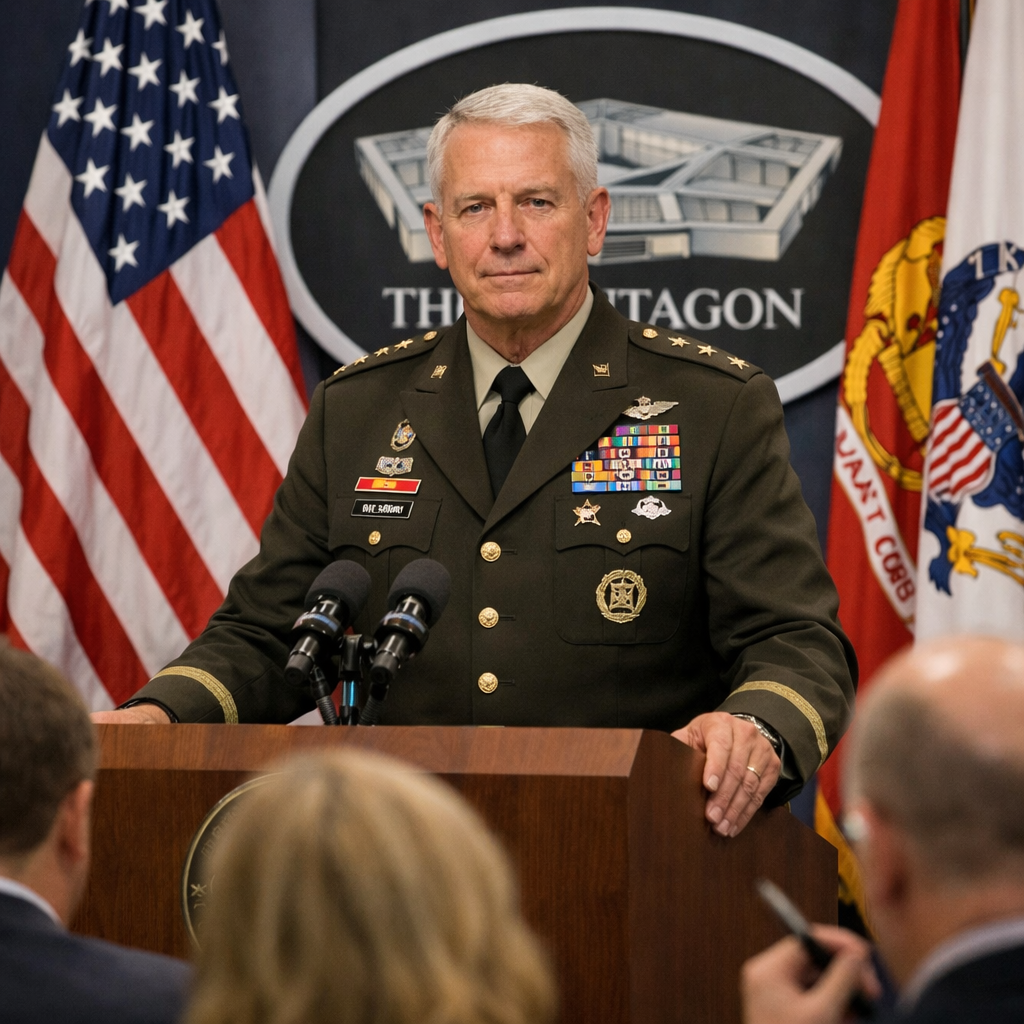
However, certain scenarios consistently exceed internal capacity, particularly when political complexity, legal exposure, and media volume converge simultaneously.
You need specialist military PR support when:
- A crisis involves national media attention at a scale that exceeds internal public affairs capacity
- Partisan pressure is influencing institutional communications in ways that risk long-term credibility damage
- An incident has generated contradictory messaging that requires a structured narrative recovery
- Congressional testimony, legislative hearings, or inspector general investigations require coordinated communications management.
- Your public affairs team needs independent crisis scenario preparation and rehearsal support that internal training resources cannot provide.
Spred Communications builds military PR strategies for defense agencies, armed forces public affairs teams, and senior military officials.
They combine crisis playbook development, media relationship infrastructure, and specialist narrative management to protect institutional credibility when it matters most.
Conclusions
Military PR strategy is not about winning news cycles.
It is about maintaining the public trust that makes democratic armed forces legitimate, in peacetime, in crisis, and under every form of political and media pressure that public service generates.
The armed forces that manage this best are the ones that prepare most thoroughly before the crisis arrives.
They build their spokesperson authority structures, proactive media relationships, scenario response frameworks, and institutional credibility reserves long before any incident tests them.
Build your playbook now. Train your team, and protect the institutional voice that citizens of every background must be able to trust.
A military that communicates credibly is one that commands public confidence, and that confidence is as essential to national security as any weapon system in the arsenal.
