
One post, screenshot, or video clip, and within hours, a government agency’s reputation can literally be in a free fall. That’s the reality of managing a social media crisis in 2026.
The speed is brutal, the audience is global, and the damage compounds every minute you wait.

But here’s what most agencies get wrong: a social media crisis is not just a PR problem. It’s a trust problem. And trust, once broken publicly, is far harder to rebuild than any news cycle suggests.
The good news is that with the right strategy in place, you can turn a viral moment of backlash into a long-term credibility asset.
This guide shows you exactly what to do.
Social Media Crisis Guide 2026: Viral Backlash to Public Trust: Table of contents
- Why Social Media Crises Hit Government Agencies Harder
- How Fast a Social Media Crisis Moves Today
- The 5 Most Common Government Social Media Crisis Mistakes
- A Social Media Crisis Response Framework
- The Role of Online Reputation Management During a Social Media Crisis
- What Effective Crisis Containment Looks Like in Practice
- When to Bring In External Crisis PR Support
- Protecting Public Trust in the Age of Viral Backlash
Why Social Media Crises Hit Government Agencies Harder
A social media crisis doesn’t treat everyone equally.
For a private brand, a viral backlash hurts revenue. For a government agency or public institution, it damages something harder to measure, and even harder to restore.
The global social media crisis management market was valued at $3.41 billion in 2025 and is growing at over 22% annually, a clear signal that organisations worldwide are waking up to just how costly these moments have become.
Furthermore, 54% of adults in the U.S. now get their news from social media, according to a 2024 Pew Research Centre report.
That means the moment your agency is involved in a controversy, half the country is getting its first impression of it from the most unfiltered, unmanaged source available, social media.
For a government agency, that context matters enormously. You’re not just managing a news cycle; you’re managing public perception of an institution that people depend on for safety, services, and truth.
Additionally, over 63% of an organisation’s market value is attributed to reputation, according to Weber Shandwick research.
For public institutions, where the “market value” is measured in political legitimacy and citizen compliance, that figure becomes even more sobering.
The stakes, in short, are not comparable to a brand PR misstep. They are categorically higher.
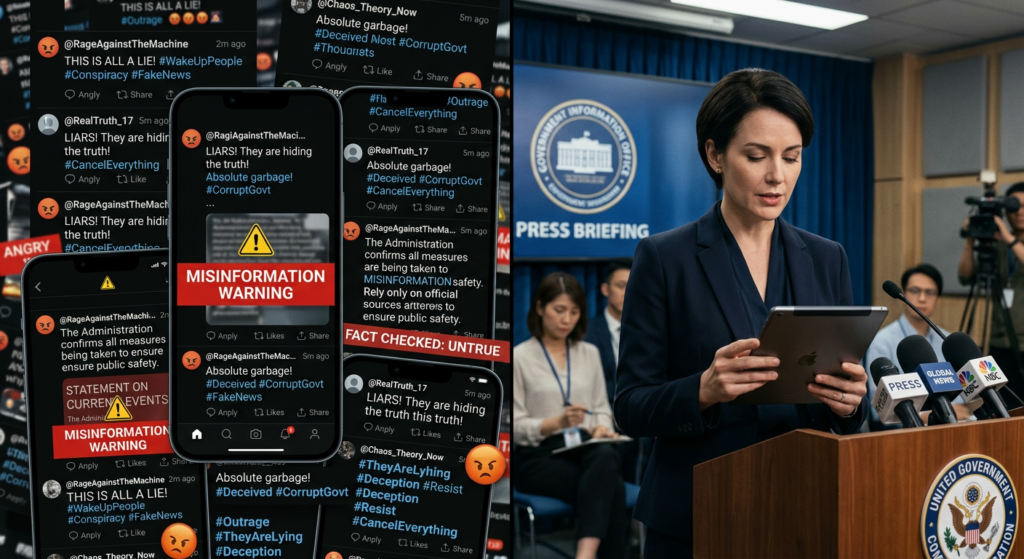
How Fast a Social Media Crisis Moves Today
Speed is the defining feature of a modern social media crisis, and most government agencies are built for processes that move at the opposite speed.
By October 2025, social media had reached 5.66 billion active user identities worldwide, effectively placing corporate and institutional reputation in front of most of the planet.
A single post, when amplified, can cross borders in seconds.
The Astronomer “ColdplayGate” crisis in 2025 is a sharp example of how fast silence becomes dangerous.
The company remained silent for days after the incident went viral.
In that silence, the internet took over, AI-made videos, fake press releases, and made-up resignation letters flooded social media. By the time the real facts came out, no one knew what to believe.
That’s what an uncontrolled narrative looks like. And for a government agency, the consequences of that kind of narrative vacuum are far more serious than for a tech startup.
Consequently, the first hours of a social media crisis are not a time for deliberation. They are a time for controlled, pre-prepared action.
The 5 Most Common Government Social Media Crisis Mistakes
Before you can respond well, you need to understand the failure patterns that consistently make government social media crises worse.
Here are the five most common:
1. Waiting for legal clearance before speaking
Legal caution is understandable. But silence on social media is never neutral; it always reads as guilt, evasion, or incompetence. By the time legal approves a statement, the narrative is three steps ahead of you.
2. Using formal, bureaucratic language in an informal medium
Social media is a human conversation. When government agencies respond to a viral moment with stilted, jargon-heavy statements, they signal a disconnect that makes the backlash worse. Plain language is not optional during a social media crisis. It’s the whole point.
3. Treating each platform the same
A statement that works on your official website will not land on X (formerly Twitter) the same way. The tone, length, and format of your response must match the platform where the crisis is burning. One-size-fits-all responses tell the public you haven’t actually thought about them.
4. Going silent after the first statement
Many agencies issue one initial response and then disappear. That silence leaves a vacuum, one that critics, journalists, and social media users will fill with speculation, misinformation, and mockery. Regular updates, even brief ones, are essential.
5. Failing to monitor for misinformation
Around 47% of misinformation during crises originates from anonymous or bot accounts, making source-tracking genuinely difficult. However, not tracking it at all is far more dangerous. False narratives spread faster than corrections, and an agency that doesn’t know what misinformation is circulating cannot effectively counter it.
Related: Government Crisis Response: Why 73% Fail & How to Fix It
A Social Media Crisis Response Framework
This is a framework that works specifically for government and public institutions:
Step 1: Monitor before the crisis happens
Real-time monitoring is your early warning system. You need to know what’s being said about your agency across platforms, not just on your own channels. Tools that track sentiment shifts, keyword spikes, and influencer activity give you crucial seconds — sometimes minutes — of lead time before a post goes viral.
Step 2: Activate a pre-approved holding statement immediately
Your first public response should be available within 30 minutes of a crisis breaking. It doesn’t need to be comprehensive. It needs to be fast, human, and honest. “We are aware of what is being shared. We are investigating and will update you within [specific time].” is a complete, effective holding statement.
Step 3: Designate one official social media voice
Conflicting responses from different agency accounts are among the most damaging things you can do during a social media crisis. One account, one voice, one message. All other agency accounts should defer or amplify only that official channel.
Step 4: Counter misinformation directly and calmly
Real-time monitoring is essential to stop misinformation from spreading. If you’re building a plan during a crisis, you’re already behind. When false content circulates, name it specifically, correct it factually, and link to verified sources. Do this without aggression, defensive or combative responses almost always make things worse.
Step 5: Set and communicate an update cadence
Tell your audience when they will hear from you next, and then honour that commitment. A government agency that updates regularly, even with small amounts of new information, signals control and transparency. Silence, by contrast, signals neither.
Step 6: Shift to recovery narrative within 72 hours
The social media crisis response phase should transition to a recovery phase within three days. This means communicating what you’ve learned, what you’re changing, and what accountability looks like.
The Role of Online Reputation Management During a Social Media Crisis
Online reputation management during a social media crisis is not about hiding bad news.
It’s about making sure verified, accurate information is visible, accessible, and dominant in the conversation.
For government agencies, that means three things:
- Proactive content: Before a crisis, build a track record of transparent, regular communication. Agencies with a strong content history have credibility to draw on when a crisis hits.
- Owned channel dominance: Your official website, verified social accounts, and government press releases must be updated first and updated often during a crisis. These are your primary trust signals.
- Third-party validation: Where possible, have credible external voices, independent oversight bodies, trusted community leaders, and academic experts amplify your official position during the crisis.
Overall, the agencies that manage online reputation best are those that treat it as an ongoing discipline, not an emergency response.
What Effective Crisis Containment Looks Like in Practice
The Astronomer case, while from the private sector, offers a clear lesson for government communicators.
The company eventually issued a strong, transparent statement that highlighted the action being taken, including a new CEO stepping in. But by the time the real facts came out, no one knew what to believe.
That’s the cost of delayed transparency. The facts were good, and the timing was not.
For government agencies, the principle is identical.
A strong, transparent, timely response, even one that acknowledges incomplete information, preserves far more trust than a polished statement that arrives three days too late.
Using holding statements early, such as “We’re aware and reviewing it,” can stop speculation and buy time.
That principle is not just good PR, it’s the foundation of government credibility in a digital age.

When to Bring In External Crisis PR Support
There’s a threshold in every government social media crisis where internal resources reach their limit.
Recognising that threshold, and acting on it before you cross it, is one of the most important leadership decisions you can make.
External crisis PR support becomes critical when:
- The crisis is generating national or international media attention
- Misinformation is circulating faster than your internal team can counter it
- Multiple agencies are involved and producing conflicting messages
- Your internal communications team lacks social media crisis experience
- The volume of incoming public and media enquiries exceeds your current capacity
A specialist government crisis communications partner brings pre-existing media relationships, dedicated monitoring infrastructure, and narrative management experience that most agencies simply don’t have on standby.
Spred Communications works with government agencies and public institutions to build crisis-proof social media communication architecture.
We combine real-time monitoring, rapid response frameworks, and strategic narrative management to protect institutional credibility when it matters most.
Read Also: Public Sector PR Trust: How to Build Confidence in Government Institutions
Protecting Public Trust in the Age of Viral Backlash
A social media crisis is not an if-it-happens situation. For any government agency operating in the public eye, it’s when it happens.
What determines whether that moment damages your institution permanently or becomes a proof point of your credibility is not luck.
It’s preparation, speed, and the quality of your response.
Build your monitoring systems before you need them.
Prepare your holding statements before a crisis breaks out.
Train your team on platform-specific communication, and be willing to bring in specialist support when the situation demands it.
The agencies that protect public trust in the age of viral backlash are not the ones that never face a social media crisis.
They’re the ones that are ready when it arrives.
