
Corporate trust is one of the most valuable assets any company can have today.
In our fast-paced world, where information is shared instantly and nobody trusts big companies more than they used to, corporate trust is what sets winners apart from losers.

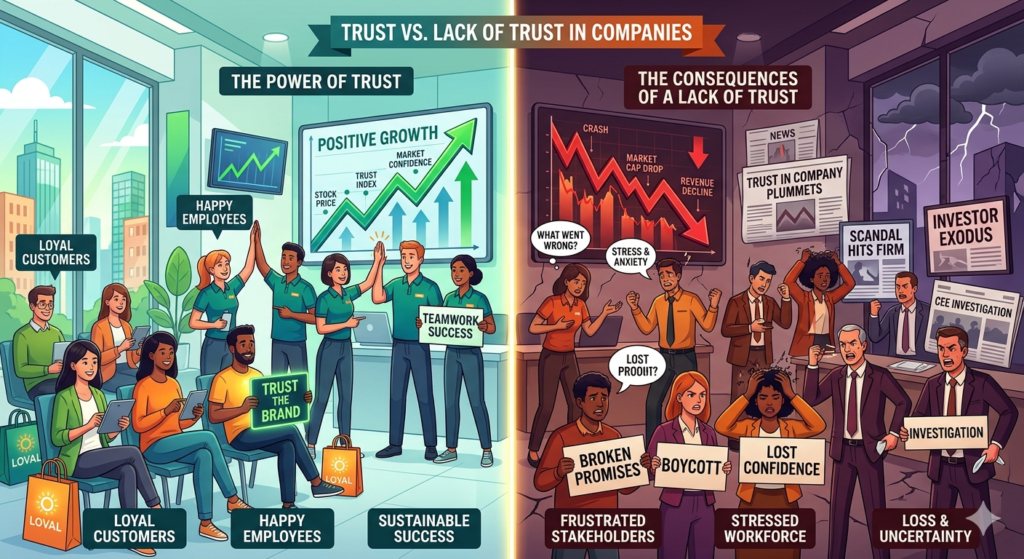
If people trust a company, they will stick with it. And if employees trust the company they work for, they will work harder. If investors trust the company they invest in, they will invest in it.
But corporate trust is more than just empty rhetoric.
Corporate trust is what determines how much money a company will make, how long it will retain its customers, and how well it will weather any storm.
Companies with high levels of corporate trust are financially better off than their competition.
The Edelman Trust Barometer, which monitors this for us year after year, proves it time and again.
Companies that are trusted by people have more customers, grow faster, and are worth more.
So what is corporate trust, and how do companies build it?
Corporate Trust: The Quiet Force Behind Strong Brands and Growth: Table of contents
- Understanding Corporate Trust: What It Really Means
- Why Corporate Trust Matters to Your Bottom Line
- How Companies Build Strong Corporate Trust
- What Trust Looks Like: Real Examples
Understanding Corporate Trust: What It Really Means
Corporate trust is really pretty simple.
Additionally, this is also based on whether or not people believe that the company is going to do what the company said it was going to do.
Corporate trust is based on whether or not people think the company is honest, is reliable, and is fair.
So, think about it this way.
Personal trust is based on whether or not you know the person.
Corporate trust is based on whether or not you know the company, and the only way you can know the company is because they have thousands and thousands of people all over the world. But the basic question is the same.
People are interested in whether or not the company is honest, whether or not the company is reliable, and whether or not the company is fair.
So, corporate trust is really based on four things:
1. Competence: Can the company actually do what they said they could do?
Are the products they’re selling really good? Are the services they’re selling really good?
2. Integrity: Does the company really keep its word?
Does the company really do the right thing, even when nobody is looking?
3. Caring: Does the company really care?
4. Reliability: Does the company do what it says it will do, over and over again?
When all these things are strong, corporate trust holds firm even when times get tough.
When any one of them is weak, the whole thing starts to fall apart.

Why Corporate Trust Matters to Your Bottom Line
Now, let’s discuss money, since, in the end, money is what it’s all about.
Research done by McKinsey, as well as other large companies, has shown that when a company has high trust, it makes more money.
Here are the ways in which they do so:
Customer Loyalty and Sales
When people trust a company, they will pay more money to do business with them, as well as continue to do so in the future.
In addition, they will not shop around as much.
In other words, when people trust a company, they will pay more money for what they are selling, since they will know it is worth the money they are paying.
A customer who trusts a company will not only continue to do business with them but will also go out of their way to let others know about the company they are working with, which is far less expensive than buying an ad. Here are the numbers:
Companies that people trust retain customers 25-40% longer than those they don’t trust.
People who are customers of companies they trust will, on average, go out of their way to let 8-12 other people know about the company they work for.
Read More: Corporate Storytelling Strategy: How to Build Powerful Brand Trust
Keeping Good Employees
People want to work somewhere they feel respected and where leaders tell them the truth.
When a company lacks trust, workers leave, don’t try their best, and come up with fewer new ideas.
But when employees trust their leaders, they stay, work harder, and care more about doing good work.
Real corporate trust at work shows up as:
1. Clear talk about where the company is going and big decisions that get made.
2. Fair pay and clear ways to get promoted.
3. Leaders who follow the company’s values consistently.
4. Managers who listen when employees have problems. Leaders who admit when they mess up.
5. When employees feel this kind of trust, they show up better. T
6. They are more creative. They put their heart into their work.
Getting Investors to Believe In You
Companies people trust attract investor money more easily.
When a company is clear about finances and how it’s run, investors feel confident.
When a company follows good ethics, it attracts investors who care about doing business the right way.
Companies with strong trust also bounce back from problems faster, which protects investor money.
How Companies Build Strong Corporate Trust
Trust doesn’t just happen by luck. Smart companies build it on purpose.
Being Open and Clear
The most important thing is being transparent.
When a company tells people what’s really going on, trust grows. When it hides stuff or lies, trust disappears fast.
What’s a company without honesty? Nothing. Trust falls apart without it.
Smart companies do this:
Share regular updates about what the company is doing and how decisions get made.
Explain why the company makes tough choices.
Tell people both the wins and the losses. Be honest about real problems and dangers. Keep leaders easy to reach and available to talk.
Doing the Right Thing
Trust breaks down when companies act unethically.
Doing the right thing has to be non-negotiable.
That means following laws and doing business fairly. It also means caring about the world around you, not just profits.
But fake goodness hurts trust.
Real commitments to helping the environment and communities actually matter to today’s workers and customers.
Employees especially want to work for companies whose values match their own beliefs. When a company truly acts ethically, trust gets stronger.
Walking the Walk, Not Just Talking the Talk
Corporate trust means that if you say something, you have to mean it and also do it.
So, if a business says that it cares about the environment and then goes and pollutes rivers, no one is going to trust that business.
Similarly, if a business leader talks about diversity and then only employs people who are similar to themselves, that business leader is a hypocrite.
True trust is something that is built up over time, rather than something that is achieved through one major announcement.
For example, a business may announce that it is going to be a sustainable business, and people may take notice for a day or two.
But if that business is actually spending a lot of money to reduce pollution (action), then people are actually going to trust that business and believe in that business.
What Trust Looks Like: Real Examples
Apple Does Trust Right
- Makes high-quality products, generation after generation
- Customers know what they are getting when they purchase Apple products
- Products designed with care and attention to ease of use and aesthetics
- Respects customer privacy, even when forced to compromise by governments
- Leadership transparently discusses their actions and motives
Result: Customers are willing to pay a premium; investors trust the company through thick and thin; trust is worth billions
Volkswagen’s Trust Disaster
Developed secret software to cheat pollution tests. Spent years covering up the cheating rather than owning up to it and being honest
The results when caught:
- Customers lost trust in the company; car values fell through the floor
- Employees found out that leadership had lied to them
- Investors lost billions in company value
- Regulators no longer trusted what the company was saying
Efforts to rebuild trust:
Leadership was replaced, confessions made, payoffs made, and a switch to electric cars was made
The big lesson learned: It takes much longer to rebuild trust than to destroy it, and lying and cheating cost much more than honesty, no matter how tempting cheating might be
Southwest Airlines: Trust Through Culture
- Empowers employees to make customer-focused decisions independently
- This approach creates speed and better service
- Transparent about business model and ticket pricing; no hidden fees or tricks
- Delivered reliable service and good customer treatment for decades
- Result: Customers remain loyal longer than competitors, despite intense market competition
How to Measure Whether Your Company Has Trust
You can’t manage what you don’t measure. So companies need to track trust in real ways.
Numbers That Matter
1. Net Promoter Score: Ask people if they’d recommend your company. Track this over time to see if trust is getting better or worse. Look at the numbers for customers, employees, and investors separately to see where problems might be.
2. Trust Surveys: Ask specific questions about whether people think you’re competent, honest, caring, and reliable. Use simple rating scales. Check these results every few months or once a year to spot areas that need work.
3. Brand Health Tracking: Watch how people view your company. Compare yourself to competitors to see where you stand.
4. Customer Retention: Track how many customers come back. If more keep coming back, trust is probably growing.
The Human Side of Corporate Trust
Numbers tell part of the story, but conversations tell the real story:
- Interviews: Talk one-on-one with customers, employees, and investors. Ask open questions. Learn what really makes them trust you or doubt you.
- Focus Groups: Bring groups together to talk about how they see your company. This shows what worries people have in common and where they disagree.
- Sentiment Analysis: Read what journalists and people online say about your company. Are they saying nice things or mean things? Track whether this is getting better or worse.
- Social Media Watching: See what people say about you on Facebook, Twitter, and other platforms. When you respond to problems, you show you care about what people think.
Building Trust: The Practical Playbook
Talk Before There’s a Problem
Don’t wait for a crisis to communicate. Share stories about your company’s values all the time:
Have leaders write articles and speak at events.
They become trusted voices. Tell real stories about how your products help real people. Be specific, not vague.
Share updates about promises you made and how you’re doing on them. Talk honestly about what’s tough and what you’re learning.
Be Ready for When Things Go Wrong
- Crises test trust hard. You need a plan:
- Respond fast, within hours. Silence hurts way more than honest words.
- Take responsibility. Don’t make excuses or blame others.
- Explain exactly what you’re doing to fix it and when.
- Keep talking as you work through the problem. Show you care by staying in touch.
Tell Stories, Not Speeches
Instead of just saying “we care about the environment,” tell real stories. Talk about actual projects.
Have employees explain what they did. Show the real results. Numbers work. Trees saved. Emissions cut. Communities helped.
This turns big talk into proof that you mean it.
Really Listen to What People Say
Corporate trust isn’t a one-way street. Create real ways for people to talk back:
- Set up customer groups that meet regularly.
- Have leaders do town halls where employees ask questions directly.
- Stay in touch with investors.
- Work with communities.
- Listen carefully, then do something with what you hear.

Making Corporate Trust Real in Your Organization
Companies that truly care about trust need dedicated people and systems:
Someone Responsible: Have a leader or team whose main job is building trust. This person makes sure all departments work together on trust.
Teamwork: Get communications, HR, operations, and leadership together regularly. Trust strategy has to touch everything.
Dashboard of Real Numbers: Track trust metrics the same way you track sales and profits. Look at the numbers regularly. Change what’s not working.
Annual Check-In: Once a year, honestly assess where your trust stands. Compare yourself to competitors. Figure out what to improve. Set real goals for the next year.
The Real Value of Corporate Trust
Corporate trust isn’t nice to have. It’s essential.
Companies that build it get loyal customers, engaged employees, confident investors, and a better ability to handle crises.
Success requires real commitment.
Trust has to be built into strategy from the top. Progress has to be measured. And companies have to listen to stakeholders and adjust when needed.
Leaders have to model trustworthy behavior. This isn’t something to do on the side; it’s central work.
Corporate trust is what makes brands strong in today’s complicated, transparent world where information moves at lightning speed.
Communications and PR leaders should make trust building their most important priority.
Companies that commit to real trust will lead their markets.
Those that skip it will eventually discover that getting trust back takes enormous effort.
Start now. Measure constantly. Communicate honestly. Act ethically.
Build the trust that helps your organization make it through change, challenges, and competition.
Trust doesn’t build itself. It takes real strategy and real effort.
If your company is ready to figure out where trust stands today and build a plan to make it stronger with customers, employees, investors, and communities, now is the time.
Transform how people see your company. Build the trust that drives real, lasting growth.
