
Corporate reputation is the single most powerful and most underestimated asset a company owns.
It takes years to build as it, can fracture in a single news cycle. Once it breaks, the cost of repair is almost always higher than the cost of protection would have been.

This piece gives you a complete, honest guide to understanding corporate reputation.
You will learn what shapes it, how leading organizations measure and manage it, and what research actually says about its impact on business performance.
Think about the last time you picked one company over another without a clear reason. The product was similar, the price is comparable. Yet one brand felt more trustworthy, more credible. Simply, it felt like the right company to do business with.
That feeling has a name. It is corporate reputation.
Corporate Reputation is The Hidden Force Behind Brand Power: Table of contents
What Corporate Reputation Means
Corporate reputation is the collective judgment that your stakeholders – customers, investors, employees, regulators, media, and the public- hold about your organization.
It is not what you say about yourself, it is what others say about you when you are not in the room.
Your brand identity is what you project; your corporate image is what sticks. The two are related, but they are not the same thing.
Corporate reputation forms at the intersection of three things. First, your actual behavior as an organization, the decisions you make, the products you build, the way you treat your employees and communities.
Secondly, your communication, how clearly and consistently you explain who you are and what you stand for.
Third, the experiences your stakeholders have when they interact with your organization directly.
A company that claims to prioritize sustainability but quietly lobbies against climate legislation will find that misalignment reflected in its reputation score within months.
According to the 2024 RepTrak Global Reputation Study, which surveys 243,000 respondents across 14 global economies, reputation accounts for an average of 42% of a company’s market capitalization when isolated from other financial factors.
Additionally, the same study found that a one-point improvement in corporate reputation score correlates with a 2.6% increase in willingness to purchase, recommend, and invest.
Furthermore, a 2023 Oxford Saïd Business School meta-analysis of 42 studies on corporate reputation found that companies ranked in the top quartile for reputation outperform peers in total shareholder return by an average of 7.5% per year over a ten-year period.
Consequently, reputation is not a soft metric; it is a financial one

Corporate Reputation vs. Brand Reputation
People sometimes use corporate reputation and brand reputation as if they mean the same thing. They do not. Knowing the difference helps you manage both more effectively.
Brand reputation refers to how people perceive a specific product, product line, or consumer-facing brand name. It lives primarily in the minds of customers, shaped by product quality, marketing, pricing, and customer service, and it can be relatively isolated
A brand can suffer a reputation problem without dragging the entire corporation down with it, if the corporate entity is sufficiently distant.
Corporate reputation, by contrast, refers to how people perceive the organization as a whole.
It includes your relationship with employees, your governance practices, your environmental and social record, your financial integrity, your leadership team, and your communications behavior during difficult moments.
Corporate reputation matters to a much wider group of stakeholders than brand reputation alone.
This distinction has real consequences. Take a look at the difference between a product recall and a governance scandal. A product recall damages brand reputation, but if handled well, it can actually strengthen reputation through transparent, responsible communication.
A governance scandal, however, damages corporate reputation directly, affecting investor confidence, employee morale, regulatory relationships, and media coverage simultaneously.
Because corporate reputation affects so many stakeholder groups at once, it requires a different kind of management than brand reputation. It is not just a marketing challenge. It is a leadership, communications, and operational challenge combined.
Organizations that understand this distinction invest in both brand reputation management and a broader corporate reputation strategy that works across all stakeholder groups.
What Corporate Reputation is Worth
One reason reputation gets underinvested is that its value is harder to see on a balance sheet than a factory or a patent portfolio. But the research is consistent and compelling.
The Reputation Institute’s 2023 Corporate Reputation Quotient study found that for companies in the S&P 500, corporate reputation contributes between 35% and 55% of total market value, depending on the industry.
Financial services and healthcare companies sit at the high end of that range. Consumer goods companies sit in the middle. Technology companies vary widely based on how differentiated their products are.
Reputations consistently attract better talent at lower acquisition cost, retain customers longer, and access capital at more favorable rates than peers with average or poor corporate reputations.
The talent dimension is particularly significant.
According to LinkedIn’s 2024 Global Talent Trends Report, 76% of job seekers research a company’s reputation before applying. Companies ranked in the top quartile for corporate reputation receive 50% more qualified applicants per open role than those in the bottom quartile.
For government agencies, the value of corporate reputation translates differently but no less powerfully. Public trust, the government equivalent of reputation, directly affects compliance rates, program participation, and the agency’s ability to implement policy effectively.
A 2023 OECD report on government trust found that high-trust agencies achieve 28% higher program compliance rates than low-trust peers.
Overall, corporate reputation is the asset that makes every other asset work better. Start evaluating your organization’s reputation today to unlock greater value and resilience for the future.

Five Key Drivers That Shapes Reputation in the Corporate Space
Corporate reputation does not form randomly. Research consistently identifies a set of core drivers that determine how stakeholders evaluate an organization.
Understanding these drivers gives you the most direct path to managing reputation proactively.
The RepTrak model, which is one of the most widely cited frameworks for measuring corporate image, identifies seven dimensions: products and services, innovation, workplace, governance, citizenship, leadership, and financial performance.
Of these, three consistently carry the most weight across industries and stakeholder groups.
The first is leadership. How your executive team communicates, makes decisions, and handles pressure shapes corporate reputation more than almost any other single factor. Stakeholders form strong impressions of organizations through their leaders.
A CEO who communicates clearly, takes responsibility during difficult moments, and demonstrates consistent values over time is one of the most powerful corporate image assets an organization can have.
The second is governance. How your organization makes decisions, treats its employees, manages conflicts of interest, and upholds ethical standards.
Governance failures are among the fastest ways to destroy corporate reputation. But strong governance, communicated clearly and consistently, builds the kind of deep institutional trust that sustains corporate reputation through difficult periods.
The third driver is communication behavior during a crisis. How you respond when something goes wrong matters more to your corporate reputation than almost anything that happens when everything is fine.
Stakeholders judge organizations not by whether problems occur, but by how honestly and quickly those problems are addressed.
Read Also: How to Manage Internal Crisis Communications During Corporate Crises
How Leading Organizations Manage Corporate Image
The organizations with the strongest corporate reputations do not wait for problems to think about reputation management. They build proactive systems that protect and strengthen corporate reputation continuously.
Here is how serious corporate reputation management works in practice:
- Reputation audits: Leading organizations conduct regular, structured assessments of how key stakeholder groups perceive them. This includes surveys, media analysis, social listening, and direct stakeholder engagement. A corporate reputation audit tells you the gap between how you see yourself and how your audiences see you.
- Stakeholder mapping: This requires understanding which stakeholder groups matter most to your specific situation. Investors, employees, regulators, media, and customers all have different perceptions and different levels of influence over your overall corporate reputation. You cannot manage all of them the same way.
- Message architecture: Great reputation management starts with a clear, consistent set of messages that communicate your organization’s values, priorities, and commitments. These messages must be authentic — rooted in what your organization actually does, not just what it aspires to say.
- Earned media strategy: Corporate image is built through what others say about you, not just what you say about yourself. A disciplined earned media strategy that places your perspective in credible, high-authority outlets builds the kind of third-party validation that advertising cannot replicate.
- Crisis protocols: Every serious corporate reputation management program includes pre-built crisis communication protocols. Who speaks? Through which channels? With what key messages? These decisions should be made during calm periods, not during the first frantic hours of a developing situation.
- Continuous monitoring: This shifts continuously in response to news cycles, social media conversations, competitor behavior, and macroeconomic events. Real-time monitoring allows organizations to spot emerging threats early and respond before they escalate.
Besides these six elements, the most effective corporate image management programs ensure that the communication strategy and operational behavior stay aligned.
Corporate Reputation Examples
Understanding corporate reputation in the abstract is useful. But seeing how it plays out in real organizational life makes the lessons much clearer.
Consider what happened to Johnson & Johnson during the 1982 Tylenol crisis. Someone tampered with Tylenol bottles in the Chicago area, resulting in seven deaths.
Johnson & Johnson faced a corporate reputation moment with almost no precedent. The company recalled 31 million bottles immediately, at a cost of $100 million. CEO James Burke communicated directly, frequently, and with complete transparency.
The company prioritized public safety over financial considerations in every public statement it made.
Within a year, Tylenol had recovered more than 70% of its pre-crisis market share.
Corporate reputation researchers still cite this case as the clearest demonstration of how crisis communication, handled well, can actually strengthen corporate reputation rather than simply limit the damage.
The contrast with what happens when organizations do the opposite is equally instructive.
When Volkswagen’s emissions scandal broke in 2015, the company initially attempted to minimize and deflect. The corporate reputation damage was compounded far beyond what the original engineering failure would have caused.
VW’s corporate reputation score dropped by 18 points in a single quarter according to RepTrak data, and it took more than four years for the company to return to its pre-scandal standing.
The lesson is not that crises are avoidable. They are not. The lesson is that how you respond to them is one of the most consequential corporate reputation decisions your organization will ever make.
How to Measure Reputation Effectively
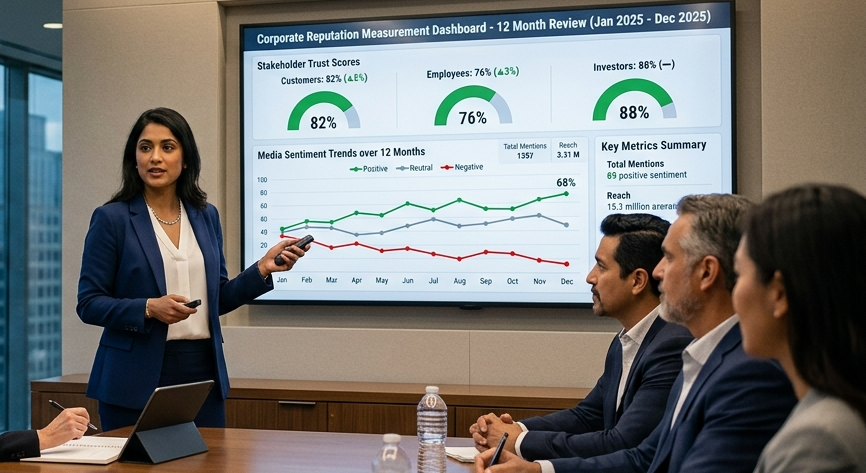
You cannot manage what you cannot measure. The challenge with corporate reputation is that it is inherently qualitative — it lives in the minds and hearts of your stakeholders, not on a spreadsheet.
The most rigorous approach to measuring corporate reputation combines several complementary methods:
Structured stakeholder surveys measure how different audiences perceive your organization across specific dimensions, trust, admiration, good feeling, and esteem are the four dimensions in the classic Fombrun-van Riel corporate reputation framework.
Running these surveys regularly and comparing results over time gives you a clear picture of whether corporate reputation is strengthening or weakening and why.
Media analysis goes deeper than counting mentions. Serious corporate reputation measurement tracks the tone, prominence, and credibility of media coverage.
Coverage in the Wall Street Journal carries different reputational weight than coverage in a local trade publication.
Sentiment analysis of media coverage gives you a real-time indicator of how the information environment around your organization is shifting.
Social listening tools monitor the conversations happening about your organization across social platforms, review sites, forums, and comment sections.
Because these conversations happen without your organization’s involvement, they often reveal more authentic stakeholder perceptions than direct surveys.
Employee surveys are an underused corporate reputation measurement tool. Your employees experience your corporate reputation from the inside.
Their perception of how the organization lives its stated values is often the most accurate indicator of whether your external corporate reputation is built on a solid foundation or a fragile one.
The Corporate Reputation Quotient, developed by Charles Fombrun and Harris Interactive, remains one of the most widely used and academically validated corporate reputation measurement frameworks.
It scores organizations across six dimensions: emotional appeal, products and services, financial performance, vision and leadership, workplace environment, and social responsibility.
Building Reputation Through Strategic Communications
Corporate reputation does not build itself. It requires deliberate, sustained communication that tells your organization’s story accurately, consistently, and through channels your stakeholders trust.
This is where strategic communications partners play a specific and important role. Not every organization needs an external communications firm to manage its corporate reputation.
But organizations that operate under high public scrutiny, elite and executive brands, government agencies, institutions facing regulatory pressure — often benefit from the outside perspective, the media relationships, and the crisis-readiness that a specialist firm provides.
The right communications partner helps you build corporate reputation before you need it.
They develop the message architecture that keeps your communication consistent.
Additionally, they manage your earned media presence in the publications your most important stakeholders read.
They also build crisis protocols before situations arise. And they give you honest, data-driven feedback on how your corporate reputation is tracking over time.
Spred Communications works with organizations navigating exactly these challenges. We focus on strategic communications, earned media placement, and reputation management for clients where the stakes of a misstep are high.
If you are thinking seriously about your corporate reputation strategy, a conversation with a firm that works at this level is a reasonable starting point.
Frequently Asked Questions
What is strategic reputation management?
It is the proactive, long-term process of monitoring how your organization is perceived, building stakeholder trust through disciplined communication, and preparing your organization to respond effectively when a crisis occurs. It is broader and more rigorous than standard PR or reactive crisis management.
How is strategic reputation management different from standard PR?
Standard PR focuses on media placements and communication outputs. Strategic reputation management focuses on perception outcomes, how your key stakeholders actually think and feel about your organization over time. It integrates intelligence gathering, message strategy, earned media, crisis simulation, and ongoing measurement.
What is strategic reputation risk management?
It is the process of identifying the scenarios most likely to threaten your organization’s reputation, assessing their likelihood and impact, and building specific response protocols for each one before a crisis occurs.
How long does it take to build a strategic reputation management program?
A baseline reputation assessment, stakeholder mapping, and initial message architecture can be completed in six to eight weeks. Building the full infrastructure, earned media presence, crisis protocols, monitoring systems, and executive positioning, is a 12- to 18-month effort that then requires ongoing maintenance.
What should I look for in a strategic reputation management firm?
Look for firms with documented crisis experience, senior partner involvement, strong media relationships with the outlets your stakeholders trust, a clear measurement framework, and experience running crisis simulation exercises with clients.
