
The reputation recovery timeline is rarely straightforward, and organizations that underestimate the duration of the crisis recovery often make decisions that slow the process rather than speed it up.
When a corporate crisis hits, the first question most leadership teams ask is not “What do we do?” It is “How long will this take?”
This article breaks down what the research shows about how long reputation rebuilding actually takes, what the key stages look like, and what organizations need to track along the way.
What the Reputation Recovery Timeline Actually Looks Like
The duration of crisis recovery depends heavily on the type of crisis, the speed of the initial response, and whether leadership takes visible corrective action.
What most people do not realize is that the reputational harm almost always outlasts the triggering event itself, sometimes by years.
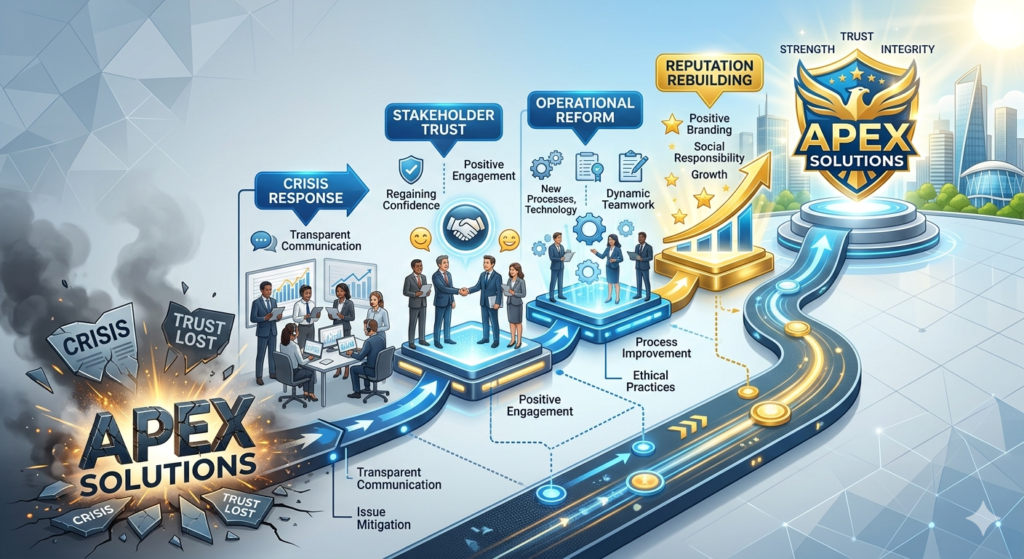
Most organizations move through a rough sequence:
- Immediate stabilization: the first 72 hours
- Narrative correction: weeks one through four
- Stakeholder reassurance: months one through three
- Operational reform: months three through twelve
- Long-term reputation rebuilding: one to three years or more
These reputation repair stages are not always clean or sequential.
External developments, legal proceedings, and shifting media cycles can push an organization backward at any point.
Treating the reputation recovery timeline like a fixed project schedule is, in practice, one of the most common and costly mistakes organizations make.

Reputation Recovery Timeline: The First 72 Hours
The first 72 hours carry weight that most organizations only appreciate in hindsight. Initial public impressions form fast, and they are genuinely hard to reverse once they settle.
During this window, leadership needs to confirm facts, activate crisis response protocols, protect anyone directly affected, and establish clear communication channels.
One tension the research identifies consistently is the friction between legal caution and public transparency. Legal teams often want to minimize disclosures to reduce liability exposure.
Communications teams, on the other hand, understand that silence does not protect; it creates a vacuum, and speculation fills that vacuum quickly.
Organizations that stay quiet too long in the early phase routinely add weeks or months to their overall reputation recovery timeline without realizing it until later.
This is precisely the kind of problem that pre-built crisis infrastructure is designed to solve.
Firms like Spred Global Communications operate on the principle that clients should not be making foundational decisions about messaging and response structure in the middle of a breaking situation.
Having response protocols in place before a crisis means organizations can act with accuracy and speed simultaneously, rather than sacrificing one for the other.
Internal communication also matters more than most leadership teams expect during this window.
Employees who receive no information from their own organization often become unintentional sources of speculation externally.
That dynamic adds unpredictable variables to the trust recovery data organizations are already struggling to manage.
Reputation Recovery Timeline: Brand Restoration Stage by Stage
Stabilization and Initial Response
The stabilization phase typically runs through the first two to four weeks.
During this period, the primary goal is to stop the immediate reputational damage from spreading further.
The brand restoration timeline does not meaningfully begin until misinformation is contained and a consistent message is established across channels.
Crisis recovery metrics at this stage tend to focus on:
- Volume and tone of media coverage
- Sentiment movement on social platforms
- Early customer response signals
- Internal employee morale indicators
Organizations that respond with clear, grounded, fact-based communication during this phase generally move through their overall reputation recovery timeline faster than those that either go silent or issue overly defensive statements that read as blame-shifting.
Narrative Correction and Stakeholder Reassurance
Between months one and three, the focus shifts. The organization is no longer just trying to stop the bleeding; it is actively working to correct the dominant public narrative and rebuild confidence with key stakeholder groups.
Customers, investors, employees, regulators, and partners each need different things, and research has detailed that trust-recovery data across these groups do not move at the same pace or respond to the same signals.
Investors typically want risk disclosures and early indicators of governance reform. Customers want evidence that whatever failed will not affect them going forward.
Employees want honest, direct communication and a sense of operational clarity from leadership.
Trying to satisfy all of these audiences with one message rarely works, and it can quietly extend the duration of crisis recovery in ways that are hard to detect until sentiment data starts to show stagnation.
Operational Reform Phase
This is the phase where the reputation recovery timeline either accelerates or stalls completely.
Organizations that announce reforms without the infrastructure to back them up damage their credibility in ways that are very difficult to walk back.
The research brief is direct about this: public promises unsupported by action make distrust worse, not better.
Operational reform may include:
- Policy changes and compliance system improvements
- Independent audits or third-party investigations
- Leadership restructuring where accountability requires it
- Governance improvements at the board level
- Compensation or remediation programs for those directly affected
None of this happens quickly. The brand restoration timeline during this phase is properly measured in months.
Organizations that rush past genuine reform to reach the reputation-rebuilding phase, because the PR pressure to show progress is high, tend to face renewed scrutiny when the gaps become visible, which they almost always do.
Crisis Recovery Metrics: What Organizations Should Actually Track
One of the more practically useful parts of the research covers what meaningful crisis recovery metrics actually look like.
Many organizations default to tracking media volume, which tells them how much coverage they are getting but not whether the narrative is actually shifting.
Others track short-term customer complaints rather than longer-term retention patterns that reveal whether trust is genuinely returning.
More useful crisis recovery metrics include:
- Net Promoter Score (NPS) tracked across rolling quarters, not just point-in-time
- Employee retention rates during and after the crisis period
- Ratio of positive to negative media sentiment over time, not just total volume
- Customer churn rate compared to the pre-crisis baseline
- Search visibility of negative versus neutral or positive content
- Regulatory relationship indicators, particularly in sectors under formal scrutiny
The benchmarking point matters here. Organizations need pre-crisis data to meaningfully measure recovery.
Without that baseline, it becomes very hard to know whether the reputation recovery timeline is actually progressing or just appears to be.
Trust recovery data needs to be collected continuously rather than at fixed quarterly intervals because public perception can shift quickly in either direction, and organizations that only check in every three months often miss the window to course-correct.
Reputation Recovery Timeline: What Extends the Crisis Recovery Duration
Several factors consistently extend the duration of crisis recovery well beyond what organizations project at the outset.
1. Delayed initial response is the most common. Silence reads as avoidance, and audiences, whether customers, journalists, or investors, respond to it accordingly.
The research consistently finds that communication delays in the early phase are among the primary drivers of extended reputation recovery timelines.
2. Inconsistent messaging across channels is another significant factor. When executive statements contradict legal filings, or when social media accounts say something different from formal press releases, the trust recovery data moves in the wrong direction.
Stakeholders lose confidence not just in the organization’s character but in its basic competence.
3. Overpromising without follow-through extends the duration of crisis recovery in a particularly damaging way.
Organizations sometimes rush their public communications to get ahead of negative coverage, announcing reforms before the operational structures to support them are actually in place.
This approach frequently resets the entire reputation-recovery timeline when the gap between the announcement and reality becomes apparent.
4. Neglecting employees is consistently underestimated as a factor. Employees influence external reputation through their own networks, social accounts, and informal commentary in ways that are hard to track and harder to correct.
Organizations that focus entirely on external communication while leaving their own people without clear information tend to experience a second wave of reputational damage as internal frustration becomes public.
How the Reputation Recovery Timeline Differs by Industry
The crisis recovery duration does not look the same across sectors. In finance, healthcare, aviation, and energy, reputational damage can directly affect operating licenses and regulatory standing.
That adds formal legal complexity to the brand restoration timeline that other industries do not face to the same extent.
In consumer goods and retail, the customer relationship is more direct, which means trust recovery data tends to move faster when organizations take genuine corrective action.
However, social media amplification in these sectors also means negative narratives embed more quickly and more deeply in public memory.
Technology companies face a specific structural challenge. Data-related crises generate negative coverage that stays highly searchable for years.
The reputation recovery timeline for a company that has experienced a data breach frequently runs longer than leadership’s own projections, because the digital record does not fade the way a traditional news cycle does.
Long-Term Reputation Rebuilding: When Does It Actually End?
Honestly, it does not have a clean endpoint.
Reputation rebuilding is a continuous process, and organizations that treat it as a finite project with a completion date tend to relax their standards too early and, usually during the next difficult moment, discover that the foundation they thought they had built was thinner than it appeared.
What successful long-term recovery looks like, according to the research, includes:
- Consistent leadership communication long after the crisis has left the headlines
- Governance structures that demonstrably did not exist before the crisis
- Transparent reporting mechanisms that stakeholders can point to as concrete evidence of change
- Relationships with regulators, partners, and media that have been actively rebuilt rather than assumed to have healed on their own
The organizations that come through crises with stronger reputations than they entered with are not the ones that managed their messaging most skillfully in the first few weeks.
They are the ones who used the reputation recovery timeline as a signal to make substantive improvements in how they actually operate, and then stayed consistent with it long after the immediate pressure had passed.
Key Factors That Shorten the Crisis Recovery Duration
Not every crisis recovery is slow. Several factors consistently shorten the crisis recovery duration in practice:
- Early and accurate communication that establishes credibility before narratives have time to solidify
- Leadership visibility that puts a human face on accountability rather than leaving statements to stand alone
- Independent oversight that provides third-party validation of reform efforts
- Stakeholder-specific communication strategies rather than one-size-fits-all messaging
- Continuous monitoring that lets organizations detect and respond to shifts in public sentiment before they escalate into something harder to manage
Organizations that build crisis preparedness infrastructure before a crisis occurs, through scenario planning, executive communication training, and pre-approved response frameworks, consistently show shorter crisis recovery durations than those responding without any prior structure in place.
The Future of Reputation Recovery Timeline
The reputation recovery timeline is neither fixed nor fully predictable, but it is measurable.
Organizations that track the right crisis recovery metrics, act with accuracy in the early phase, implement genuine operational reform, and sustain transparency over time consistently demonstrate faster trajectories in trust recovery than those treating reputation rebuilding as a communications exercise alone.
The research is consistent on this: actions carry more weight than statements, and what an organization does over the long run determines the outcome far more than any single decision made during the crisis itself.
That is not a comfortable truth for leadership teams under immediate pressure, but it is the one the evidence keeps returning to.