
Some brands seem to grow effortlessly. They show up everywhere, on your feed and in search results; that kind of presence belongs to brands that made a deliberate choice to invest in strategic visibility, and they did it through media marketing agencies.

These firms do not just place ads.
They study audience behavior, match messaging to intent, and engineer presence across the channels that actually influence decisions.
Without that level of precision, even a generous budget tends to produce underwhelming returns.
Therefore, whether you are launching something new or trying to push an existing brand past a growth plateau, the agency you choose shapes what the next chapter looks like.
This article covers how media marketing agencies work, what they genuinely deliver, and what separates the good ones from the ones that burn your budget quietly.
Media Marketing Agencies: Powerful Ways to Drive Brand Growth: Table of contents
- What Are Media Marketing Agencies and Why Do They Matter?
- How Media Marketing Agencies Build Brand Authority
- The 7 Core Services That Drive Powerful Results from Media Marketing Agencies
- 1. Media Planning & Buying
- 2. Digital Advertising on Social, Search, & Display
- 3. Content Strategy and Distribution
- 4. Influencer & Partnership Campaigns
- 5. Performance Marketing & ROI Optimization
- 6. Data Analytics and Audience Segmentation
- 7. Real-Time Campaign Optimization
- Case Study 1 : Dollar Shave Club and the Power of Media Marketing Agencies
- Case Study 2 : Airbnb’s Shift Toward Performance Media
- How to Choose the Right Media Marketing Agencies for Your Brand
- Why Location Matters When Selecting Media Marketing Agencies
- Mistakes Brands Make Without Strong Media Marketing Agencies
- Future Trends Shaping Media Marketing Agencies in 2026 and Beyond
- Conclusion: Why Media Marketing Agencies Are Essential for Brand Growth in 2026
What Are Media Marketing Agencies and Why Do They Matter?
At their core, media marketing agencies plan, buy, and optimize paid and organic media campaigns across digital and traditional channels.
The end goal varies; sometimes it is brand awareness, sometimes lead generation, and sometimes direct conversions, but the discipline behind it stays consistent.
However, reducing these agencies to “ad buyers” misses most of what they actually do.
They build strategies that connect brand messaging to audience intent at scale.
In addition, they carry platform knowledge and technical infrastructure that most in-house teams spend years trying to develop.
The shift in media consumption has raised the stakes considerably.
People no longer gather around television schedules or browse printed publications in the same volumes.
They scroll, search, and stream, and they do it across devices and platforms that behave completely differently from each other.
As a result, brands need partners who understand those environments and can move quickly when they change.
Media agencies, therefore, have become less of an optional upgrade and more of a structural requirement for brands that intend to grow in a crowded, fragmented landscape.
Read Also: High-Stakes Media Interview Preparation: Complete Executive Guide

How Media Marketing Agencies Build Brand Authority
Authority in a market does not arrive through a single campaign.
It accumulates through repeated, relevant exposure across platforms that your audience already trusts.
Media marketing agencies construct that kind of presence deliberately, not randomly.
The process tends to follow a clear logic:
- They identify which platforms hold the highest concentration of your target audience
- They develop messaging that fits the specific behavior and intent of users on each platform
- They secure placements in environments that naturally support brand credibility
- They track performance and recalibrate campaigns when the data signals a shift
Additionally, frequency matters. When an audience encounters your brand consistently across channels they trust, familiarity develops.
Familiarity, when backed by a strong product and clear messaging, eventually converts into trust.
This is the core mechanism through which media marketing agencies move brands from obscure to authoritative.
Social media marketing agencies specialize in this work across platforms like Instagram, LinkedIn, TikTok, and YouTube.
Each platform offers targeting tools precise enough to reach very specific audience profiles.
Therefore, the visibility your brand builds through these agencies is not scattered; it is engineered to land where it counts.
The 7 Core Services That Drive Powerful Results from Media Marketing Agencies
Understanding what marketing agencies in the media marketing industry actually do makes it much easier to judge them correctly.
The following are the seven services that have the most direct correlation with brand growth:
1. Media Planning & Buying
This is the foundation.
The ability to plan effectively is demonstrated by allocating budgets according to where your target audience is actually spending time, not just where it is cheapest.
Media marketing agencies near me, as well as globally, utilize various tools that enable them to access premium inventory without having to pay premium prices.
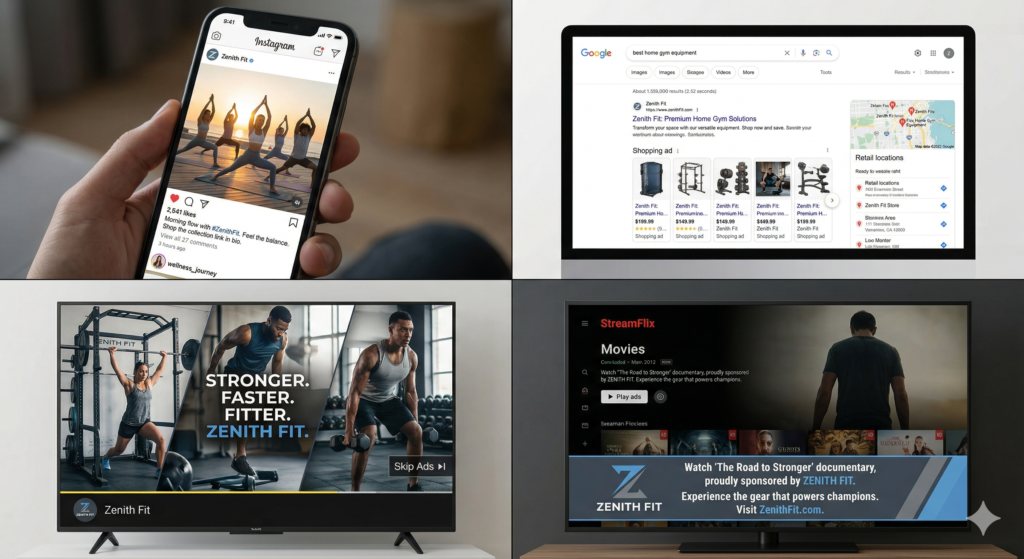
2. Digital Advertising on Social, Search, & Display
- Social Ads: These are utilized to create brand awareness as well as generate interest at the beginning of the customer journey
- Search Ads: These are utilized to reach customers that are already ready to purchase
- Display Ads: These are utilized to keep customers engaged and re-convert them
Digital marketing agencies in New York City, as well as other places, utilize all three simultaneously.
3. Content Strategy and Distribution
Agencies that are worth working with do not simply copy and paste content across platforms.
Rather, they adapt content to fit each platform’s specific format, tone, and expectation.
An article on LinkedIn is not equivalent to a creative on TikTok. As such, content strategy that is effective is one that is built on a per-channel basis.
4. Influencer & Partnership Campaigns
Influencer marketing campaigns are able to reach communities that paid advertising is not able to penetrate genuinely.
The best social media marketing agencies evaluate influencers based on their genuine ability to align with their audience, rather than on their ability to attract clicks with a misleading headline.
5. Performance Marketing & ROI Optimization
Performance marketing is all about results. Campaigns live and die by numbers such as cost per acquisition, return on ad spend, and conversion rates.
The best digital marketing agencies in Houston, as well as other large US cities, use live dashboards to monitor these numbers in real-time.
6. Data Analytics and Audience Segmentation
The agencies that beat the market consistently do so because they base their strategies on data.
These agencies utilize demographic, behavioral, and contextual data to improve targeting and eliminate wasteful spending.
On the other hand, agencies that rely on instinctive decision-making tend to create results that are difficult to understand, not to mention improve.
7. Real-Time Campaign Optimization
For agencies, the traditional method of campaign management, i.e., allocating budgets and reviewing them at the end of the month, is unlikely to get them good results, especially if they are operating in a competitive market.
Therefore, active optimization is the best method, i.e., shifting the budget to what is working, mid-campaign, based on real-time signals.
In this way, the campaign gets better as it goes, not just as the flight ends.
Case Study 1 : Dollar Shave Club and the Power of Media Marketing Agencies
When Dollar Shave Club uploaded its now-famous launch video in March 2012, the response was immediate. The site crashed within hours.
Nevertheless, it is not the viral attention alone that helps create a billion-dollar brand, and this is exactly where the media marketing strategy of the company is worth looking at.
The media marketing agency they worked with designed a multi-channel campaign that combined social advertising with the distribution of the content and the retargeting of the ads. The targeting was very specific, targeting men aged 18-45 years old, reaching them via Facebook and YouTube as well as the display network.
Furthermore, the retargeting aspect of the campaign was also very aggressive, as the people who did not end up subscribing after watching the video were exposed to the brand again on multiple touch points the following day.
This caused the conversion rates to rise significantly above the subscription e-commerce norms of the time.
Unilever acquired Dollar Shave Club in 2016 for $1 billion.
That outcome traced back not to a single clever video but to years of disciplined, data-driven media marketing executed consistently across channels.
Social media marketing agencies in New York contributed meaningfully to scaling the brand’s paid distribution during its fastest growth period.
The lesson holds up: creative work creates attention. Strategic media marketing turns that attention into compounding revenue.
Case Study 2 : Airbnb’s Shift Toward Performance Media
Few brands faced a harder test during the COVID-19 pandemic than Airbnb. International travel collapsed almost overnight. Revenue fell sharply.
However, rather than retreating from media spend entirely, the company worked with media marketing agencies to rebuild their approach from scratch.
The pivot was significant. Broad global awareness campaigns gave way to hyper-local performance marketing focused on markets where domestic travel still existed.
Search ads captured demand from users willing to drive a few hours for a change of scenery.
Meanwhile, social campaigns moved away from aspirational international content and toward featuring unique local properties and road-trip-accessible stays.
Social media marketing agencies in Los Angeles targeted California users looking for weekend escapes within driving distance.
Media agencies in Chicago focused on Midwest audiences open to short regional trips.
Digital marketing agencies in LA reconfigured the visual content strategy for Instagram and Pinterest, where travel inspiration continued to perform even during lockdowns.
Airbnb’s recovery outpaced most analyst expectations.
The company went public in December 2020 at a valuation exceeding $100 billion, a figure that would have seemed implausible just months earlier given the state of global travel.
Their experience makes a point that goes beyond pandemic resilience. Media marketing agencies do not just execute plans.
They help brands find the available market when conditions shift dramatically and execute against it with speed and precision.
How to Choose the Right Media Marketing Agencies for Your Brand
The wrong agency partnership costs more than the retainer fee. It costs time, campaign momentum, and sometimes market position.
Therefore, the selection process deserves a level of scrutiny proportional to what is at stake.
Here is what to examine carefully:
- Proven Track Record Ask for case studies with actual performance data, not testimonials written in vague superlatives.
- Best social media marketing agencies share campaign results without hesitation because the numbers support the narrative. Agencies that resist this conversation usually have a reason for it.
- Industry and Platform Experience Sector familiarity helps. However, deep platform expertise matters more.
For example, knowing how to run TikTok campaigns in theory is different from understanding how content actually performs there in practice. Push for specifics.
- Technical Capabilities: The strongest media marketing agencies operate with advanced analytics stacks, programmatic buying infrastructure, and audience intelligence tools.
Social media marketing agencies in Chicago and social media marketing agencies in San Diego both rely on these systems to reduce wasted spend and make targeting decisions based on data.
- Transparent reporting agencies that report clearly and regularly are agencies that operate with accountability.
Expect structured performance reports that include context, recommendations, and honest assessments of what is and is not working, not just metric dashboards delivered without interpretation.
Communication Structure Know exactly who manages your account from day one. Unclear ownership creates delays. Delays in fast-moving campaign environments cost real money.
Why Location Matters When Selecting Media Marketing Agencies
The assumption that digital marketing makes geography irrelevant is understandable. However, local market knowledge still creates real advantages in many campaign contexts.
Social media marketing agencies in NYC operate in one of the most competitive advertising environments in the world.
That exposure builds a specific kind of strategic sharpness.
Social media marketing agencies near me can offer in-person collaboration, faster turnaround on regional decisions, and access to local creator networks that national agencies cannot always replicate.
Meanwhile, social media marketing agencies in Los Angeles carry deep expertise in entertainment culture, creator-driven content, and lifestyle positioning, knowledge that translates directly into campaign performance for brands in those spaces.
For brands running campaigns across multiple cities simultaneously, partnering with media marketing agencies that hold genuine regional expertise.
Additionally, media agencies in Boston, digital marketing agencies in Houston, and social media marketing agencies in New York, at the same time, create a structural advantage over competitors relying on a single generalist firm.
Additionally, agencies with local market presence often maintain established relationships with regional publishers, media buyers, and content creators.
Those relationships produce better placement quality and more competitive rates than a national agency negotiating from a distance can usually secure.
Mistakes Brands Make Without Strong Media Marketing Agencies
Managing media marketing in-house is a reasonable instinct when budgets are tight. However, the expertise gap tends to surface through mistakes that cost more than the agency fee would have.
Here are the patterns that emerge most frequently:
1. Inefficient Ad Spend Without clear campaign architecture, budget scatters across channels with no coherent allocation logic.
Proper concentration and optimization require both tooling and experience, and most internal teams are still building both.
2. Poor Audience Targeting: An unqualified audience click costs the same as a qualified one. The difference shows up downstream in conversion rates and acquisition costs.
Media marketing agencies apply segmentation tools and data signals that most brands simply do not have access to independently.
3. Inconsistent Brand Messaging Running separate campaigns on separate channels without unified messaging erodes brand identity over time.
Agencies maintain consistency across every placement and every format. That consistency compounds; each exposure reinforces the last rather than contradicting it.
4. No Measurable Growth Framework Without a defined measurement architecture built before campaigns launch, brands accumulate data that answers no useful questions.
As a result, the same allocation mistakes repeat across quarters.
Strong media marketing agencies build the tracking infrastructure first. Everything else follows from that foundation.
Future Trends Shaping Media Marketing Agencies in 2026 and Beyond
The industry moves quickly enough that agency selection today has implications for where you stand two years from now.
Therefore, understanding where media marketing agencies are headed helps brands identify which partners are building for the future and which ones are managing the present.
1. AI and Automation in Media Buying algorithmic systems now handle bidding, pacing, and audience optimization at speeds and scales no manual team can match.
However, strategy and creative judgment still require human expertise.
The strongest media marketing agencies treat AI as infrastructure, powerful but requiring skilled direction.
2. Privacy-first advertising, third-party cookie deprecation, and tightening data regulations are reshaping audience targeting at a structural level.
Forward-thinking media marketing agencies have already started building first-party data strategies for their clients.
Brands that have invested in owned media and community development enter this transition with a significant head start.
3. Creator-led media creators have become platforms in their own right, with loyal, trusting audiences that respond differently to content than they do to traditional ads.
Top social media marketing agencies are building structured creator partnership programs designed to work alongside paid media strategies, not separately from them.
The combination consistently outperforms either approach used in isolation.
4. Omnichannel Integration: Disconnected campaigns across separate channels produce disconnected results and confused audiences.
In 2026, the best media marketing agencies build coordinated strategies that align messaging across search, social, display, email, and streaming simultaneously.
Integration reduces acquisition costs, improves recall, and compounds returns across the full campaign lifecycle.
Conclusion: Why Media Marketing Agencies Are Essential for Brand Growth in 2026
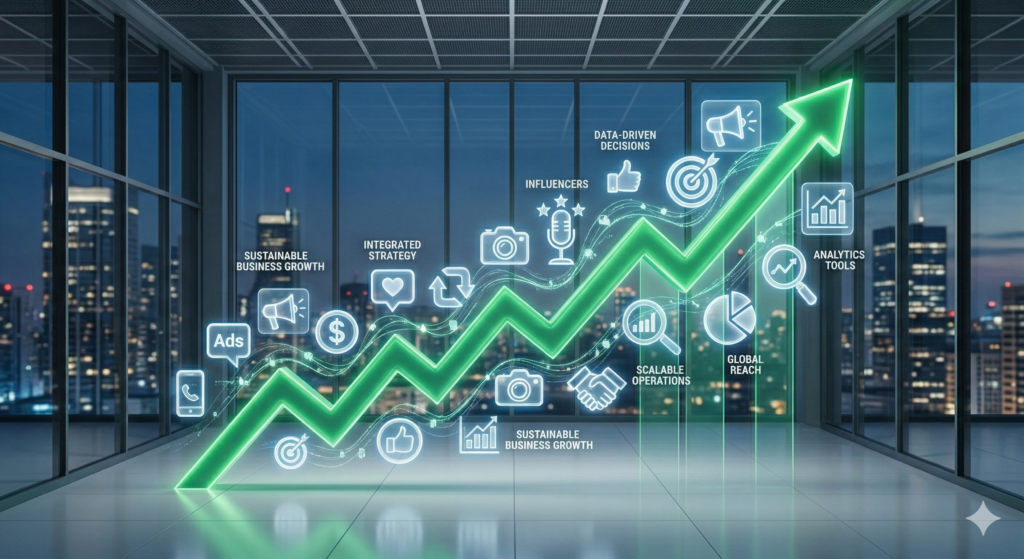
Brands that grow with consistency share a common discipline; they do not leave visibility to chance.
They partner with media marketing agencies that bring together strategy, data, creative execution, and continuous optimization in service of outcomes that are trackable and real.
Therefore, whether you are evaluating media agencies in Boston, digital marketing agencies in Houston, or top social media marketing agencies operating at a national scale.
The right partner for your situation exists.
What separates brands that find them from brands that do not is usually the seriousness of the search, not the size of the budget.
Choose with discipline. Hold agencies accountable to real numbers.
And treat media investment as the strategic foundation it actually is, not a line item to be minimized when quarters get tight.
Your brand’s next stage of growth depends far more on who helps you build it than on how much you spend trying to build it alone.