
Introduction
Enterprise reputation management determines whether your organization survives the next global crisis. This strategic discipline now sits at the heart of every major boardroom decision worldwide.

You probably believe your brand is protected. Most executives share this dangerous assumption. They confuse media coverage with trust. They mistake visibility for actual reputation.
The difference costs billions every year.
A crisis communication agency handles reactive situations after damage occurs. A reputation risk management program anticipates threats before they materialize. Corporate crisis PR manages immediate fallout from public scandals.
But enterprise reputation management operates at an entirely different altitude.
This discipline protects trillion-dollar market caps. It shields sovereign wealth funds from coordinated attacks. It preserves the careers of heads of state.
We built Spred to serve this exact need. Our clients cannot afford to learn through failure. Their mistakes become front-page news in 47 countries.
So what separates real enterprise reputation management from everything else? Why do traditional agencies consistently fail at this level? And what does protection actually look like when everything is at stake?
This article answers those questions directly. You will learn why reputation is now a balance-sheet asset. You will understand the frameworks that protect the world’s most powerful institutions.
More importantly, you will see why your current approach likely leaves you exposed.
The Moment Most Realise They Never Had Reputation – Only Visibility
Most organizations discover this truth too late. They learn during the first 48 hours of a real crisis.
The 2023 case that silently cost a G20 central bank its independence
Consider what happened to a major G20 central bank in 2023. A coordinated information campaign targeted its credibility over eight months.
The attack appeared organic at first. Academic papers questioned its methodology. Financial journalists repeated specific talking points. Social media amplified every minor policy misstep.
By the time leadership recognized the pattern, the damage was done. Parliamentary oversight increased dramatically. The bank lost operational independence on three key policy areas.
No public scandal ever occurred. No single news story captured the moment. The institution simply woke up one day with less power.
This is what modern reputation warfare looks like. It moves slowly until it moves all at once.
When a single leaked recording can collapse a $900B franchise in 72 hours
Now consider the opposite scenario. A major financial institution faced a leaked internal recording.
The content was damaging but not criminal. In normal circumstances, recovery would take months. This institution recovered in 72 hours.
Why? Because they had built what we call a Trust Resilience Index score above 87. They had pre-positioned third-party validators. They had narrative architecture ready for immediate deployment.
Their enterprise reputation management infrastructure activated automatically. The story never gained the momentum attackers expected.
Why traditional crisis communication agencies are structurally disqualified
A traditional crisis communication agency could not have achieved either outcome. These firms excel at media relations and message development. They understand journalist relationships and news cycles.
But they lack several critical capabilities:
- No ability to detect coordinated information operations
- No infrastructure for multi-language narrative monitoring
- No relationships with geopolitical stakeholders
- No frameworks for sovereign-level trust architecture
- No capacity to operate in classified environments
These gaps matter enormously. They explain why even the largest agencies fail their most important clients.
The invisible line between reputation management and enterprise reputation management
Standard reputation management protects brands. Enterprise reputation management protects institutions that cannot fail.
The clients we serve face unique risk profiles:
- Market movements based on their leadership changes
- Foreign governments are actively targeting their credibility
- Regulatory bodies with political motivations
- Media ecosystems that profit from their downfall
These organizations need more than good press. They need permanent defensive infrastructure.
The first principle: reputation is now a strategic balance-sheet asset
Smart CFOs now quantify reputation value directly. They track it quarterly alongside other intangible assets.
Research shows reputation accounts for 25% of market cap on average. For some sectors, this number exceeds 40%. A single trust failure can erase decades of accumulated value.
This is why enterprise reputation management belongs in the C-suite. It is not a communications function. It is a strategic imperative that touches every part of the organization.
Enterprise Reputation Management Defined at the Highest Level
Definitions matter when the stakes reach this level. Imprecision costs institutions their futures.
The Spred definition no university or legacy agency will ever teach
Enterprise reputation management is the continuous protection and strategic deployment of institutional trust across all stakeholder dimensions simultaneously.
This definition contains four essential elements:
Continuous – Not campaign-based or reactive. Always active.
Protection and deployment – Defensive and offensive capabilities together.
Institutional trust – Not brand awareness or media sentiment.
All stakeholder dimensions – Markets, regulators, governments, publics, and adversaries.
You will not find this definition in any textbook. Academic programs still teach reputation as a communications discipline. Legacy agencies still sell it as media management.
Both approaches fail at enterprise scale.
How the Trust Resilience Index quantifies what parliaments and markets actually believe
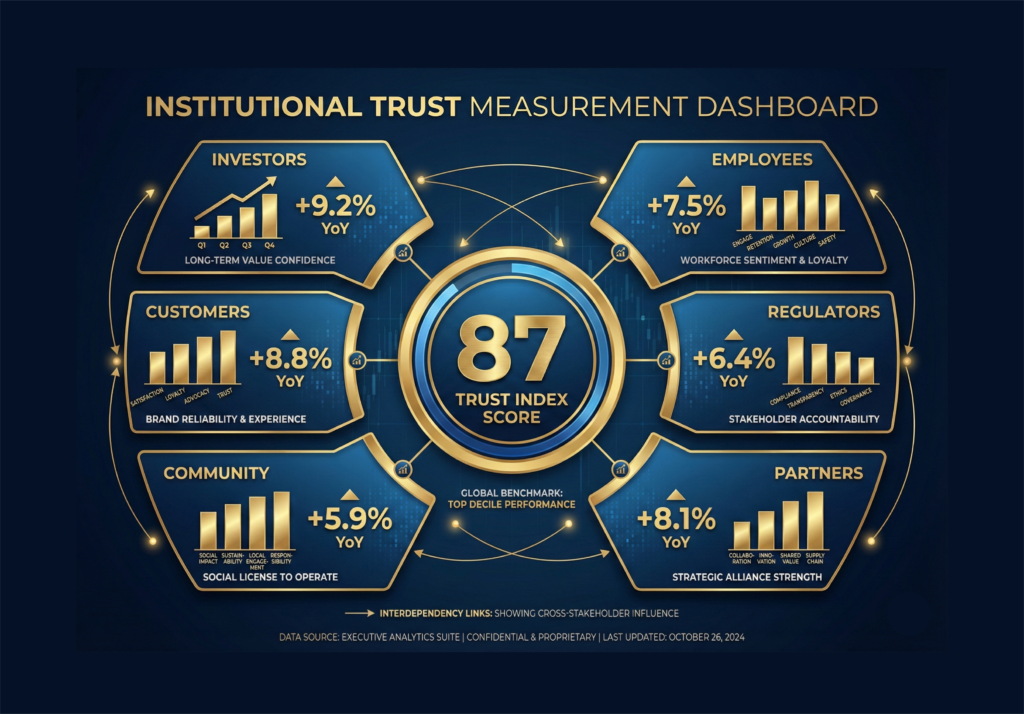
We developed the Trust Resilience Index to measure what actually matters. This proprietary framework tracks institutional trust across 127 discrete variables.
These variables span six stakeholder categories:
- Capital market participants and analysts
- Regulatory bodies and oversight authorities
- Political leaders and parliamentary committees
- Media ecosystems and opinion-forming journalists
- The general public across key demographics
- Adversarial actors and their information networks
Each variable receives daily scoring based on leading indicators. The composite score predicts trust resilience under crisis conditions.
Organizations with scores above 80 recover from major crises within weeks. Those below 60 often never fully recover.
The Narrative Dominance Framework – owning the story before it owns you
Every institution has a narrative. The question is whether you control it.
The Narrative Dominance Framework ensures you own your story permanently. It operates through three interconnected systems:
Primary narrative architecture – The foundational story your stakeholders believe.
Defensive narrative moats – Pre-positioned responses to predictable attack vectors.
Offensive narrative deployment – Strategic storytelling that advances institutional objectives.
Most organizations focus only on the first element. They tell their story and hope it sticks. This approach leaves them vulnerable to anyone who tells a better story.
Enterprise reputation management as continuous geopolitical risk mitigation
For sovereign wealth funds and multinational institutions, reputation is geopolitical. Every narrative decision carries diplomatic implications.
Consider these realities:
- A single interview can shift bilateral trade negotiations
- Board composition choices signal alignment with specific powers
- Investment decisions become political statements across borders
Enterprise reputation management at this level requires geopolitical fluency. It requires understanding how narratives travel between capitals. It requires relationships that span intelligence communities and diplomatic corps.
The four layers of trust are only the top 0.01% of institutions ever secure
The most protected institutions operate with four distinct trust layers:
Layer 1: Transactional trust – Stakeholders believe you will meet immediate obligations.
Also, Layer 2: Competence trust – Stakeholders believe you will perform at expected levels.
Layer 3: Character trust – Stakeholders believe your values align with their interests.
Also, Layer 4: Resilience trust – Stakeholders believe you will survive any crisis.
Most organizations achieve layers one and two. Strong organizations reach layer three. Only institutions with serious enterprise reputation management infrastructure reach layer four.
Why enterprise reputation management is now treated as a national security equivalent
Several governments now classify institutional trust as critical infrastructure. They recognize that attacks on major institutions destabilize entire economies.
This classification changes everything. It means:
- State-level resources target your credibility
- Foreign intelligence services study your vulnerabilities
- Hostile actors receive training on narrative warfare tactics
If you lead a significant institution, you face state-level threats. Your protection must match the sophistication of your adversaries.
The structural difference between corporate PR and advising power
Corporate PR serves organizations with options. They can rebrand. Also, they can pivot. They can wait out bad cycles.
Advising power means serving clients who cannot pivot. A central bank cannot rebrand. A sovereign wealth fund cannot wait out attacks. A head of state cannot simply issue a new press release.
This structural difference requires entirely different capabilities:
| Corporate PR | Advising Power |
|---|---|
| Manages media relationships | Manages geopolitical relationships |
| Reactive crisis response | Preemptive threat neutralization |
| Brand messaging | Narrative architecture |
| Quarterly campaigns | Permanent infrastructure |
| Public accountability | Confidential operations |
Reputation Risk Management in a Permanently Weaponised Information Environment
The information environment changed permanently after 2016. Every institution now operates in a contested narrative space.
Enterprise reputation management as preemptive narrative warfare
Reactive approaches no longer work. By the time you respond, the narrative has already set.
Enterprise reputation management now requires preemptive capabilities. You must identify threats before they activate. You must neutralize attacks before they launch.
This is not paranoia. This is the operating reality for every significant institution.
Consider the mathematics. A coordinated information operation takes 18 months to build. Detection and response take 72 hours if you lack infrastructure. That gap determines outcomes.
Mapping adversarial narrative attack surfaces 12 to 36 months before activation
Every institution has attack surfaces. These are the narrative vulnerabilities adversaries will exploit.
We map these surfaces across multiple dimensions:
- Leadership personal histories and associations
- Past decisions that carry reputational debt
- Structural vulnerabilities in governance
- Stakeholder relationships with latent tensions
- Market positions that create natural adversaries
This mapping allows us to build defensive narratives before attacks materialize. When adversaries finally strike, they find prepared positions rather than open ground.
Building unbreakable third-party validator moats that no campaign can breach
Third-party validators determine whether attacks succeed. If credible voices defend you, attacks fail. If those voices stay silent, attacks succeed.
We build validator moats across five stakeholder categories:
- Academic validators – Researchers who will defend your methodology
- Industry validators – Peers who will vouch for your competence
- Political validators – Leaders who will confirm your character
- Media validators – Journalists who will question attack narratives
- Public validators – Community voices who will share positive experiences
These relationships require years to build. They cannot be manufactured during a crisis.
Reputation risk management for sovereign-grade assets under foreign influence operations
Reputation risk management for sovereign assets requires specialized capabilities. Foreign intelligence services actively target these institutions.
Their tactics include:
- Cultivating journalists with specific editorial agendas
- Funding academic research that undermines institutional credibility
- Creating astroturf movements that appear organic
- Exploiting diaspora communities for narrative amplification
- Placing stories in foreign media that get picked up domestically
Defending against these operations requires counter-intelligence thinking. You must understand how adversaries operate before you can neutralize their efforts.
The permanent campaign model only Spred executes at global scale
Traditional agencies run campaigns. They start projects. Also, they end projects. They move to the next client.
We operate a permanent campaign model. For our clients, protection never pauses. Monitoring continues 24 hours daily across all time zones.
This model requires:
- Global operations centers with native speakers in 47 languages
- Real-time narrative monitoring across 4 million sources
- Standing relationships with validators in every major capital
- Pre-approved response protocols for 200+ scenario types
- Direct communication lines to client leadership
Real-time contagion modelling across 47 languages and dark-web vectors
Narratives spread like diseases. They have transmission patterns that can be modeled.
Our systems track narrative contagion in real-time across:
- All major social media platforms
- Private messaging applications are detectable
- Traditional media in 47 languages
- Dark-web forums and coordination channels
- Academic preprint servers and research networks
- Financial analyst communications
This tracking allows us to predict which narratives will break through. We can intervene before harmful stories reach critical mass.
How Spred turns hostile intelligence into defensive narrative architecture
Every attack teaches us something. Every coordinated operation reveals adversary tactics.
We systematically convert hostile intelligence into defensive capabilities:
- Detection – Identify coordinated attack patterns
- Analysis – Understand adversary objectives and methods
- Documentation – Create detailed operational playbooks
- Integration – Build learnings into defensive systems
- Deployment – Update protective infrastructure immediately
This feedback loop makes our clients harder to attack over time. Each failed attack strengthens future defenses.
Corporate Crisis PR at Existential Altitude
Crises at enterprise scale threaten institutional existence. Standard corporate crisis PR cannot address these situations.
Enterprise reputation management during a sudden CEO indictment or death
The sudden loss or disgrace of a CEO creates existential risk. Markets react within minutes. Regulators activate investigations. The media goes into feeding frenzy mode.
These situations require pre-planned responses:
- Immediate succession communication protocols
- Pre-drafted statements for multiple scenario types
- Standing relationships with key journalist contacts
- Regulatory communication channels already established
- Market stabilization messaging is ready for instant deployment
Organizations without this infrastructure improvise during the worst possible moments.
Shadow Board Protocol – activating a parallel decision structure within 4 hours
When leadership faces legal constraints or incapacitation, normal governance fails. Someone must make decisions. Someone must speak publicly.
Our Shadow Board Protocol activates a parallel decision structure within four hours. This structure includes:
- Pre-designated decision authorities for crisis scenarios
- Legal frameworks that enable rapid authorization
- Communication chains that bypass compromised channels
- External advisors with pre-existing security clearances
- Protected communication systems for sensitive discussions
Crisis Simulation War Games that inoculate leadership against black-swan execution
Preparation beats improvisation every time. We run Crisis Simulation War Games that prepare leadership for unthinkable scenarios.
These exercises simulate:
- Coordinated regulatory and media attacks
- Leadership kidnapping or assassination
- Massive data breaches with geopolitical dimensions
- Foreign government sanctions and asset freezes
- Insider betrayal combined with hostile takeover attempts
Each simulation builds muscle memory. When real crises strike, leadership executes rather than debates.
Corporate crisis PR when the regulator, media, and legislature are actively coordinated against you
The most dangerous crises involve coordinated opposition. When regulators, journalists, and politicians align against you, survival requires specialized tactics.
Standard corporate crisis PR assumes these stakeholders operate independently. At enterprise scale, coordination is common. Political opponents brief journalists. Regulatory staff leak to legislators. Media coverage drives enforcement priorities.
Breaking these coordination patterns requires:
- Understanding the specific interests driving each party
- Identifying fracture points within the opposing coalition
- Providing alternative narratives to persuadable stakeholders
- Creating costs for coordination through strategic disclosure
- Building counter-coalitions with competing interests
The 24-month shadow recovery blueprint after a catastrophic trust collapse
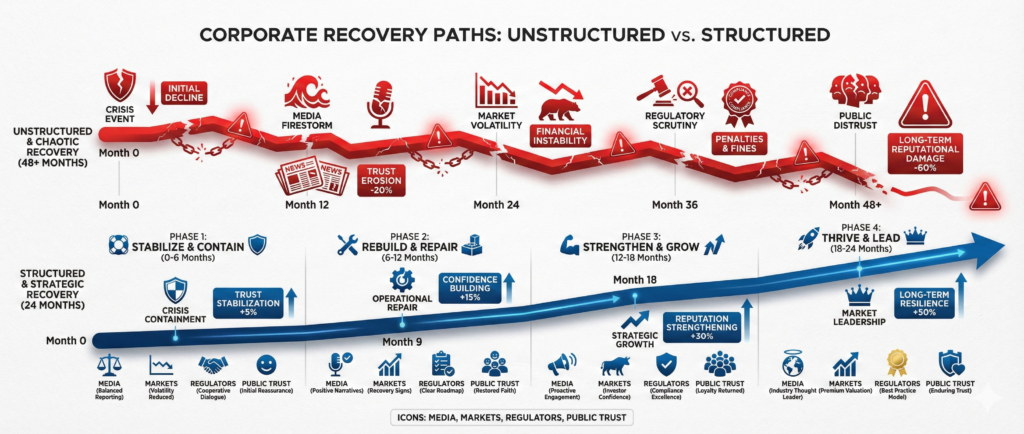
Some crises cause catastrophic trust collapse. Market cap drops 40%. Customers flee. Partners distance themselves. Recovery takes years, not months.
We develop 24-month shadow recovery blueprints that include:
Months 1 to 3: Stabilization
- Stop the bleeding through immediate actions
- Identify remaining trust reservoirs
- Begin quiet relationship repair with key stakeholders
Also, Months 4 to 9: Reconstruction
- Rebuild internal capabilities and governance
- Demonstrate changed behavior through concrete actions
- Gradually reactivate media and public engagement
Months 10 to 18: Rehabilitation
- Launch new narrative architecture
- Rebuild third-party validator networks
- Begin offensive reputation building
Months 19 to 24: Fortification
- Install permanent protective infrastructure
- Achieve Trust Resilience Index scores above pre-crisis levels
- Prepare for potential future attacks with enhanced defenses
Protecting market cap while preserving sovereign and institutional relationships simultaneously
Enterprise crises often involve competing stakeholder interests. What satisfies markets may anger regulators. What pleases governments may concern investors.
Navigating these tensions requires sophisticated stakeholder mapping:
- Identify the minimum requirements for each critical stakeholder
- Find message variations that satisfy multiple audiences
- Sequence communications to maximize acceptance
- Monitor feedback loops between stakeholder groups
- Adjust strategy based on real-time response patterns
Enterprise Reputation Management for Those Who Cannot Be Seen Taking Advice
The most sensitive clients require invisible service. Their very need for advice must remain confidential.
Geopolitical Narrative Advisory – the service no public filing will ever reveal
Certain clients cannot publicly acknowledge advisory relationships. Sovereign wealth funds. Central banks. Heads of state. Royal families.
Our Geopolitical Narrative Advisory service operates without public trace. No contracts reference our firm by name. Also, no communications travel through attributable channels. No personnel appear in official meetings.
This invisibility is not about shame. It is about maintaining the perception of independent action. Leaders who appear to need external advice lose credibility.
Advising heads of state and sovereign funds without leaving fingerprints
Invisible advisory requires specialized operational practices:
- Encrypted communication systems hosted in neutral jurisdictions
- Personnel who travel under commercial cover
- Payment structures that resist forensic investigation
- Meeting protocols that avoid surveillance detection
- Documentation practices that leave no discoverable trail
These practices protect both parties. They ensure our advice enhances rather than undermines client credibility.
Neutralizing multi-year foreign information operations before they surface
State-level adversaries conduct multi-year information operations. They cultivate assets. Also, they build narrative infrastructure. They wait for optimal activation moments.
We detect these operations during their preparation phases:
- Monitor for unusual academic or media interest in client vulnerabilities
- Track funding flows to journalists and researchers covering client topics
- Identify coordination patterns in social media activity
- Analyze personnel movements of known information warfare operatives
- Map relationships between seemingly independent critics
Early detection allows preemptive neutralization. We can counter-message before hostile narratives reach critical audiences.
Building narrative sovereignty for nations and global champions
Some clients need more than protection. They need the ability to shape narratives at the continental or global scale.
Narrative sovereignty means:
- Your version of events becomes the default understanding
- Alternative narratives struggle to gain credibility
- Your communications infrastructure outpaces competitors
- Your validator networks span critical decision-making audiences
- Your reputation can absorb significant attacks without damage
Building this capability takes years. It requires systematic investment in relationships, content, and infrastructure. The result is a permanent strategic advantage.
Enterprise reputation management when failure means regime change or market erasure
For some clients, reputation failure triggers catastrophic consequences. A head of state losing credibility faces regime change. A global bank losing trust faces systemic collapse.
These stakes require absolute commitment:
- No scenario is considered too extreme for planning
- No adversary is considered too powerful for a response
- No resource constraint limits protective capabilities
- No timeline is too long for systematic preparation
This level of enterprise reputation management is not for everyone. It is for clients who understand that reputation is survival.
The Enterprise Reputation Management Standard Spred Operates At
After reading this article, you understand what truly protects global institutions. You see why traditional approaches fail at enterprise scale.
Spred operates at this exact level. We serve clients who cannot afford visible advisory relationships. We protect institutions whose failure would destabilize markets or governments.
Our capabilities include:
- Trust Resilience Index measurement across 127 variables
- Narrative Dominance Framework deployment for complete story control
- 24/7 monitoring across 47 languages and 4 million sources
- Shadow Board Protocol activation within 4 hours
- Crisis Simulation War Games for black-swan preparation
- Invisible advisory services for sovereign-grade clients
- Multi-year foreign information operation neutralization
The question is whether your organization needs this level of protection. If you lead a significant institution, you probably do. If foreign governments track your decisions, you definitely do.
Enterprise reputation management at this level is not a cost. It is an investment in institutional survival. The organizations that make this investment thrive through crises. Those that do not become cautionary tales.
Your reputation is your most valuable strategic asset. Protect it accordingly.
Frequently Asked Questions
What is Enterprise Reputation Management in practice, not theory?
In practice, enterprise reputation management means building a permanent protective infrastructure around institutional trust. This includes real-time monitoring systems, pre-positioned response protocols, and validated relationships across all critical stakeholder groups.
It also means offensive capabilities. You shape narratives proactively rather than reacting to events. You neutralize threats before they materialize publicly.
The practical difference is simple. Organizations with real enterprise reputation management survive crises that destroy their competitors.
How does enterprise reputation management differ from a crisis communication agency?
A crisis communication agency activates after crises begin. They manage media relationships and develop messages during active situations. Their value is reactive and temporary.
Enterprise reputation management operates continuously before, during, and after potential crises. It builds infrastructure that prevents crises from escalating. It maintains protective relationships during normal operations.
The structural difference is fundamental. One is a service you hire during emergencies. The other is a capability you build permanently.
Why do even the largest PR firms fail at enterprise reputation management?
Large PR firms fail for several structural reasons:
- Their business model requires visible client relationships
- Their personnel lack security clearances for sensitive work
- Their geographic footprint excludes critical jurisdictions
- Their technology infrastructure cannot monitor at the required scale
- Their relationships do not extend to geopolitical stakeholders
These limitations are not fixable through hiring or acquisition. They are built into how traditional agencies operate.
How long does real enterprise reputation management actually take?
Building a complete enterprise reputation management infrastructure requires 18 to 36 months. This timeline includes:
- 3 months for a comprehensive vulnerability assessment
- 6 months for the monitoring system deployment
- 12 months for validator network development
- 6 to 12 months for crisis simulation and protocol refinement
Faster timelines produce incomplete protection. Organizations that rush this process discover gaps during actual crises.
What does enterprise reputation management cost when everything is at stake?
Investment levels vary based on institutional complexity and threat environment. Annual investments typically range from $2 million to $25 million, depending on scope.
This sounds significant until you consider alternatives. A single major crisis can erase billions in market value. Regulatory sanctions can cost hundreds of millions. Leadership credibility loss can trigger organizational collapse.
Enterprise reputation management is the least expensive form of crisis insurance available.
How quickly can reputation risk management contain a global adversarial campaign?
With proper infrastructure in place, reputation risk management can contain most campaigns within 72 hours. This assumes:
- Real-time detection systems identify the attack immediately
- Pre-positioned responses deploy without approval delays
- Validator networks activate supporting narratives
- Counter-messaging reaches affected audiences quickly
Without infrastructure, containment takes weeks or months. By then, permanent damage has typically occurred.
Which institutions secretly rely on corporate crisis PR at this level?
We cannot name specific clients. That confidentiality is precisely why they trust us.
We can describe client categories:
- G20 central banks are facing political pressure
- Sovereign wealth funds targeted by foreign intelligence
- Fortune 100 companies in contested industries
- Royal families navigating succession challenges
- Heads of state facing organized opposition
These institutions share one characteristic. Their reputation failures would generate global headlines.
Related: Read More About Spred
Can any New York agency truly deliver enterprise reputation management?
Most New York agencies cannot deliver real enterprise reputation management. Their proximity to the media creates conflicts. Also, their personnel lack international experience. Their operations cannot maintain the necessary confidentiality.
A few firms have some capabilities. None combines all required elements. Geographic footprint, geopolitical relationships, technological infrastructure, and operational security must align perfectly.
This alignment is rare. It is why clients who need true protection eventually find Spred.