
To define sentiment in business terms is to understand the emotional tone behind what people say about you.
It is the difference between knowing what people said and knowing how they felt when they said it.

Public sentiment can make or break a brand overnight. One viral story, one misread policy announcement, one poorly worded statement, and the mood shifts.
When it does, you need to understand exactly what happened and why.
This piece gives you a clear and complete guide to the sentiment definition in marketing, communications, and public affairs.
You will also learn how advanced sentiment analysis works, why it matters for your brand, and how Spred Communications uses it to protect and grow the reputations of executive brands and government agencies.
Define Sentiment: Powerful Meaning Behind Public Reactions: Table of contents
- How to Define Sentiment in Business and Communications
- Defined Market Sentiment and Investor Sentiment for Business Leaders
- Negative Sentiment Override and How to Fix It
- How Spred Communications Uses Sentiment to Protect Your Reputation
- Why You Must Define Sentiment and Act on It
- Frequently Asked Questions
How to Define Sentiment in Business and Communications
Before you can manage public sentiment, you need to define sentiment clearly. The word comes from the Latin sentire, meaning to feel or to perceive.
In business and communications, the sentiment definition is the emotional tone or attitude expressed in a piece of communication or a body of public opinion.
When you define sentiment in a marketing context, you are asking one fundamental question: how do people feel about your brand, your product, your leadership, or your actions?
Sentiment is not the same as opinion. An opinion is a stated view. Sentiment is the emotional charge behind that view.
Someone can say they support your product but express it with frustration. Someone can criticize your company but do so with underlying respect.
Sentiment captures that emotional layer.
According to a 2024 Sprout Social Industry Report, 89% of consumers say they are more likely to stay loyal to a brand after a positive emotional interaction.
Conversely, a single highly negative sentiment event can reduce purchase intent by up to 37% among previously neutral audiences, according to research published by the Journal of Marketing in 2023.
Furthermore, organizations that actively monitor and respond to public sentiment recover from reputational incidents 2.4 times faster than those that do not, according to the Reputation Institute’s 2023 Global RepTrak Report.
Consequently, to define sentiment is not just an academic exercise. It is the foundation of smart reputation management.

Three Types of Sentiment Definition
When communications professionals define sentiment, they typically work with three categories. Understanding each one helps you respond to public reactions with accuracy and confidence.
1.Positive sentiment
This is when public communication about your brand, product, or actions carries an overall tone of approval, enthusiasm, trust, or satisfaction. Positive sentiment builds brand equity over time.
It is what you get when your product consistently delivers, your leadership communicates clearly, and your values align with your audience’s expectations.
2. Negative sentiment
This is when public communication carries a tone of disappointment, anger, distrust, or criticism. Negative sentiment spreads faster than positive sentiment on social media, according to a 2022 MIT study that found negative content receives 70% more engagement than neutral or positive posts.
Understanding where negative sentiment comes from is the first step in addressing it.
3. Neutral sentiment
This is informational communication that carries no strong emotional charge. Neutral sentiment is not a victory, but it is not a threat. However, it often signals a missed opportunity to build stronger positive feelings.
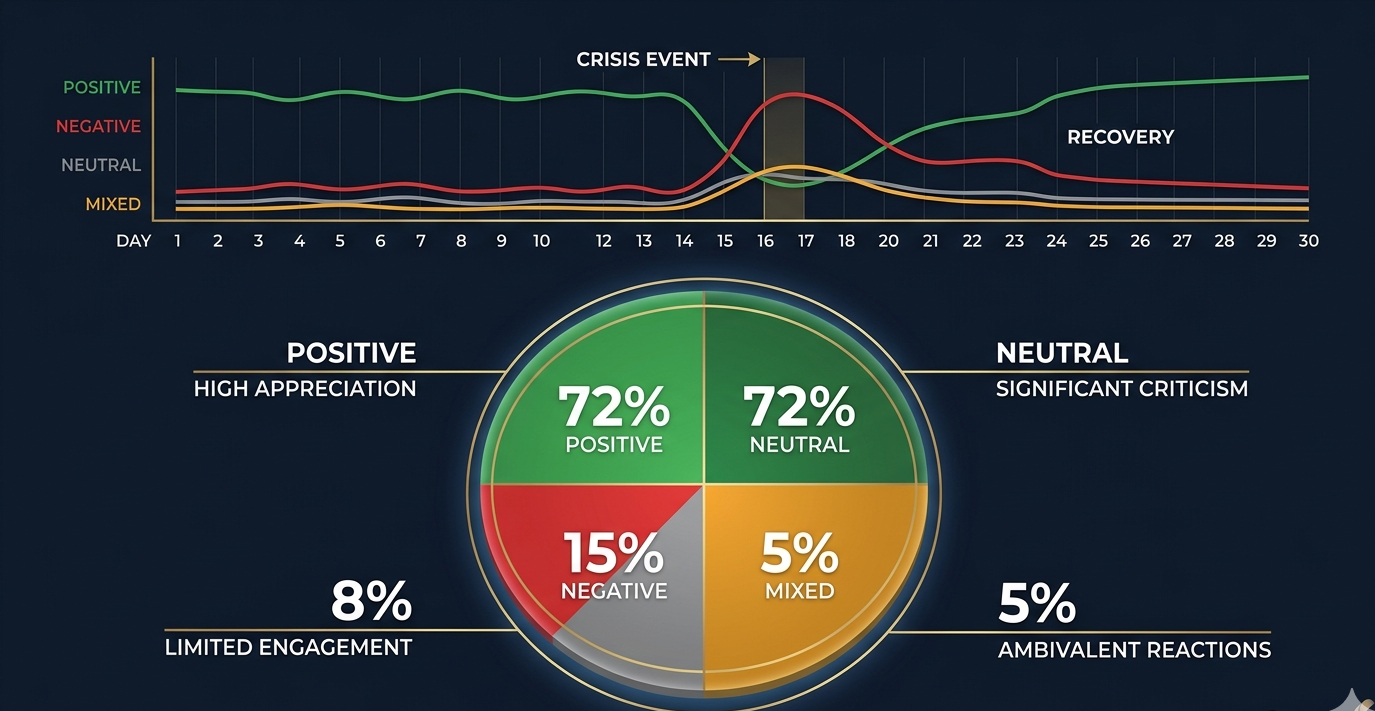
Additionally, communications professionals often define sentiment in a fourth dimension: mixed sentiment. This is when public opinion contains both positive and negative elements simultaneously.
Mixed sentiment is common during a corporate transformation, a leadership change, or a policy shift. It requires careful monitoring and a nuanced response strategy.
Spred Communications tracks all four sentiment types for its clients using advanced analytics tools that monitor millions of data points across social media, news outlets, forums, and review platforms simultaneously.
What Is Sentiment Analysis and Why Does It Matter?
Once you define sentiment, the next step is to measure it at scale. That is what sentiment analysis does.
Sentiment analysis is the process of using data tools, often powered by natural language processing, to automatically classify the emotional tone of large volumes of text. Instead of reading thousands of social media posts manually, sentiment analysis tools scan them instantly and tell you the overall mood of the conversation.
For an executive brand or a government agency, sentiment analysis in marketing and public affairs is not optional.
This is why:
- Your brand generates thousands of mentions every day across social media, news sites, forums, and review platforms. No human team can read all of them.
- Sentiment shifts can be early warning signs of a crisis. Spotting a spike in negative sentiment before it reaches the mainstream media gives you time to respond.
- Sentiment data tells you which audiences feel positively about you and which ones do not. This shapes where you invest your communications effort.
- Sentiment analysis in social media gives you real-time feedback on campaigns, announcements, and policy decisions, so you can adjust quickly.
- Investor sentiment, when tracked properly, can signal risks to your stock price before they become visible through traditional financial metrics.
Spred Communications uses enterprise-grade sentiment analysis tools that track public and investor sentiment in real time. We provide clients with clear, actionable reports that translate raw data into communication decisions.
Defined Market Sentiment and Investor Sentiment for Business Leaders
Two of the most important applications of sentiment analysis in the corporate world are market sentiment and investor sentiment. Both carry serious financial implications.
Both require careful monitoring and proactive management.
When you define market sentiment, you are measuring the overall mood of investors, analysts, and financial media toward a particular asset, sector, or economy.
Market sentiment drives buying and selling decisions that can move stock prices independent of actual company performance.
To define investor sentiment more specifically, you are looking at how institutional and retail investors feel about your company in particular.
Positive investor sentiment attracts capital, supports your stock price, and reduces the cost of borrowing. Negative investor sentiment does the opposite.
Market sentiment and investor sentiment are shaped by factors beyond your financial performance.
They respond to your leadership team’s communication style, your response to crises, your environmental and governance record, and your visibility in the financial media.
This is what that means in practical terms:
- A CEO who communicates clearly and consistently in Bloomberg and the Wall Street Journal builds investor sentiment over time.
- A company that responds poorly to a crisis, or stays silent when the media is asking questions, sees investor sentiment drop sharply.
- Organizations that publish regular thought leadership content in top financial outlets maintain stronger investor confidence through periods of market uncertainty.
- Brands with a strong earned media presence in tier-one business publications consistently outperform peers in investor perception surveys.
Spred Communications manages investor sentiment for its clients by securing consistent, high-authority media coverage in Forbes, Bloomberg, and the Wall Street Journal.
We build executive profiles that reassure investors and position organizations as clear, credible voices in their sector.
Defined Consumer Sentiment and How It Drives Brand Loyalty
Consumer sentiment is the emotional relationship your customers have with your brand. It is built slowly over years of interactions, communications, and experiences, and it can be damaged quickly.
When you define consumer sentiment accurately, you discover things that standard market research misses.
You find out not just what customers think about your product but how they feel about your company as a whole.
You learn whether they trust you, whether they recommend you, and whether a crisis would shake their loyalty or hold it.
Consumer sentiment data also tells you which of your messages land and which ones fall flat. A product launch that generates strong positive consumer sentiment tells you that your positioning worked.
One that generates neutral or negative sentiment tells you something is misaligned between what you said and what your audience heard.
Specifically, this is how the best brands use consumer sentiment data to drive loyalty:
- They monitor sentiment before and after major announcements to measure whether their communication strategy is working.
- They identify the specific audiences where sentiment is weakest and focus communication resources on improving those relationships.
- They use sentiment analysis in social media to spot emerging concerns before they become public complaints or press stories.
- They track competitor sentiment to understand how their own brand compares in the eyes of shared audiences.
- They build their customer communications strategy around the emotional drivers that sentiment data reveals.
Spred Communications builds consumer sentiment monitoring into every client’s communication strategy.
Besides giving you a real-time view of how your audience feels, this data shapes the messages you send, the stories you tell, and the crises you prevent before they start.
Read Also: Government Communication Secrets: Powerful Methods to Win Loyalty
Defined Public Sentiment for Government Agencies and Policy Leaders
Public sentiment is not just a business concept. For government agencies and policy leaders, it is a measure of democratic trust.
When you define public sentiment in a government context, you are asking: how does the public feel about this agency, this policy, this leader, or this decision?
That emotional reading shapes compliance rates, public cooperation, election outcomes, and the legitimacy of governance itself.
Public sentiment toward government agencies is shaped by three main factors.
First, how clearly and honestly the agency communicates. Secondly, how effectively it delivers on its mandate. Additionally, how it responds when things go wrong.
Of these three factors, communication has the most immediate impact on sentiment.
A poorly worded press release, an evasive press briefing, or a delayed response to a public concern can shift public sentiment overnight in ways that take months to repair.
This is what effective sentiment management looks like for government agencies:
- Regular, proactive communication that keeps the public informed before they feel left out of decisions.
- Real-time monitoring of public conversation across news, social media, and community platforms.
- Rapid response capabilities that allow the agency to address negative sentiment before it spreads.
- Transparent crisis communication that addresses concerns directly without deflection.
- Consistent messaging across all public-facing channels so that no part of the agency contradicts another.
Spred Communications works with government agencies to build the communication infrastructure that supports strong, stable public sentiment.
The team includes former government communications directors and public affairs specialists who understand the unique demands of public-sector reputation management.

Negative Sentiment Override and How to Fix It
If you have spent time in digital marketing or customer relationship management, you may have come across the term negative sentiment override.
It describes a state where a customer’s negative emotional experiences consistently override their positive ones, creating a permanent bias against a brand regardless of improvements.
Negative sentiment override is one of the most serious reputational conditions a brand can face.
It means that no matter what you do right, your audience filters it through a lens of distrust. The good news is that it is reversible, but only if you address it directly and with a long-term communication strategy.
To define negative sentiment override in practical terms, your audience has accumulated enough negative emotional experiences with your brand that positive interactions no longer register at full weight.
A 2022 study by the Harvard Business Review found that it takes an average of 12 positive brand experiences to overcome the impact of one significant negative one.
Correcting negative sentiment override requires:
- An honest audit of what caused the negative sentiment in the first place.
- A public acknowledgment of the problem, where appropriate, with a clear commitment to improvement.
- Consistent positive communication over an extended period through channels your audience trusts.
- Earned media coverage in top-tier outlets that reframes the brand narrative.
- Ongoing sentiment monitoring to track whether the recovery is working.
Spred Communications has helped clients navigate negative sentiment override by building long-term reputation recovery strategies that combine honest communication, tier-one media placement, and continuous sentiment tracking.
The take a data-driven approach to recovery and does not declare success until the numbers show it.
How Spred Communications Uses Sentiment to Protect Your Reputation
You cannot manage what you cannot measure. That is why sentiment analysis sits at the core of everything Spred Communications builds for its clients.
The firm tracks public sentiment, investor sentiment, consumer sentiment, and media sentiment simultaneously. This gives clients a complete picture of how the world sees them at any given moment.
When sentiment shifts, Spred’s team acts immediately. The firm does not wait for a crisis to become a headline.
It identifies emerging sentiment threats early and addresses them before they escalate.
This is what working with Spred on sentiment management looks like in practice:
- Real-time sentiment monitoring across social media, news outlets, financial platforms, and community forums.
- Weekly and monthly sentiment reports that translate data into clear communication priorities.
- Rapid response playbooks built for specific sentiment scenarios, from a product controversy to an executive misstep.
- Earned media strategy that consistently builds positive sentiment through tier-one coverage in Forbes, Bloomberg, and the Wall Street Journal.
- Executive communication coaching that ensures your leadership team’s public statements support strong, stable sentiment.
Furthermore, Spred’s approach to sentiment management is always connected to your broader reputation strategy.
Sentiment data does not live in a silo. It informs your messaging, your media placements, your crisis protocols, and your long-term brand story.
Overall, when you define sentiment as a strategic priority, you unlock a level of reputational intelligence that most organizations never achieve. Spred Communications helps you get there.
Why You Must Define Sentiment and Act on It
To define sentiment is to understand one of the most powerful forces shaping your brand’s future. Public reactions, investor confidence, consumer loyalty, and community trust all live in the emotional layer of communication.
Organizations that ignore sentiment operate blind. They are always surprised by crises that the data would have predicted.
They miss opportunities to strengthen relationships when audiences are already leaning positive, and take longer to recover when things go wrong.
The organizations that define sentiment clearly, monitor it consistently, and act on it proactively are the ones that build lasting authority and trust.
Spred Communications gives you the tools, the expertise, and the media access to make sentiment work for your organization. From real-time monitoring to guaranteed tier-one media placement, we build the communication infrastructure that keeps your reputation strong.
Frequently Asked Questions
How do you define sentiment in marketing?
In marketing, you define sentiment as the emotional tone behind what your audience says and feels about your brand. It goes beyond opinion to measure the underlying feelings that drive consumer behavior.
What is the difference between sentiment and opinion?
An opinion is a stated view. Sentiment is the emotional charge behind that view. Sentiment analysis captures the feeling behind the words, not just the words themselves.
What is negative sentiment override?
Negative sentiment override is a condition where accumulated negative experiences create a permanent emotional bias against a brand. Research shows it takes approximately 12 positive experiences to overcome one significant negative one.
How does sentiment analysis work in social media?
Sentiment analysis in social media uses natural language processing tools to scan large volumes of posts, comments, and mentions and classify each one as positive, negative, or neutral. This gives brands a real-time view of public mood.
How does Spred Communications use sentiment data for its clients?
Spred monitors public, consumer, investor, and media sentiment in real time. The firm uses this data to guide communication strategy, identify emerging risks, and build proactive responses before negative sentiment escalates into a full reputational crisis.