
Crisis simulation training is essential for executives. It builds crisis preparedness through cybersecurity, PR, financial, legal & safety scenarios.
In the dynamic business world we live in today, crisis simulation training has taken a major leap forward. In fact, crisis preparedness is now an integral mission-critical element of executive development programs around the world.

Today’s business world is facing unprecedented crisis threats from all sides. These include sophisticated cyber attacks, viral social media scandals, supply chain failures, and even regulatory investigations.
Crisis management is no longer just about crisis response planning. Today’s executive must learn to make critical decisions in the midst of crisis. Crisis management requires the executive to manage crisis response teams across departments.
This article will discuss the five most critical crisis simulation training programs that every executive must learn. Including: Cyber Security Breach Response & Reputation Management. Financial Disruption, Legal Challenges, and Health Emergencies are equally critical.
Crisis Simulation Training: The Ultimate Resilience Breakthrough: Table of contents
- Why Executives Need Crisis Simulation Training
- 1. Cybersecurity Breach Crisis Simulation Training
- 2. Reputation & PR Crisis Preparedness Simulation
- 3. Financial & Operational Crisis Simulation Training
- Tools: Dashboards, Scenario Modeling
- 4. Legal & Compliance Crisis Simulation Training
- 5. Health & Safety Emergency Crisis Simulation Training
- How to Implement Crisis Simulation Training in Your OrganizationStep-by-Step: Planning, Execution, Debriefing
- Measuring Success of Crisis Simulation Training
- Conclusion
Why Executives Need Crisis Simulation Training
However, while executives may understand crisis management theory, nothing prepares them for actual high-stakes situations like hands-on practice.
Here’s why crisis simulation training is essential for executive teams:
- Complexity – Crisis situations in today’s world are marked by simultaneous crisis threats. Therefore, executives need to be aware of how to navigate these crisis situations.
- Legal – Executives can avoid legal sanctions by demonstrating commitment to crisis simulation training.
- Financial – Executives can minimize losses by 38% in cases of breach and 52% in cases of regulatory issue.
- Improve Team Coordination – Simulations improve team cooperation to help cross-discipline coordination in crisis situations.
- Practice Under Pressure – Simulations simulate stress and the rigors of leadership.
- Reveal Hidden Strengths – Crisis simulation training can help leaders discover their weaknesses before a real crisis occurs and is a catastrophe for the business.
In order for managers to be well prepared for emergencies, they need to be trained in various types of crises that may arise in a complex business environment of today.
Therefore, the following five types of crisis simulation training will guide executives in preparation for and response to multiple crises which may occur between 2022 and 2026.
These Simulations outlined will enable executives to enhance leadership skills and be prepared for crises :
1. Cybersecurity Breach Crisis Simulation Training
What It Involves: Phishing, Ransomware, Data Leaks
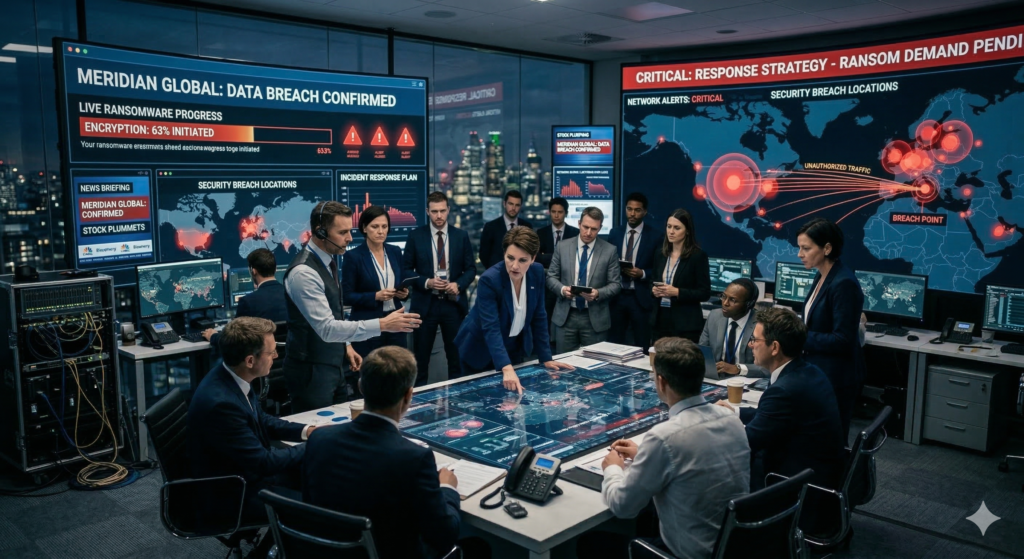
In a cybersecurity breach crisis simulation training, executives are prepared for a realistic scenario where a cybersecurity breach occurs. The realistic scenario includes a ransomware attack on key systems and data leaks.
Phishing campaigns targeting executives are sophisticated and a major part of these simulations. In these simulations, executives make quick decisions on shutting down key systems and communicating with key stakeholders.
At the same time, their IT team works on containing the damage.
Executives navigate realistic challenges like determining ransom payment decisions. They decide which stakeholders to notify first strategically. The simulation balances transparency with legal obligations under pressure.
Today’s business world is facing unprecedented crisis threats from all sides. These include sophisticated cyber attacks, viral social media scandals, supply chain failures, and even regulatory investigations.
Real-World Examples and Stats
The importance of cybersecurity crisis preparedness cannot be emphasized enough.
Cybersecurity Ventures has reported that global cybercrime costs will hit astronomical figures in the future.
For example, $10.5 trillion annually by 2025, which is equivalent to wealth transfer of monumental proportions.
IBM published its 2022 Cyber Resilience Report, which reported alarming statistics. For example, 60% of corporate boards underestimate cybersecurity risks.
This puts companies at risk of attacks they never imagined could happen to them.
The impact of lacking crisis preparedness training is huge on companies that lack such training.
For example, average breach costs exceed $4.35 million, according to IBM. Also, average time to identify and contain breaches is 277 days.
Benefits for Executives: Rapid Decision Making and Risk Awareness
A cybersecurity crisis simulation training program is essential in building critical decision-making skills.
In other words, executives can make quick decisions even if they lack complete information at hand.
This is an essential skill in crisis situations that can arise in any organization.
Executives realize that isolated IT-related crises can cause widespread problems such as reputation loss, regulatory breaches, and financial loss.
In addition, PwC published its 2023 Global Digital Trust Insights report, which provided convincing evidence that organizations that regularly run cybersecurity crisis simulations
Related: Crisis Communications Planning: Frameworks on How to Prevent Disasters
2. Reputation & PR Crisis Preparedness Simulation
Scenarios: Social Media Backlash, Scandal Management
In reputation crisis management simulations, executives are put through a public relations crisis situation. A controversial statement goes viral, and there is an immediate backlash from consumers.
Product defects or issues related to executive conduct can put entire brands at stake. These are real-world crisis management practice scenarios that condense weeks of crisis situation fallout into a single exercise.
Executives have to respond and manage stakeholders and brand equity, all while keeping an eye on continuous social media feeds running in real-time.
Additionally, they have to manage Instagram backlash from thousands of customers, respond to investigative journalism scandals, and manage investor panic, among other scenarios. Managing employee morale during a public scandal is equally challenging.
Key Skills Developed: Communication, Stakeholder Management
According to the 2023 Edelman Trust Barometer, there are critical expectations from CEOs and executives that have to be met.
In particular, 61% of consumers worldwide expect CEOs to personally respond to brand crises. This makes communication competence absolutely non-negotiable for today’s executives.
Reputation crisis management simulation training allows executives to develop several key skills simultaneously.
Executives can develop crisis management team coordination competence. Moreover, they can also develop authentic communication competence under intense crisis.
Case Study: Executives Who Managed Crises Successfully
Johnson & Johnson’s management handled the 2022 talc case litigation successfully. The executives who received extensive training in crisis preparedness performed well. They formed different subsidiaries, communicated effectively, and kept all stakeholders informed.
In addition, their preparedness through crisis simulation training allowed them to act in unison. This helped preserve stakeholders’ trust despite the multi-billion-dollar lawsuits they encountered.
Maersk’s management also appreciated the 2023 supply chain crisis response. They received simulation training for years to prepare for the effects. They communicated with customers in advance about substantial delays.
3. Financial & Operational Crisis Simulation Training
Situations: Sudden Revenue Loss, Supply Chain Disruptions
Financial crisis simulation training for executives simulates survival situations. Large customers suddenly go bankrupt, wiping out 40% of the company’s revenue. Essential suppliers experience devastating factory fires, halting all production immediately.
The training includes authentic constraints such as low cash flow. Existing debt agreements, anxious shareholders, and worried employees concerned about layoffs. The executives face difficult choices about resource allocation and restructuring.
The crisis preparedness strategy included in the training is just like real-life situations. It is an exact representation of real-life situations with no perfect information available. All decisions are trade-offs.
Executive Takeaways: Prioritization, Resource Allocation
McKinsey’s 2022 Risk and Resilience report revealed strong results. Specifically, 70% of executives identify supply chain disruptions as influencing their decisions.
Operational crisis simulation training solves this problem by ruthless prioritization.
Attendees create frameworks for rapid resource allocation under pressure. They learn to separate survival from positioning.
Executives learn to make decisions with 60% of desired information.
Deloitte’s 2023 Crisis Management Insights report reveals outstanding results. Executives who underwent financial simulation training made allocation decisions 43% quicker. They sustained superior results during actual crises faced.

Tools: Dashboards, Scenario Modeling
Essential tools needed in Financial crisis preparedness today:
- Real-Time Dashboards – This is similar to actual financial crisis management software, which allows executives to grasp financial information under extreme pressure.
- Scenario Modeling – This tool allows executives to simulate the impact of any decision they make, such as the effect of spending cuts on customer acquisition.
- Financials – Executives can see the effect of changing payment terms on the firm’s liquidity with this tool.
- AI-Driven Analytics – This tool revolutionizes the simulation process by allowing executives to efficiently process hundreds of scenarios within a short time frame.
- Predictive Capabilities – This tool allows executives to make the best decision before resource allocation during actual crises.
4. Legal & Compliance Crisis Simulation Training
Focus: Regulatory Breaches, Lawsuits, Ethical Dilemmas
In legal crisis preparedness simulations, corporate leaders are immersed in situations where they have to deal with various regulatory investigations.
Whistleblowers sue corporations, and ethical dilemmas threaten corporate integrity.
In this crisis simulation training, corporate heads are tasked with dealing with information from their legal team, which sometimes translates into complex issues.
Board members call on corporate leaders to immediately come up with a solution, and newspapers file a series of charges against corporations.
Corporate leaders must be calm and manage multiple response efforts.
How Executives Benefit: Risk Mitigation, Decision Accountability
As the SEC revealed in its 2022 Annual Enforcement Report, corporations face massive fines and penalties. In fact, corporations pay $4.2 billion in fines and penalties.
It also shows that corporate failures to adhere to a code of conduct have huge consequences for corporations. Corporate leaders can understand the personal responsibility in training in legal crisis simulations.
In addition, they learn to judge and understand their lawyers and report violations. The corporate leaders begin to realise what to look for in terms of transparency and privilege.
The 2023 Global Crisis Management Survey of PwC yields compelling facts about corporate crisis management. A company with a well-established compliance simulation program reduces regulatory fines and penalties by an average of 52% compared to a company that did not.
Futhermore, risk management in emergencies now requires understanding multiple regulatory regimes across the world. For EU citizens, data privacy breaches are a source of domestic SEC disclosure obligations.
Law can also have implications regarding supply chain labor practices.
These multi-jurisdictional difficulties facing modern executives increasingly become present in simulations
5. Health & Safety Emergency Crisis Simulation Training
Situations: Workplace Accidents, Natural Disasters, Pandemics.
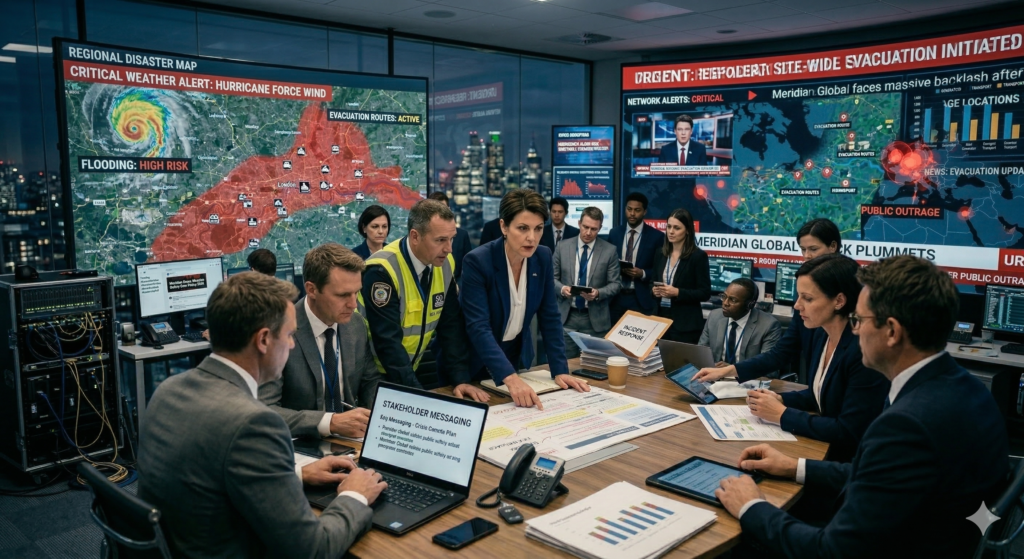
Simulations of disaster health and safety crisis preparedness are excellent for executive preparation. Spills of chemicals, for example, may call for facility evacuations as hurricanes approach the facility.
Active shooter scenarios and infectious diseases also present threats.
Crisis prepredness trainings for health and safety crises creates a sense of urgency, distinguishing between life safety crises and other types of crises.
The World Economic Forum’s “Global Risks Report for 2023” identifies the risks. Natural disasters and health crises are ranked as top five risks.
Executive Response: Crisis Coordination, Evacuation Planning
Simulations for health emergencies are highly effective for developing crisis coordination skills for the executive. Executives can coordinate the crisis responses of the fire department, the emergency medical services, and other agencies.
At the same time, they coordinate crisis responses within the organization. The COVID-19 pandemic was a stark reminder of the catastrophic consequences of inadequate crisis preparation.
Organizations whose executives are prepared for a pandemic crisis can pivot much quicker, 3.5 times quicker, compared to those without prepared executives, as research shows.
How to Implement Crisis Simulation Training in Your OrganizationStep-by-Step: Planning, Execution, Debriefing
- Conduct Risk Assessments – First identify where your organization is at risk in terms of major vulnerabilities and highest priority areas.
- Build Custom Simulations – Create realistic simulations for your industry, geography, and/or business environment.
- Develop Cross-Functional Teams – Develop crisis teams with executive teams, communications specialists, lawyers and managers.
- Schedule Strategically – Schedule exercises when full executive attention is available without distractions.
- Conceive and Debrief – Simulated with professional help, then decision making, and interpretation.
Recommendations for Executives
Crisis simulation training must be carried out regularly and not as one-off events. Industries that are highly risky must conduct major crisis simulation exercises twice annually as a minimum.
Organizations that are less risky must conduct comprehensive crisis preparedness exercises at least once annually.
If your executive team has experienced significant turnover and new people have joined your executive team, then you must conduct crisis simulation training exercises as soon as possible.
If your CEO has not been involved in crisis simulation training exercises, then your organization is highly vulnerable and must conduct crisis simulation exercises as soon as possible.
Using External Facilitators vs. Internal Teams
Your organization must consider various strategic options when choosing between using external facilitators and Internal Teams
Many organizations adopt hybrid approaches for optimal results achieved. External facilitators design and lead major annual simulations effectively.
Internal teams conduct quarterly tabletop exercises maintaining crisis preparedness continuously.
Measuring Success of Crisis Simulation Training
KPIs: Decision Time, Team Coordination, Communication Clarity
Effective crisis preparedness programs require rigorous measurement beyond satisfaction surveys. Key performance indicators should include decision-making speed metrics.
In addition to decision quality, crisis team coordination, and communication clarity.
Advanced organizations employ AI-powered analytics tracking metrics across simulations. They measure whether executives improve rapid response performance over time.
Feedback Loops and Continuous Improvement
Strategic crisis planning improves through systematic feedback integration always. After each simulation, collect input from participants and observers
And analyze decisions made during exercises, identifying organizational vulnerabilities.
Compare simulation performance to actual crisis responses when occurring. Organizations serious about crisis preparedness create formal processes continuously. Simulation insights inform policy updates, training refinements, and modifications.
Conclusion
The five crisis simulation training programs outlined represent essential preparation. As business environments grow increasingly volatile between 2022 and 2026, questions change. Organizations will face crises; executives must respond effectively.
Also, crisis preparedness through realistic simulation builds muscle memory successfully. It develops crisis team coordination capabilities and creates organizational resilience.
Additionally, executives who practice demonstrate measurably superior performance during emergencies.
They respond faster, communicate more clearly, and maintain stakeholder confidence. The investment in comprehensive crisis simulation training yields returns exceeding costs.
In other words, organizations that prioritize outperform competitors during disruptions significantly.
They recover faster from setbacks and build reliable reputations. Start integrating these simulations into your executive development today. The crisis your organization faces tomorrow demands preparation now.
Don’t wait for actual emergencies to discover readiness gaps. Invest in strategic crisis planning that transforms vulnerabilities into strengths. Ensure your executives lead confidently under pressure when stakeholders need it most.