

A global communications firm ensures your brand does not exist only in your home market, but exists wherever someone searches your name, reads about your organization, or forms an impression based on what they have heard.

That reality changes everything about what you need from a communications partner. A firm that handles your domestic media well but has no real capability beyond your borders is not enough.
Not when your investors span continents, your regulators watch from multiple capitals, and a story that breaks in one market can reach every market within hours.
A global communications firm fills that gap. However, not every firm that claims to be global truly is.
Some have offices in multiple countries but lack deep local expertise. Others apply uniform strategies, overlooking cultural and media differences critical to international communication.
This article gives you a clear, practical guide to what a real global communications firm does. Why the distinction between global presence and global capability matters enormously, and what to look for when you choose a firm to represent an organization that operates, or wants to operate, across borders.
Global Communications Firm that Drives Powerful and Exclusive Brand Power: Table of contents
- What a Global Communications Company Does for You
- How to Choose the Right Global Communications Firm
- What Makes Spred Communications a Credible Global Partner
- How to Find a Global Communications Firm That Delivers
- Frequently Asked Questions
- What does a global communications company do?
- How is a global communications firm different from an international PR network?
- What should I look for when choosing a global communications Company?
- Why does cross-cultural communication matter for global brands?
- Can a global communications partner help government agencies with international communication?
What a Global Communications Company Does for You
A global communications firm does more than place your story in international media. It builds and protects your organization’s reputation across multiple markets simultaneously.
Each market has its own media culture, regulatory environment, political dynamics, and audience expectations. Managing all of them at once, coherently, is the core challenge.
That is fundamentally different from domestic communications work. At home, you manage one media landscape, one regulatory audience, and one primary language.
Globally, you manage many of each, simultaneously, and often in response to the same news event breaking across markets in real time.
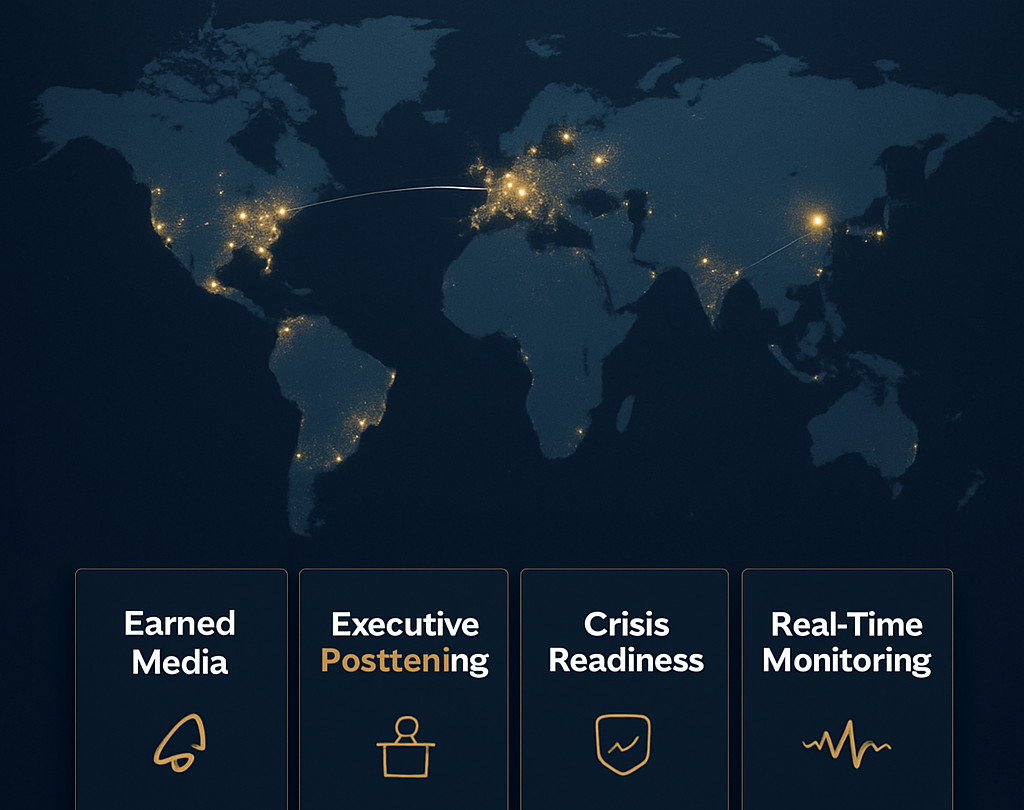
Specifically, a serious global communications firm provides:
- A multi-market media strategy that identifies the right outlets, journalists, and editorial angles for each geography your organization operates in.
- Cross-border message consistency – keeping your core narrative coherent even as it is adapted for different cultural contexts and audience expectations.
- International crisis communications capability, with teams who can respond across multiple markets simultaneously when something goes wrong.
- Executive positioning in different regional media markets, so your leadership is visible and credible beyond your home country.
- Stakeholder mapping that accounts for the different institutional relationships your organization needs in each market.
- Global media monitoring and sentiment analysis that tracks how your organization is perceived across languages, platforms, and geographies in real time.
Additionally, organizations with a coordinated global communications strategy are 3.1 times more likely to maintain consistent brand trust scores across markets. This is compared to those managing communications on a market-by-market basis without central coordination.
Consequently, choosing the right global communications firm is a strategic decision with measurable financial and reputational consequences.

Global Communications vs. International PR Network
When you search for a global communications firm, you encounter two very different types of organizations that both claim international capability.
The first type is a true global communications firm. An integrated organization with a unified global team, shared strategy processes, consistent quality standards, and full accountability for outcomes.
One team owns your strategy and coordinates execution across geographies, taking responsibility for all results.
The second type is an international PR network. This is a loose affiliation of independent agencies in different countries that have agreed to refer work to each other under a shared brand or association name.
When you brief an international PR network, you are often dealing with multiple independent businesses with different ownership, different processes, different quality standards, and different levels of commitment to your success.
The difference is significant in practice.
- A true global communications firm gives you one strategic lead who owns your global account. An international PR network gives you a domestic lead and a series of local contacts who may have never worked together before your mandate.
- A global communications firm runs consistent measurement and reporting across all markets. An international PR network often produces fragmented reports with incompatible metrics.
- A global communications firm can deploy a coordinated crisis response across multiple markets within hours. An international PR network depends on individual firm relationships and response times that vary widely by location.
- A global communications firm develops shared knowledge of your organization, your sector, and your communication style across its whole team. An international PR network starts largely from scratch in each new market.
When you evaluate any global communications firm, ask directly. Is this a unified organization or a network of affiliates? The answer will tell you more than any pitch deck about what your experience will actually be.
Global Communications Trends Shaping the Industry Right Now
The environment in which a global communications firm operates is changing faster than at any previous point in the industry’s history.
The key trends help you evaluate whether a prospective firm is genuinely prepared for the current landscape, or still operating on assumptions that no longer hold.
The first major trend is the shift toward earned trust over paid visibility. Audiences in every major market are growing more skeptical of advertising and more attentive to editorial coverage, peer reviews, and leadership communication.
The global communications firms winning today are those with genuine editorial relationships, the kind that produce credible third-party coverage rather than purchased placement.
The second trend is the growing importance of executive visibility internationally. A 2024 Weber Shandwick study across 23 countries found that CEO and senior leader communications now account for an average of 46% of an organization’s global reputation score.
Accordingly, global communications firms that invest in executive positioning across multiple markets deliver meaningfully stronger outcomes than those focused purely on brand-level messaging.
The third trend is real-time global intelligence. A story that breaks in Singapore at midnight can be in the Wall Street Journal by morning. A social media conversation that starts in Brazil can reach global institutional investors by afternoon.
Companies with real-time monitoring across languages and platforms can protect clients in this environment.
The fourth trend is full communications integration. Organizations with the strongest global reputations have stopped treating earned media, owned content, internal communications, and crisis response as separate disciplines.
They run them as one integrated strategy. The best global communications firms build and manage this integration deliberately for their clients.
Read Also: Marketing Companies Known for Bold Growth and Authority
How to Choose the Right Global Communications Firm
The selection process for a global communications firm deserves more rigor than most organizations apply to it.
A polished pitch and a long list of client logos are not reliable indicators of whether a firm will actually perform in your specific markets and for your specific challenges.
Here is a structured process that gives you a much more accurate picture:
- Define your geographic priorities first. Not every global communications firm has genuine depth in every market. Identify the three to five geographies that matter most to your current and near-term strategy. Then evaluate firms specifically on their capability in those markets, not on the total length of their office list.
- Assess real local market depth. Ask each firm to describe the actual team and editorial relationships they have in your priority markets. Who specifically manages your account in each country? What is their background? Which journalists do they have genuine working relationships with, and how recently?
- Test their global coordination model. Ask how the global communications firm coordinates strategy and execution across markets. Request a specific example of a cross-border campaign or crisis they have managed. Who was accountable? How were decisions made? What was the outcome?
- Ask about cross-cultural communication capability. Different audiences interpret identical messages differently. Ask how the firm adapts core messages for different cultural contexts without losing their essential meaning or contradicting the global brand narrative.
- Evaluate their measurement framework. Ask how they track and report outcomes across all geographies consistently. Can they show you a sample global reporting dashboard? What metrics do they use beyond clip counts?
- Check their international crisis credentials. Ask specifically for examples of cross-border crises they have managed. Which markets were involved? What was the timeline of response? What were the measurable outcomes?
Besides these six steps, pay close attention to how the firm talks about your markets during the pitch.
A global communications firm with genuine knowledge will reference specific media dynamics, political contexts, and audience behaviors relevant to your situation.
Global Communications for Government and Institutional Clients
Government agencies, multilateral institutions, and public-sector organizations face a communications challenge that commercial brands largely do not.
They must build trust and credibility across multiple national audiences simultaneously, often in politically sensitive or diplomatically complex situations where a single misstep can damage relationships that took years to build.
A global communications firm serving government and institutional clients needs capabilities that go well beyond standard corporate communications:
- Public diplomacy communication: building understanding and goodwill for a government’s positions and programs across international audiences that may be skeptical or openly hostile.
- Multilateral stakeholder engagement: managing communication with international bodies, foreign governments, and global civil society organizations with different mandates and different expectations.
- Regulatory and policy communications: translating complex policy positions into clear, accessible narratives for diverse international audiences without losing technical accuracy.
- Crisis communication in politically sensitive environments: managing reputational situations where diplomatic and political dimensions are as important as the media ones.
- Internal alignment for international teams: keeping large, geographically dispersed workforces connected to institutional values and strategic priorities across language and time zone barriers.
Additionally, government and institutional clients require a global communications firm that understands the specific protocols, accountability structures, and constraints of public-sector communication.
Commercial PR tactics do not automatically translate. The firm needs direct experience in this environment.
Spred Communications has worked with government and institutional clients navigating exactly these challenges.
We bring the sector experience, discretion, and the international media relationships that high-stakes public-sector communications require.
Building a Global Communications Strategy That Actually Works Across Borders
Many organizations have a global communications strategy in name only. It is a domestic strategy with translations attached.
That approach almost always underperforms, because it assumes audiences in different markets respond to the same messages in the same ways. They do not.
A global communications strategy that actually works starts from a clear set of universal organizational truths, things that are genuinely true about your organization regardless of where it operates.
Then it develops market-specific interpretations of those truths that resonate with local audiences without contradicting the global message.
Here is what a working global communications strategy looks like in structural terms:
- Global message architecture: a hierarchy of core messages that all markets draw from, ensuring fundamental consistency across geographies without rigidity in local execution.
- Market adaptation guidelines: clear parameters for how local teams can adapt global messages to fit local cultural, regulatory, and media contexts without undermining brand coherence.
- Global media strategy: identification of international outlets – Reuters, the Financial Times, Bloomberg, the Wall Street Journal, that reach cross-border audiences, alongside market-specific tier-one targets in each priority geography.
- International crisis protocols: pre-built response workflows that account for the time zone, language, regulatory, and political differences that make cross-border crisis response so demanding.
- Global measurement framework: consistent metrics across all markets that allow you to track whether your global communications strategy is achieving its objectives and compare performance across geographies over time.
Overall, a global communications firm that helps you build this kind of strategy from the ground up is worth far more than one that simply executes local media pitches in multiple languages under the same invoice.

What Makes Spred Communications a Credible Global Partner
Spred Communications works with Fortune 500 companies, government agencies, and senior executives who need their communications to perform beyond their home market.
Our approach to global communications is built on a straightforward principle. Genuine market expertise matters more than the length of an office list.
Spred invests in the editorial relationships, the cultural knowledge, and the real-time intelligence capability that allow it to serve clients navigating complex international environments.
We guarantee placement in Forbes, Bloomberg, and the Wall Street Journal, outlets that reach the cross-border audiences most relevant to its clients.
Additionally, Spred brings direct experience in crisis communications, government affairs, and strategic reputation management across markets where the stakes of getting communication wrong are highest.
For organizations evaluating a global communications firm, Spred is a serious option to include in that process. The firm is direct about what it does well and honest about where it is the strongest fit.
How to Find a Global Communications Firm That Delivers
A global communications firm earns its value by doing something genuinely hard. Building and protecting your organization’s reputation consistently across markets with different media cultures, different political environments, and different audience expectations, all simultaneously.
The firms that do this well share consistent qualities. They have real depth in the markets that matter most to you, not just a website presence in those cities.
Also, they run integrated strategies rather than disconnected local campaigns and measure outcomes consistently across geographies.
They bring genuine cross-border crisis capability for the situations that are hardest to manage without preparation. When you evaluate global communications firms, use the six-question framework in this article. Push past the global office list and the impressive client logos.
Ask the questions that reveal whether a firm’s international capability is real or mostly a compelling pitch.
Your brand’s reputation does not stop at your home border. Your communications strategy should not be either.
Frequently Asked Questions
What does a global communications company do?
A global communications firm builds and protects your organization’s reputation across multiple international markets simultaneously. It provides multi-market media strategy, cross-border message consistency, international crisis communications, executive positioning, and global media monitoring.
How is a global communications firm different from an international PR network?
A global communications firm is a single integrated organization with a unified strategy, consistent quality standards, and full accountability for outcomes across all markets. An international PR network is a loose affiliation of independent agencies. The difference is significant in terms of strategic consistency, crisis response speed, and day-to-day account management.
What should I look for when choosing a global communications Company?
Evaluate firms on their genuine depth in your priority markets, their cross-border coordination model, their cultural adaptation capability, their measurement framework, and their documented experience managing international crisis situations with specific outcomes.
Why does cross-cultural communication matter for global brands?
Different markets interpret identical messages differently because of cultural, political, and historical context. A global communications firm with genuine cultural expertise adapts your messages without losing their essential meaning or contradicting your global brand narrative.
Can a global communications partner help government agencies with international communication?
Yes. Government agencies and multilateral institutions have specific needs, including public diplomacy, multilateral stakeholder engagement, and cross-border crisis communication. The best global communications firms have direct experience in these areas, distinct from their commercial brand communication work.