

In a world where we are constantly seeing ads, earned media is really hard to come by. When you pay for an ad, people might see it.
When other people say good things about you, that is what really makes you look good.
The thing is, people are getting tired of seeing many ads, and they do not believe them as much as they used to.

So it is really important to understand why people trust what others say about a company rather than what the company says about itself, especially if you want to build a brand that will be around for a long time.
What Is Earned Media?
Earned media is when people talk about a company or a product without being paid to do so. This can happen in a lot of ways.
They might write about the company or product in a newspaper or magazine.
This is really people sharing their own thoughts and opinions about a company or product.
This can be very powerful because people are more likely to trust what other people say about a company or product than what the company says about itself.
Earned media refers to publicity gained through promotional efforts other than paid advertising. This includes press coverage, journalist interviews, podcast features, industry awards, and organic social media mentions.
Unlike advertising, earned media cannot be purchased directly—it must be earned through newsworthiness, relevance, or expertise
Furthermore, these placements build media trust through editorial validation.
Read More : Corporate Storytelling Strategy: How to Build Powerful Brand Trust
3 Exclusive Ways Earned Media Strengthens Trust: Table of contents
- What Is Earned Media?
- What Is Advertising?
- Earned Media vs Advertising: Key Differences
- 3 Ways Earned Media Builds Media Trust (That Advertising Can’t)
- 2. Earned Media Shapes Reputation Through Narrative, Not Promotional Claims
- 3. Earned Media Feels Discovered Rather Than Sold: Bypassing Psychological Resistance
- Why Trust in Advertising Has Declined: Making Earned Media More Essential
- Why Advertising Still Matters (But Can’t Build Media Trust)
- How to Use Earned Media to Build Media Trust
- PR Strategies That Increase Earned Media and Media Trust
- Common Mistakes That Undermine Media Trust
- The Future of Earned Media vs Advertising: Why Media Trust Matters More
- Conclusion: Why Media Trust Can’t Be Bought
What Is Advertising?
Advertising is paid communication designed to persuade audiences toward a specific action or perception. Brands control the message, timing, placement, and creative execution.
When you see a sponsored post, a banner ad, or a television commercial, your brain immediately recognizes it as biased information.
Therefore, while advertising excels at reach and repetition, it struggles to build the deeper media trust that influences high-stakes decisions.
Consequently, it builds awareness but cannot create foundational credibility.

Earned Media vs Advertising: Key Differences
Upon recognizing the true difference between advertising and earned media, it becomes obvious that trust through these respective media channels differs.
Essentially, there are the following distinctions:
1. Credibility vs Visibility: Advertising optimizes visibility through paid placement. This optimizes credibility through editorial selection.
Advertising interrupts;earned media attracts through relevance.
2. Long-Term Impact vs. Short-Term Exposure: While advertising efforts yield quick yet fleeting results, earned media provides a snowball effect that grows over time.
Press coverage secured three years ago can still have an impact today, while an ad campaign run yesterday is forgotten.
3. Cost Structure vs. Value Creation: Relying on a constant stream of ad budgets limits advertising, but paid media also generates lasting content that continues to earn public trust long after publication.
Thus, the role of earned media and advertising differ fundamentally from a strategic point of view.
This constructs the reputation architecture, whereas advertising only activates awareness in the architecture.
3 Ways Earned Media Builds Media Trust (That Advertising Can’t)
While advertising can buy attention, it cannot purchase belief.
Earned media operates through three distinct mechanisms that create authentic media trust mechanisms that advertising cannot replicate regardless of budget or creative execution.
1. Earned Media Transfers Institutional Credibility Through Third-Party Validation
The fundamental difference between earned media and advertising revolves around the concept of credibility transfer.
When Bloomberg picks you as a company or TechCrunch covers you, they’re actually transferring their credibility to you.
Additionally, credibility of the media does not come from making claims but from the organization that validates those claims.
How Institutional Trust Transfer Works:
Journalists are professional gatekeepers. Before publishing any information, they verify it, conduct interviews, and determine whether the information they receive is worthy of publication.
This multi-level accountability does not exist in advertising. Because of this, consumers become more trusting because the publisher has already vetted the information.
The Psychology of Authority Bias:
Studies have shown that people have media trust and put more credibility in information provided by persons or institutions they recognize as authorities.
The Edelman Trust Barometer survey found that journalists were ranked amongst the highest in credibility, while brand executives and advertisers were considered some of the least trusted professionals.
This trust differential results in a gap that bridges earned media and advertising efforts, a gap that no other medium or advertising tool can achieve.
Moreover, the effect of authority bias is cumulative.
While one mention of earned media can create initial credibility, several mentions in different prestigious publications create the illusion of industry agreement.
Why Advertising Cannot Replicate This:
In the case of advertising, the action skips the system of sharing media trust altogether since the consumer immediately knows that the message is false due to the brand’s influence.
This is evident from the study by the Pew Research Center that showed the large gap in consumer trust of editorial vs. sponsored stories.
So, earned media’s inherent credibility cannot be bought through paid media.
2. Earned Media Shapes Reputation Through Narrative, Not Promotional Claims
The second difference is in information framing and assimilation.
The difference here is that, while earned media relies on a narrative approach for reputation building, advertising relies on a claim-based approach for persuasion.
Therefore, this difference will influence information assimilation differently.
Story vs. Slogan: The Narrative Advantage:
When a person reads a feature article about the way your company approaches a solution to a problem in an industry, they are not being marketed to; they are being taught.
Moreover, the theory of narrative transportation tells us why stories stay with people while commercials are forgotten: people are immersed in the stories. Immersion is more effective in the formation of memory than the repetition of claims.
How Long-Form Journalism Creates Cognitive Media Trust:
Earned media in respected publications generally consists of:
- Multiple sources and perspectives that provide balanced reporting
- Specific evidence used that renders the claims concrete • Context and comparison used to help the audience understand the significance of what is being discussed
- Nuance and complexity that demonstrate depth rather than superficiality
This results in the formulation of “cognitive media trust,” which is, the belief in the accuracy, completeness, and dependability of the information provided.
It is impossible for advertising in the form it takes to provide the complexity required for such cognitive elements.
The Compounding Effect of Repeated Coverage:
Additionally, earned media creates reputation through the accumulation of stories. This contrasts with the repetition of messages in other ways of reaching the public.
When Forbes tells the story of the funding round, TechCrunch tells the story of product innovation, and Bloomberg quotes the CEO, the public makes sense of all these stories.
This type of organic reputation building creates media trust that repetitive advertising messages cannot substantiate in any way.
Hence, the second means through which earned media generates better media trust is by a narrative-based reputation building.
3.Earned Media Feels Discovered Rather Than Sold: Bypassing Psychological Resistance
The third important difference deals with psychological reception, and this explains how earned media works because it generates discovery psychology, while ads trigger persuasion resistance.
The Persuasion Knowledge Problem:
When people encounter advertising, they immediately activate “persuasion knowledge,” recognizing that someone is trying to influence them.
Therefore, people approach advertising in a way that is both skeptical and critical.
In contrast, earned media positions your brand within an informational context that feels discovered rather than pushed.
The reader sought out the article, the journalist chose the angle, and the brand appears as part of a larger story. This discovery framing bypasses persuasion resistance entirely.
How Search Behavior Reveals Discovery Bias:
Research shows that humans will only trust what they feel they have found on their own more than what they are interrupted by.
In the sense that, if your company were to pop up in the results for a query that the reader typed into a browser, such as “what are the best cybersecurity solutions?” the reader will have a sense that they have found that information.
In addition to that sense, the reader will also have a sense that they have chosen
Why Organic Validation Beats Paid Persuasion:
Also, the signal of being earned media can be enjoyed. This is in the sense that being picked up by the media represents a form of endorsement for a company.
Additionally, the fact that it is not in the exchange of money for information makes this mode different.
The average individual is exposed to between 4,000 and 10,000 advertisements on a daily basis.
This high level of exposure has accustomed brains to be immune to promotional content. On the other hand, this cuts through this immune response.
Therefore, the third manner by which earned media achieves the third way of building media trust is through the aspect of discovery psychology.
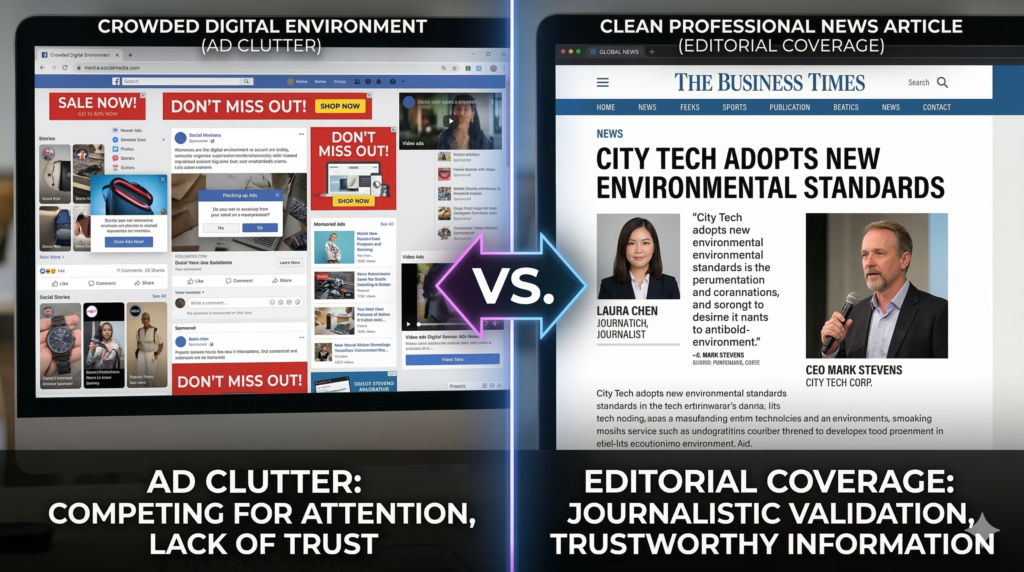
Why Trust in Advertising Has Declined: Making Earned Media More Essential
The lack of trust in advertising arises due to three key issues that have correlated with each other. Therefore, media earned has emerged as being ever more important in terms of building media trust.
1.Ad saturation and banner blindness overwhelm audiences daily, training their brains to subconsciously ignore ads. Meanwhile, earned media cuts through the clutter because editorial selection signals relevance.
2. Native Advertising Confusion : There has been confusion with sponsored content, as it resembles editorials, leading to skepticism among readers. However, this earned press from trusted publications has a higher trust level due to the brands associated with them. Therefore, there is an increase in requests for labeled editorials.
3. Influencer Skepticism: This type of partnership leads to negative consumer responses. On the other hand, earned media uses transparent editorial processes that sustain media trust.
Why Advertising Still Matters (But Can’t Build Media Trust)
Despite its limitations in generating credibility, advertising has a special function to play in the overall plan.
Advertising advances in effective messaging and rapid outreach. But advertising works best for reinforcing messages of credibility already built.
A founder who has appeared in a Forbes article has the capacity to leverage this with ads on LinkedIn that feature this media coverage.
Advertisements cannot create foundational levels of trust with media, but advertising does enable activation of trust that earned media produces.
The most sophisticated brands actively harness this dynamic—building credibility through PR and amplifying it through advertising.
How to Use Earned Media to Build Media Trust
What Makes a Brand Worth of Earned Media Coverage?
Earned media opportunities result from a brand’s genuine value to a publication’s audience. Hence, to earn a media outlet’s trust, there are three required conditions:
- Newsworthiness: original research, industry firsts, or timely responses that create a real news value
- Relevance: connection to topics that the publication is already writing about
- Audience Value: information that is useful to readers for decision-making purposes
Brands that approach PR seeking visibility without offering substantive value rarely earn meaningful coverage.
Conversely, those who lead with insight build sustained media trust through repeated validation.
PR Strategies That Increase Earned Media and Media Trust
How to Amplify Earned Media for Maximum Media Trust
Three strategic approaches consistently generate high-credibility earned media:
1. Thought Leadership Placement Position executives as subject matter experts by providing informed opinions.
When your CEO becomes the go-to source for journalist questions, compounding media trust comes with each quote.
Moreover, this continuous validation creates ongoing media opportunities.
2. Data-Led Story Creation Original research or industry surveys create natural news hooks.
Furthermore, data-driven media provides better media credibility due to the fact that numbers feel objective and not promotional.
3. Founder Visibility and Transparency: Personal stories provide human-interest angles that emotionally resonate and portray humanizing elements of authenticity to the media.
In addition, founder-driven media creates brand associations that are memorable and cannot be replicated by advertising.
Once secured, earned media becomes a long-term asset when properly leveraged:
- Website Credibility Sections: Include “As Featured In” sections with links to articles
- Sales and Investor Materials: Add third-party validation that resonates better with third-party credibility
- Social Proof Usage: Leverage media trust by using owned channels to amplify articles.
The idea is that earned media represents a constant stream of validation.
As such, the amplification strategy increases the overall media trust factor many times over.
Common Mistakes That Undermine Media Trust
Even high-end corporations negatively impact media trust opportunities through fundamental PR misapprehensions:
1. Treating PR like advertising PR messaging or tone of voice that is too prescriptive or too promotional in its expectations undermines the independence that gives PR media trust benefits.
2. Over-Controlling Messaging Too much legal analysis and corporate talk result in a lack of authenticity.
Two facets on which media trust is based are the presence of human voices rather than corporate voices.
Excessive control in messaging leads to the loss of credibility differentials between earned media and advertising.
3. Chasing Logos Instead of Relevance: A deeply relevant feature in a trade publication often delivers more media trust than a superficial mention in a mainstream outlet.
Furthermore, relevance drives audience engagement more than publication prestige.
The Future of Earned Media vs Advertising: Why Media Trust Matters More
Three emerging trends indicate that earned media will become more important while facing challenges with regard to advertising:
1. AI Content Saturation With the proliferation of AI-generated contents online, the established publishing houses with a system of editing would gain more importance as gatekeepers.
Therefore, media earned from credible sources would be more credible than advertising, which might attract more skepticism.
2. Increasing Demands for Verification Issues surrounding misinformation are prompting consumers to seek information channels with verification.
On the other hand, unverifiable or sponsored information is becoming less potent.
3. Increased Value of Trusted Publishers As a result of commoditized distribution, editorial credibility is more likely to provide the differentiation.
Consequently, the gap between earned media and advertising is likely to grow, not close.

Conclusion: Why Media Trust Can’t Be Bought
The fundamental difference between earned media and advertising actually comes down to validation structure, where advertising enables brands to say whatever they want to say about themselves, while earned media forces entities to decide that rather than the individual brand.
Smart brands understand that better copywriting does not solve trust.
Instead, media trust is a validation issue that brands solve by earning media recognition and creating real value.
As such, where advertising creates the awareness to generate transactions, this creates the reputation ground on which these transactions take place.
In a marketplace where everyone can buy visibility, earned media stands out as the channel in which people have to earn their credibility.
And that, in turn, is why this ultimately yields great media trust. The choice couldn’t be clearer: invest in lasting credibility, not temporary visibility.